Who was Mike Millard and why I have to do with Pink Floyd
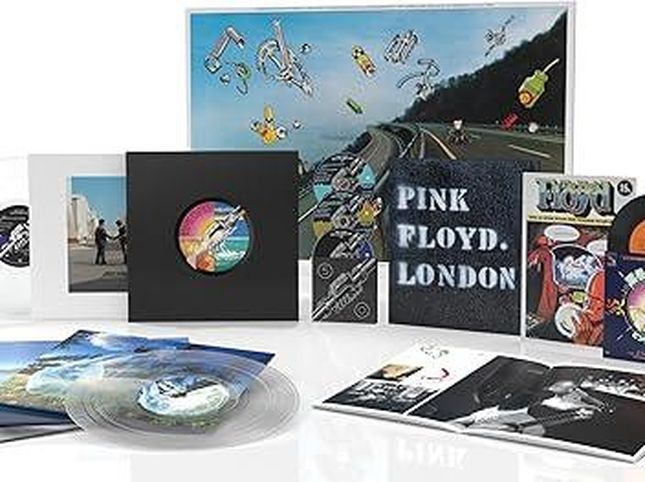
On the occasion of the publication of “Wish You Were here 50”the important new record release of Pink Floyd, designed to celebrate the 50th anniversary of the album “Wish you were here”Sony Music (here for the preorder) has decided to enrich the event with a cheap gem anything but obvious: the recording of a 1975 concert, precisely that at the Sports Arena in Los Angeles, held on April 26. The band performed for five consecutive evenings in that room, from 23 to 27 April, recording five sold-outs.
In the official archive of the Pink Floyd, however, there is no professional recording of the 1975 tour, a series of shows held between April and July of that year, concluded two months before the album release “Wish you were here”published in England on September 12, 1975. At this point a significant decision was made: to privilege, compared to the quality of a mixer recording, that of an audio engraved on a fans, in practice a bootleg, but of excellent quality. A similar choice had already been made by the King Crimson, who have made official several “pirate” records made by the public, as well as Bob Dylan and Neil Young, just to mention other illustrious names.
Mike Millard went down in history for making numerous unauthorized engravings in the Los Angeles area, where he lived, introducing his equipment in the concerts in a way that will be explained later. All the bands that performed in that area in the seventies were immortalized on a ribbon by the best known “taper” of the world. Millard has gained respect and admiration in the world of illegal recordings, especially for Rolling Stones and Led Zeppelin concerts (the latter also used parts of his recordings in official outings), but also Jethro Tull, Genesis and Emerson, Lake & Palmer.
The official bootlegs of Pink Floyd
In fact, it is not the first time that Pink Floyd publishes similar material. For some years, probably in view of future uses, they have made official even in digital version some amateur recordings made by fans around the world. Already in the famous box “The Early Years 1965–1972” However, for the first time on official support, an excellent quality recording was included, carried out by a enthusiast with semi-professional equipment (coil recorder and two environmental microphones), during the concert in Stockholm on September 10, 1967. In that case, however, the taper had agreed before the concert with the band, who had not placed any veto to recording, intended for private use. Only years later the Pink Floyd decided to buy that tape and to include it in the 2016 box. The situation is very different with this new recording: the substantial difference is that Mike Millard, in 1975, made the ribbon hidden, unbeknownst to the band.
The choice of Mike Millard’s ribbon relating to the 1975 concert was not accidental. On July 6, 2021, in fact, the online version of Rolling Stone USA He published an article on the recent discovery of an upgrade of the already known recording of that concert, thanks to the discovery of the original digitized master’s degree in 2020. The journalist Andy Greene concluded the article as follows: “If the Pink Floyd ever decide to create a bootleg series, they should get their hands on Millard’s Masters, starting from this Los Angeles concert of 1975.” No sooner said than done.
Mike Millard was not a simple enthusiast: he earned estimate and respect among the collectors for the quality of his recordings. Known with the nickname “Mike the Mic” – a game of words between his name and the term “microphone” – he created, between 1973 and 1992, about three hundred illegal recordings, all of excellent quality, most of the Sports Arena in Los Angeles. He had no commercial purposes: his purpose was not to sell recordings or provide them to Bootleg manufacturers, even if some of his engravings were used without his consent. To prevent abuse, Millard marked the recordings he exchanged, in order to identify its origin and trace its spread. He even kept a detailed list of the people to whom he provided and used markings.
We are talking about a romantic era, that of the seventies, still pre-digital, in which enthusiasts exchanged tapes of concerts to listen to unpublished or live versions of their favorite artists. Today, with a simple smartphone, anyone can record higher quality audio and video than that that it was possible to get fifty years ago.
Mike Millard’s fame is such that a documentary has recently been dedicated to him, “Juicy Sonic Magic: The Mike Millard Method”directed by David Dubois. The film tells the attempt, in 2018, to recreate Millard’s recording experience, thanks to Erik Flannigan and the rock band The National, who used that incision for a triple box published in 2019 for the Day record store.
Mike Millard Archive
Of the about three hundred concerts recorded by Millard, only just over a hundred have survived. For years it has not been possible to recover the masters, since on November 29, 1994 Millard took his life. Some even claimed that he had destroyed his recordings before the extreme gesture.
Today, thanks to Sony and the recent acquisition of the Pink Floyd musical catalog, the band approval for publications of this type is no longer necessary. For years, for example, two famous unpublished from the Barrettian period – “Scream Thy Last Scream” And “Vegetable man” – They had been blocked by a band of the band. Recently, that veto has fallen, and the songs were included in the 2016 box. David Gilmour confirmed Sony’s decision -making power in a recent interview a Rolling Stone USA: “Whatever Sony wants to do, it will be what will happen. I do not give them any suggestions, and if they want to ask me something, they will undoubtedly do it.”
Despite the high quality of Mike Millard’s recordings, the tapes were not free from technical imperfections, inevitable dates the circumstances. The 1975 Pink Floyd concert master, for example, presented tape speed problems, an error of the band’s technician who started the alarms late “Time”distortions at the beginning of “Speak to me” And “Breathe”a cut in “Any Color You Like” and a missing verse in “Have a Cigar”.
To fix everything and improve the recording, Steven Wilson was involved, who has long been working on archive material from Pink Floyd – see his work on the solo album of Richard Wright, “Wet Dream”and on the recent “Live at Pompeii”.
Wilson recently posted some of his considerations related to his restoration of the 1975 concert: “Unfortunately, during the ‘Wish You Were Here’ period there were no adequate multitrack recordings of the live Pink Floyd, so what remains are the recordings made by the fans who attended the concerts. One of these is considered the best quality recording of the band of the time, made to the Memorial Sports Arena in Los Angeles on April 26, 1975 by Mike Millard, who had witnessed the concert. That I hope it is a definitive master, repairing as many signal losses as possible, level fluctuations and other anomalies.
As Did you record the Mike Millard concert?
The saying “The end justifies the means” he fits the brush for the makeup devised by Mike Millard, whose only goal was to bring a heavy and cumbersome equipment inside concerts without arousing suspicions to safety. Millard aimed at the highest quality, so he used a Nakamichi 550 recorder with Dolby activated (about seven kilos of weight) and two AKG 451 microphones with CK-1 cardioid capsules. The only way to introduce that angry was to hide it in the pillow of a wheelchair on which he sat, making himself pushed by his friend Jim Reinsin, pretending to be disabled. Diabolical, right?
It does not end here: in a shoulder bag it brought everything you need for recording, including the microphones. To avoid in -depth checks, at the top of the bag he positioned underpants, thus dissuading the security from rummaging too much. The trick always worked. Millard began to use this stratagem in March 1975, a few weeks before the Pink Floyd concert.
Once arranged in the ideal place, the “Team Bootleg” was put to work: Mike descended from the wheelchair, stared at the microphones on the sides of a hat, passed the cables behind the jacket and then along the pants, for a perfect stereo recording. To immortalize the moment, he and Jim also took photos: some of these are available online today.
In the aforementioned documentary, Reinsin tells the ritual at the end of the show: the two took refuge in the car, opened a beer and listened to the registration just carried out on the headphones.
The discovery of the Los Angeles 1975 master
The merit of the discovery goes to a certain Rob S., a friend of Mike, whose identity is not known to everyone. After Millard’s death, Rob regularly visited his mother, Lia. During one of these visits, speaking of the recordings, Lia agreed to offer him some boxes that Rob copied. One day, deepening the research, they finally found the original masters! Later, Rob was contacted by Jim Reinsin and decided to make the recordings public, including the Pink Floyd concert. Rob said he was sure that “Mike would agree”.
On the net you can read Jim’s memory about that evening:
“Mike and I witnessed the Pink Floyd concert on April 26, 1975. I pushed him into the wheelchair. It was the fourth evening out of five at La Sports Arena. The tickets were in great demand and expensive, so we only went that evening. Since the room was managed by the county of Los Angeles, the preferential places were controlled by agents of the ticket office. Fortunately, we were in good relations with many of them and We could choose where to sit.
In advance, we knew of the quadrophonic system used by the band, so we chose more backward places than usual, in the sixteenth row, to fully enjoy the sound. The system was fantastic, with amplifiers in every corner of the stage.
That concert was among the most memorable of the approximately 200 to which we witnessed together: during the tour in Los Angeles over 500 drug seizures were carried out, according to an article in the Los Angeles Times. Despite this, we managed to secretly introduce a Nakamichi 550 recorder, as big as a telephone directory and almost 7 kilos heavy. Incredibly, while others were arrested for a few rods, we managed to record everything. What a emotion! The recording was superb. “
Who knows if Mike Millard would have been proud to find one of his ribbons within an official publication of Pink Floyd. His work of musical archive, similar to that of many other anonymous ribbon fans, has allowed the conservation and spread of numerous historical concerts of the great rock bands (and not only). All those who, like me, have sought and kept for years live recordings of their heart band, today they can feel proud: those engravings not only tell the musical evolution of the artists, but make us relive – even for a moment – the emotion of having been there, together with thousands of other spectators, in the unrepeatable magic of a concert.