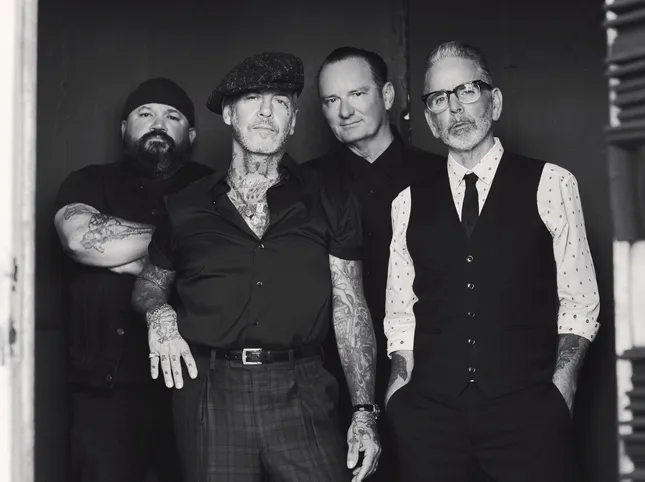
Social Distortion, after 15 years a new album is “a pride”
“I’m very proud of this record, it was a huge amount of work.” With these words Mike Ness summarized together the satisfaction and personal revenge behind the return of Social Distortion with a new album after fifteen years. A lot has happened from “Hard times and nursery rhymes” in 2011 to today, May 8, the day of release of “Born to kill”, the album that interrupts the longest silence in the studio of the career of the historic punk band from Orange County. Guest of the “Loudwire Nights” podcast to prepare fans for the publication of his new work, Ness started from personal battle against the tonsil cancerbecame one inevitable part of the album’s history and the way those songs took shape.
Where we were
When “Hard times and nursery rhymes“, Social Distortion were still a band capable of filling clubs and festivals with the naturalness of someone who had gone through three decades without losing credibility. album debuted at number four on the Billboard 200 and seemed to be able to open a new production phase for the groupbut in the following years the story took a different turn. Mike Ness continued to write, accumulate ideas, record demos, while the band remained constantly on tour and his private life began to occupy an increasingly cumbersome space.
When asked about why this was the right time to return with a new album, Ness admitted he doesn’t have a clear answer and in a new interview with Paul Cashmere of “Noise11” he explained (as transcribed by Blabbermouth.net): “Fifteen years ago we were constantly touring. Then a lot of real life things started happening. My older son had drug and alcohol problems. However, I had to go on tour and deal with all this too. I could list all the things that happenedincluding Covid, cancer, family issues, but I don’t think I could have made this record fifteen years ago. I wasn’t in the right place mentally.”
In the meantime, however, the songs kept piling up. Some even came from the ninetiessuch as “No way out” and “Don’t keep me hanging on”, both born during the “White light, white heat, white trash” sessions of 1996 and remained incomplete for almost thirty years. “It wasn’t because they weren’t good enough,” Ness explained to “Noise11”: “We just didn’t have time to complete them all“. When the time came to actually build “Born to kill”, there was truly an enormous amount of material, including more than forty songs and as many ideas to listen to, arrange and skim, with the knowledge that choosing eleven songs inevitably meant leaving out other valid ones.
In these fifteen years Social Distortion have not disappearedOn the contrary. They continued to play live, celebrate historic anniversaries and maintain the bond with the audience built between punk, rockabilly, country outlaw and street rock ‘n’ roll, but the new album seemed to become more difficult to materialize with each passing year. Ness himself had said several times that he felt under pressure, convinced that he had to write “the album of his career” and that he couldn’t afford a job created just to meet expectations or fill a gap in the record. “The only thing I knew,” Mike told “Noise11,” “was that when it came time to make this record I couldn’t afford to release something mediocre”.
Mike Ness’s illness
In June 2023, when Social Distortion had finally started recording the new album, Mike Ness publicly announced that he had stage 1 tonsil cancer. The group postponed the tour and immediately suspended work on the album. For someone like Ness, who had already been through addictions, arrests and decades of living on the edge, that was it anyway an experience unlike any other. “I was afraid of not surviving,” the band’s frontman said last December during the “KROQ Almost Acoustic Christmas 2025”: “In my life I have experienced hard things and dangerous situations, but nothing like this.”
The operation and recovery have completely changed Mike Ness’ relationship with his body, with his voice and even with the most normal gestures. “I had to relearn how to eat, swallow, everything”, he explained in the interview with “Noise11”: “They sent a robot inside me. I call him Ike, the robot. He came down and removed my tonsil and tumor. Then they opened my neck to remove the lymph nodes. I came out of the surgery with a drain and a feeding tube.” Ness said he lost a lot of weight and had difficulty experiencing the way the disease affected his family, especially in the looks of his children. The biggest fear, however, was that of not being able to sing anymore. For months he had no certainty about the future and admitted that the uncertainty was the hardest part to bear.
Then came the return to the studio and something changed. “I felt like I was singing like there was a tomorrow,” he told “Loudwire Nights”: “It changes your perspective and gave me a sense of urgency. And I think this can be heard in the vocal interpretations.” What might have seemed like the end of his career has instead become a new departure. Ness claims today that his voice is even stronger than before and is already looking beyond “Born to kill”: “I’m already thinking about the next one. I want to make as many records as possible in the next ten years”.
Inside “Born to Kill” you inevitably feel all this, not only survival, but also the need not to waste any more timeas if every song really has to leave something behind.
The return with “Born to kill” and a tour
“Born to kill” arrives today as the return of a band that never really tried to chase the presentbut which still manages to seem alive and necessary precisely because it continues to sound only like itself. The record holds together punk rock, rockabilly, garage rock and that American soul which has always run through Social Distortion’s songs, without trying to artificially modernize or chase trends that don’t belong to their history.
The title track opens the album with dry riffs and an energy that seems to immediately clarify the tone of the album. Ness’ voice remains rough, sharp, worn to the right pointwhile the guitars continue to move between punk aggression and classic rock ‘n’ roll. Songs like “No way out”, recovered from the sessions of the nineties, and “Partners in crime” show the harder and more direct side of the bandwhile “The way things were” and “Tonight” bring that back to the center melancholic and autobiographical vein which has always distinguished Ness from much of American punk.
There are also moments that they broaden the sound without distorting itlike “Crazy dreamer” with Lucinda Williamswhich seems to come from an old western jukebox immersed in dust, or the cover of “Wicked game” by Chris Isaaktransformed into a nervous and intense ballad that highlights a voice that is still surprisingly expressive after everything Ness has been through in recent years.
The album has a rough and lively sound, almost like a recording captured live, but within that simplicity there is a writing that pays great attention to detail. It’s an album that doesn’t try to reinvent Social Distortion, but to reaffirm their specific weight within a punk scene that has changed many times in the meantime. And this is precisely what makes it convincing.
The band’s return will also pass through Europe and Italy. The summer tour will touch Milan on 23 June 2026 with a single Italian date at the Carroponte of Sesto San Giovanni, four years after the last concert in our countryheld in the very same place. A symbolic return for a band that in the last fifteen years seemed suspended between the risk of becoming just a legend of the past and the desire to demonstrate that you still have something to say. “Born to kill” is the way Mike Ness and Social Distortion chose to do it.