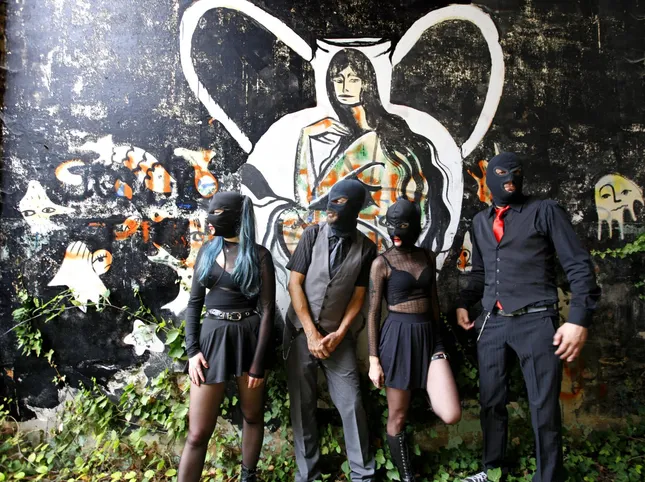
Sick Tamburo: “I transformed dementia into music”
A journey inside the mind. Among the folds of dementia, the one linked to brain pathologies, but also the more metaphorical one which seems to coincide with the world going mad. “Dementia”, Sick Tamburo’s new album out on January 16th and which will be presented on tour, does not hide personal pain, the most intimate one, but at the same time it comes out of the private dimension and tries to photograph a sclerotic and unjust world. Gian Maria Accusani, for over thirty years, first with Prozac + and then since 2009 with Sick Tamburo, founded with the late Elisabetta Imelio, has been making journeys into the dark areas of existence and illuminating them with his music, showing them even to those who would like not to look. In “Dementia” the joy of normality, sudden confusion, darkness, war, the returning light, silence, fear coexist. It’s a rock record made of fragility and confusion, of thoughts that lose their edges and spread.
Gian Maria, the title leaves no room for misunderstanding: this album talks about dementia. How many staff are there?
I had to face, and am still facing, a journey linked to dementia which concerns a person very close to me. Before I started writing songs that explicitly dealt with this theme, I had already composed others and only later did I realize that they spoke spontaneously about the same experience, even if I wasn’t aware of it. It was my subconscious that started moving in that direction.
Was everything already connected?
When I put everything I had written in order, I realized that those songs could be collected under a single title. Even when I thought I was somewhere else, I was actually already there. This makes you understand how deeply this topic was within me and around me.
Isn’t this creative process the same one that pushed you to talk about cancer in music, when you found yourself faced with Elisabetta Imelio’s illness?
Yes. But I didn’t do it and I don’t do it to exorcise what I find in front of me… that process perhaps happens later…
What do you do it for?
To try to be less afraid. And I hope that those who live or are experiencing something similar can feel less alone.
The album, however, is not just about you.
Yes, it’s true, the parallel between what I was experiencing and what is happening in the world came out completely spontaneously. Sometimes dementia is an illness, other times maybe it isn’t, or maybe it is in another sense: it still concerns something else, a “non-thinking” behavior that we see every day. It is enough to observe what happens around us to realize how the “no-mind” can lead to daily tragedies.
Does this reasoning give rise to a piece like “Have I lost my dreams”?
It talks about war, it talks about children forced to live in inhuman conditions among the rubble. They are the consequences of crazy minds. It’s something that affects me deeply and that can’t help but push me to write what I feel. I do it without pretending to be a guru, I don’t care. What really interests me is trying to illuminate the dark areas around us.
Isn’t “illuminating the dark areas” the best definition to first describe the music of Prozac + and then that of Sick Tamburo?
They are areas that are sometimes hidden, other times deliberately hidden. They are the places where the weakest subjects are found, the people on the margins. Inside me I have always felt the need to talk about them, to illuminate them, to tell them, because these are topics that few, almost no one, deal with.
The characters that populate the pieces have always had names. The latest arrival is the protagonist of “Silvia runs alone”.
Sometimes I use real names, other times I don’t. In this case the name is real, I’m talking exactly about this girl and describing her as she is. When I met her, her approach to existence seemed so poetic to me that inserting it into a song was almost spontaneous.
In the song “Immagina se” you talk about when dementia leads you to no longer recognize those you love.
The piece focuses on a person suffering from dementia who does not know he is ill but who however imagines himself to be. It is a way of reminding us that often, indeed almost always in certain cases, we are not aware of what we are or have.
Why is it important for you to put yourself in other people’s shoes?
Because I really believe in the value of empathy. Today a lot of music talks about functional things, easy things, which simply serve to make a song work and reassure the audience. I, however, am interested in telling stories, even difficult ones.
How would you describe “Dementia” sonically?
I believe that between Prozac+ and Sick Tamburo there is a line of continuity that can be summed up in “alternative rock”. It is clear that, from a musical point of view, there are elements that recur, that come back, but also some novelties as in the piece “Mexican”. I am very fond of Sick Tamburo’s sound and I also try to affirm it in a strong way, because for me it represents a sort of counterweight to the dullness of many things we listen to today. After all, I have always been attracted to the darker lines of post-punk.
The title track is one of the most particular pieces.
In that piece there are all the sensations of the album. It’s a long song that, musically, is like a roller coaster: it goes from normality to joy, up to moments of confusion. Every time I listen to it I feel the same feelings I feel when I’m faced with dementia. It’s as if he was almost able to put that type of illness, that continuous cycle of emotions and moods, into music.
A personal question: have you played the album to the person close to you with dementia?
I played some songs, not the hardest ones, but I don’t know to what extent they were really understood. What I know is that I’m not at the end of the process yet: I’m in the middle. Other things will happen, other stages of this disease will also arrive. I’m facing all this and, as always, there is music with me.