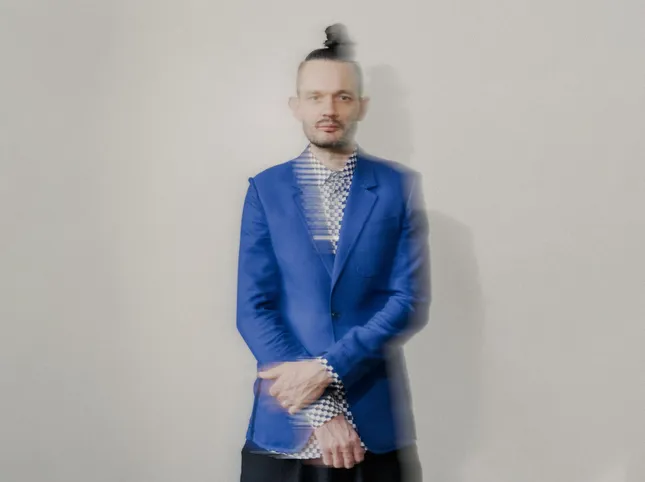
Apparat, the art of loops and doubt as a form of rebirth
After the last triumphal era of Moderat, and after seven years of recording silence as Apparat, Sasha Ring returns with “A Hum Of Maybe”, an album born from a creative block and transformed into a daily exercise of artistic human survival. A record that talks about personal transformation, about using electronic loops to escape the loops of life, but which combines electronics with the dimension of the band.
On the occasion of the release of the album and the Italian dates in April (15 April in Milan, 16 in Rome plus three other dates this summer), Ring talks about how doubt, the “maybe” has become a creative space, the difference between the Apparat project and the time with Moderat.
“A Hum Of Maybe” is your first album as Apparat in several years. When did you realize it was time to bring this project back to life?
I didn’t consciously decide to “revive” Apparat – the music itself made that decision. For a long time I wasn’t thinking in terms of albums at all, I was just trying to stay connected to making music. The change happened silently, when I noticed that certain musical notes kept coming back to my mind, even when I wasn’t in the studio. They began to relate to each other emotionally rather than stylistically. That’s when it felt like more than fragments
The album title emphasizes uncertainty as a productive space. What does “maybe” represent for you at this moment in your life?
For me it’s no longer hesitation. It’s permission. A way to avoid forcing clarity that doesn’t yet exist. I’ve become more comfortable with the things that remain unresolved – in music, in relationships, in life. That space between one decision and another now seems very alive to me. That’s where the focus becomes sharpest and things can still change.
Of the first song, “Glimmerine,” he said: “A loop I couldn’t get out of, so I turned it into one.” It almost sounds like a manifesto of electronic music. Do you see the loop as a trap or as creativity?
It can be both. A loop can become a prison, but it can also be a tool of transformation. Repetition is not the problem – unconscious repetition is. If you stay aware, a loop can become a place to explore subtle changes, not just something that’s blocking you. I think that phrase is less about electronic music itself and more about how we approach patterns in general.
Many songs talk about intimacy, family and parenting. Did working on the lyrics help you achieve an emotional level that sound alone couldn’t achieve?
Yes. Sound can contain emotion, but language allowed me to get closer to certain internal states. Not by explaining them, but by naming fragments of experience. The lyrics are not descriptive – they are more like pressure points. They helped me get closer to things that I would otherwise have continued to circle around indefinitely.
They also gave me the chance to return to moments I had buried somewhere in the back of my mind. Lyrics for me were just another way of approaching a song – but on this record they became a form of self-therapy. With no intention of being therapeutic for anyone else. In that sense, it could be a very selfish record.
THEIn this album there is electronica, but also a band dimension. How important it was. in the studio and on stage?
It was essential. Working with the same people over time creates a shared sensitivity. Decisions become intuitive rather than conceptual. In the studio, this allowed the music to remain fragile instead of being over-engineered. On stage, he gives the songs room to breathe and change. The band dynamic transforms the material into something alive.
You have long balanced electronic composition and instrumental sound. Does the distinction between “producer” and “musician” still make sense to you?
No, I don’t think so. After all these years, a tool is just an interface. A synthesizer, a guitar, a voice – they are all tools for shaping time and emotion. The distinction seems outdated to me. What matters is whether something is alive, not how it was generated.
Moderats represent another face of your creativity. How would you describe the difference today between working as an Apparat and working within the Moderat?
Apparat is introspection. It is the place where I allow uncertainty and vulnerability to remain visible. The Moderats face outward. It’s about dialogue, momentum and shared energy. Both are essential, but respond to very different needs.
Has the extensive tour with Moderat influenced your solo work or do you keep those worlds separate?
They inevitably influence each other, even if I don’t plan it. Touring with Moderat reminded me of the power of collective movement and trust. This awareness probably gave me more confidence to reopen my solo work – not stylistically, but emotionally.
It’s inevitable to ask when Moderat will return with new music. Is it a question of timing or urgency?
It’s a question of alignment. Internally there is no pressure. We don’t work well under urgency. When it happens, it should feel necessary, not expected. This has always been our rule.
Your concerts often transform studio material into something more fluid. How are you bringing these songs to the stage — and do you expect them to evolve when you arrive in Italy in April?
We are treating the live versions as translations, not replicas. The songs are more open, less fixed. They already change from one night to the next, and I expect it to continue that way. By the time we get to Italy, they will probably have changed again – and that’s exactly what I want.