And instead Ornella wants to live and sing
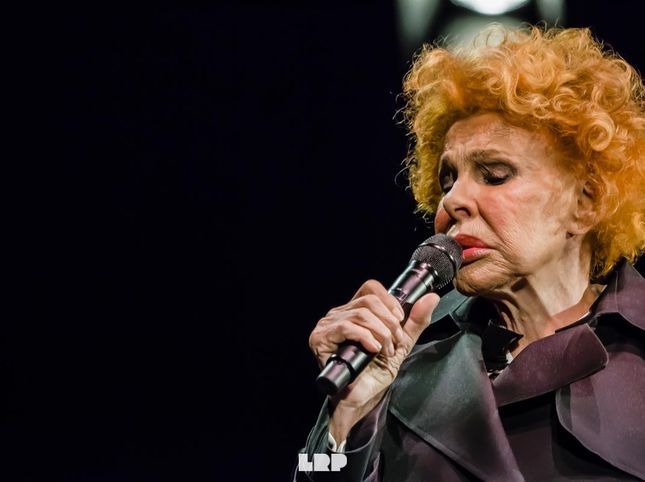
It was December 2022 and Ornella Vanoni was touring Italy with the “Women and Music” tour, accompanied by an all-female band. We went to follow the Roman date, among the last live dates, before retiring from the stages of the next tour, that of 2024. We attended not so much a concert, but a real recital on a career – and a life – of an artist from another era, one of the last divas (along with Patty Pravo and Mina) of the great Italian music. We propose the review again, without retouching, below, while Italian music mourns the passing of the voice of “The Appointment”.
With the curtain still closed, you can hear her talking to someone about her recent fall, the one that a month and a half ago caused her – at 88 years old – to break her femur and forced her to undergo a delicate surgery, postponing the debut of the tour by a few weeks. When the theater curtains open, Ornella Vanoni is sitting in an armchair in the center of the stage, as if it were the living room of her home: “They tell me to talk a lot, because people like it. One opens the TV and everyone cries. They are all sick and they say so. It’s not possible, it’s a shame“, he begins. And the ovation immediately begins, the first of a long series, even before the Milanese diva begins to sing. As if the applause were due – and it is – regardless of what happens on stage, an applause not only for the career of an artist who wrote some of the most important pages in the history of Italian song, but also for the stoicism that saw her appear on stage without crutches a few weeks after the operation. And without mentioning the slightest sign of pain.
That stoicism, that rigor, she says, was learned in the theatre, when at the age of twenty she found herself attending the Piccolo con gli grande school in Milan. Giorgio Strehler: “The middle-educated bourgeoisie thought that terrible things were happening behind the curtain, which could not even be reported. Bullshit. Behind the curtain we get fucked up like this: who has time to have sex?” “Behind a curtain how much work is done” is also one of the lines of “Ornella si nasce”, the opening number of the evening, a portrait signed by Renato Zero that Vanoni recorded for her latest album “Unica”, released last year: “Try to make me miss my whims, try to deny me all my vices / I won’t be what you want / but you won’t change me“, sings the diva on the stage of the Auditorium Conciliazione in Rome, in front of the public on special occasions, recounting in a few verses her vices and virtues, ideally making the opening credits of the show scroll by. Which is a sort of recital whose subtitle could be “At Ornella’s house”, for the type of dialogue that the singer of the underworld seeks with the spectators: it is as if she really made them enter the living room of her house, showing them the photos of a life and an entire career hanging on the walls of the room, as evidence of all the experiences, partnerships and songs that allowed her to become the legend she is today.
There are meetings with composers such as Franco Califano and Mino Reitano, among the authors of one of his greatest successes in 1969, “One more reason“, or Sergio Bardotti and Vittorio De Scalzi of the New Trolls, who in 1977 joined her in the diptych “Iointerno” and “Iointerno”, of which the singer plays the irresistible “I love you“. And then Bruno Lauzi, author – among other things – of the Italian adaptation of “Sentado à beira do caminho” by Roberto and Erasmo Carlos, which in 1970 became “The appointment“, but also Alberto Testa, who three years earlier had transformed into “Sadness“the samba song written by Niltinho and Haroldo Lobo. There are only four snapshots from the Milanese interpreter’s collection that remind us that there was a time, unfortunately very distant, in which writing songs and recording them was a craft job, which had nothing to do with algorithms and marketing logic. Today, Ornella Vanoni plays those songs with a band of jazz musicians set up by Paolo Fresu, made up of musicians – all acclaimed by specialized critics and enthusiasts: they speak for them their respective curricula, which include collaborations with Danilo Rea, Fabrizio Bosso, Renzo Arbore, just to name a few – such as the pianist Sade Mangiaracina, the guitarist Eleonora Strino, the double bass player Federica Michisanti, the drummer Laura Klain and the cellist Leila Shirvani.It’s not the pink quota, it’s the skill quota”, underlines the singer.
On “I fell in love with you” he remembers the arguments with the “demented record companies” who wanted to dissuade her from recording in 1969 her reinterpretation of the song originally written by Luigi Tenco, who died two years earlier: “I changed the concept of what a woman was allowed in love and what was not, imposing the idea that even a woman can think and say certain things in love.“, she claims. Also removing a few pebbles from her shoe: “I happened to be punished more by women than by men. I have learned to forgive them. Do you know why? Why am I here: where are they?And then every now and then he comes up with surreal reflections: “These kids today are all shy, insecure. He never fucks. In my time it was different. You met, you liked each other and off you go. I’m glad I lived in a different era“. There is no room for regrets and bitterness during the concert. “Samba for Vinicius”, “I know that I will love you”, “The desire, the madness”: the meaning of the show lies entirely in the brief parenthesis dedicated to the ’76 album, the result of the magical encounter with the poet Vinicius de Moraes and with Toquinho, in that mix of nostalgia and desire to dance of which the diva has made an art. “I spent the whole day in front of the mirror crying. I never stopped. I looked at myself reflected in the mirror and said to myself: ‘How much are you crying?’. The fact is that I really liked crying“, she says. Today sadness no longer lives here. “There are many people who need to suffer and who cry a little every day”, sings the diva. Instead Ornella wants to live and sing. And he says no to sadness.