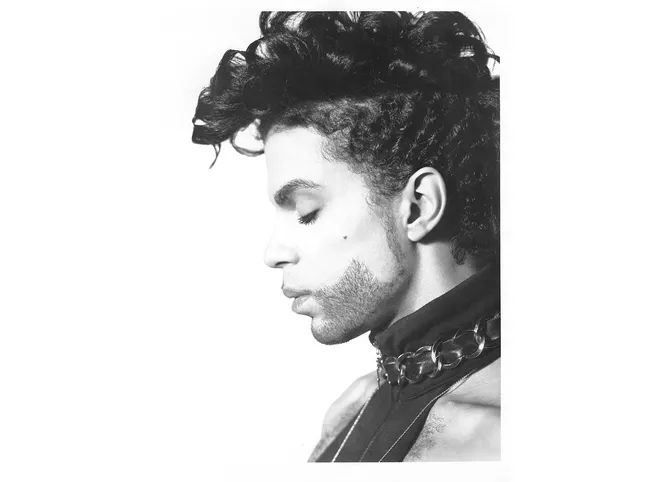
Why the future still needs Prince (10 years later)
If today your favorite artists can afford to wage war on the major labels on TikTok or claim ownership of their masters, it is only becauseAnd a man 1.60 meters tall, with 12cm heels, flamboyant clothes and a guitar in the shape of a symbol, decided to fight and bleed first.
On April 21, 2016, the world lost Prince Rogers Nelson. Ten years later, we are not here for the usual dusty obituary, but to understand whyAndin a‘era dominated by algorithms and artificial intelligence, the figure of Prince is one of the few “antidotthe” left.
The prophet of independence
Today we celebrate the courage of artists like RAYE, the English artist who broke free from the shackles of labels to climb the charts as an independent. But he was the “patient zero” of this revolution. When Prince wrote “SLAVE” on his cheek in 1993, the world thought he was crazy: in realityHe was seeing the future about thirty years ahead. He had in fact understood that the value does not lie in the contract, but in the possession of one’s dreams (and one’s .wav files).
Prince was a bold and brazen artist: he put his own personality at the forefront and always did what he wanted, how he wanted, regardless of whether the fans followed him or not. Celebrating Prince today means celebrating the idea that art cannot be a commodity governed by an algorithm or managed by a paper Excel.
Beyond Genre: The First True “Fluid Hero”
Long before the term gender-fluid became commonplace, Prince inhabited a planet of his own. Lace, stilettos, heavy makeup, but with an electric virility that defied any category. Prince didn’t “play” a role: he was the perfect synthesis. Just think of the lyrics with an overflowing carnality of “Dirty Mind” and “Controversy”, the records of the early 80s, or that extraordinary and hypothetical role-playing game that was “If I was your girlfriend”.
In a world that today laboriously tries to break down stereotypes, Prince remains the living instruction manual on how to be everything and the opposite of everything, without ever asking anyone for permission.
There “Vault” and the music played
While today the industry bombards us with disposable singles every Friday, Prince left us the Vault: a safe – physical and legendary – containing thousands of unreleased songs from which the Super DeLuxe Versions of “Sign ‘were extracted☮‘the times”, “1999”, “Diamonds and pearls” “1999” and “Purple Rain” as well as collections full of unreleased songs such as “Originals” and “Piano & A Micriphone” (ALL WITH LINKS TO THE REVIEWS). Prince didn’t write to publish, he wrote becauseAnd he couldn’t help it. He is the archetypal artist-ecosystem: a man who was, simultaneously, the best guitarist, the best bassist, and the best producer in the room.
In a 2026 where music is often generated by textual prompts, Prince’s memory takes us back to flesh and blood. At his legendary after-shows or his long and exhausting studio sessions – not always to the delight of his musicians – Prince reminds us that the musical instrument is a‘extension of the human body, not an aesthetic accessory, be it the guitar (does anyone remember the amazing 2 minute and 50 second solo on “While my guitar gently weeps” during the R&R Hall Of Fame evening?) or the piano (the last tour that never ended was titled “Piano & A Microphone Tour”).
We don’t celebrate Prince because we are nostalgic. We celebrate it becauseAnd his legacy is a map for the future. If we want music that is still free, courageous, technically impeccable and deeply human, we must continue to look towards Minneapolis. Even more today.
The world has become a slightly grayer place since that day in April, but luckily, we still have enough recordings – and we’ll have more, there’s talk of a DeLuxe Edition of his masterpiece Parade for his 40th birthday – to be able to enjoy his music. Nothing compares 2 him.
Here is the mixtape dedicated to Prince: the legacy, the fundamental songs, the deep cuts, the songs for others, the tributes, the posthumous records…