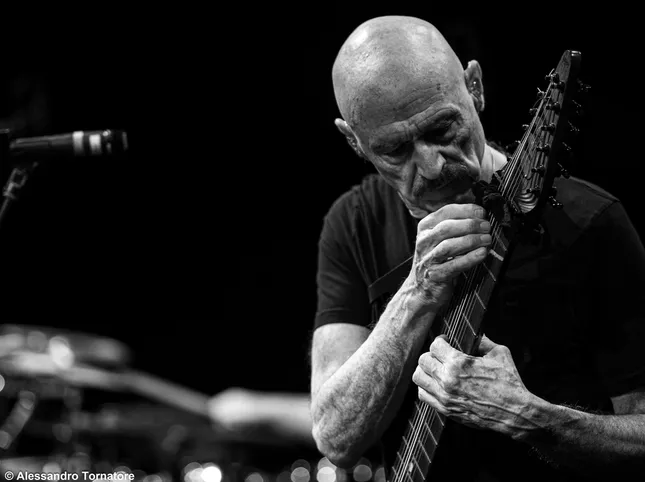
There aren’t many supergroups as strong as the BEAT
The announcement of the mini Italian tour of BEAT has generated considerable enthusiasm, which might seem exaggerated for a band that is just one or two years old, but not for those who frequent the progressive world. Prog is a niche that should not be underestimated, because those who love it often reflect its bizarre tendency: it is by studying and admiring the complexity of the songs that one ends up becoming crazy about the progressive universe. It goes without saying that if four total phenomena such as Adrian Belew, Tony Levin, Steve Vai and Danny Carey start playing together songs by those other total phenomena of King Crimsonthe emotional earthquake in the prog niche is guaranteed.
The Crimson without Fripp: does it make sense?
The first (and perhaps only) criticism leveled at the BEAT is: can King Crimson be played without Robert Fripp? Legitimate observation: Fripp is the soul of Crimson, but his absence on stage is normal in a project that does not want to be either a reunion or a simple tribute. Moreover, the quartet received Fripp’s blessingwho supported its development and, according to some, even suggested the name “BEAT”.
It is not and cannot be a simple tribute, because if four musicians of that level – with such strong and distinctive timbres and personal brands – re-read songs, they will necessarily have something different. Which doesn’t mean distorting: Belew and Levin are part of Crimson’s history, they know the material they have in their hands like the back of their hands and there is no danger that fidelity to the original songs could be lacking. But to understand better what contribution they can give these musicians to a historic band that in itself would not need reworking, just think about their CVs.
A supergroup with counter-flashes
Adrian Belew he was discovered by Frank Zappa, who immediately wanted him with him and with whom Belew remained until he joined David Bowie’s band. And maybe we could even stop here. A central figure of King Crimson in the 1980s, Belew is known for his experimental approach to guitar and singing. He has collaborated, among others, with Talking Heads, Porcupine Tree and Nine Inch Nails.
Tony Levin he is hands down one of the most influential figures in the world when it comes to electric bass and derivatives, such as his Chapman Stick. Who did David Gilmour turn to to replace Roger Waters in Pink Floyd? To him? Who was in King Crimson already in the 1980s? Him. Who is a historical member of Peter Gabriel’s band? Him. As a sessionman he has participated in hundreds of albums by artists of all genres and, with a career spanning over five decades, Levin has disseminated techniques and ideas that have expanded the rhythmic and harmonic vocabulary of the modern bass.
Internationally renowned virtuoso, Steve Vai He is considered one of the most innovative and technically gifted guitarists of his generation. After starting out as a transcriber and then member of Frank Zappa’s band in the early 1980s, he developed a hugely successful solo career. Awarded and nominated several times for a Grammy, Vai has played with Alcatrazz, David Lee Roth and Whitesnake.
Danny Carey he’s not a drummer: he is The drummer. He is best known for his work with Toolswith which he redefined the boundaries of metal and prog thanks to his complex rhythms, polyrhythms and mathematical structures. His technique combines precision, powerful groove and an almost orchestral approach to percussion. Which is why, in the list of the best prog drummers of all time according to Rockol, he occupies second place.
Why the Eighties?
At the center of the BEAT project is the “second” phase of King Crimson, i.e. the material of the 80s, in particular the three albums “Discipline”, “Beat” and “Three of a Perfect Pair” – except for occasional additions taken from other eras when the set requires it. For example, some of the pieces performed in the last dates are “Neurotica”, “Neal And Jack And Me”, “Heartbeat”, “Waiting Man”, “The Sheltering Sky”, “Larks’ Tongues (Part III)”.
Why this choice? First of all, because it is the era lived directly by Belew and Levin, so they return to music that they contributed to creating firsthand. Secondly, there is a thematic reason: the three albums of the 80s form a coherent corpusalmost a single work in three movements: same group of musicians, same rhythmic and harmonic language. And it is a language that, compared to Crimson’s previous years, is a little less linked to Fripp’s compositional and timbral personality; this allows BEAT to re-present those songs without having to simulate Fripp’s presence, but replacing his role with a new dialogue (Belew–Go).
Robert Fripp always conceived King Crimson as an idea more than a fixed band. Reviving the 80s trilogy in a new form, with different musicians, is perfectly consistent with this philosophy: music not as a relic, but as a living organism.