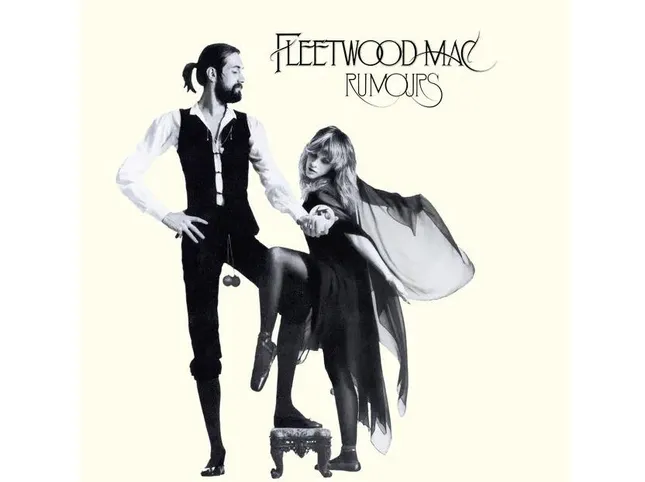
The thousand lives of “Rumours” in the charts, and beyond
To confirm what Fleetwood Mac and their symbolic album “Rumors“let them remain one strength capable of resisting timeeven almost fifty years after the album’s release, the charts are also thinking about it. And especially the Stars and Stripes chart.”Billboard 200“, the historic US ranking that evaluates albums based on the overall performance of all formats. Thanks to its ability to cross decades, formats and generations, rather than “return”, “Rumours” has built a presence, with a repertoire of returns that transform archive data into an indicator of collective memory.
The album was recorded in California by Lindsey Buckingham, Stevie Nicks, Christine McVie, John McVie and Mick Fleetwood during a year of personal fractures and study logic that resembled a novel about relationships and work. Then anticipated by the song “Go Your Own Way“, capable of climbing the “Billboard Hot 100” week after week up to tenth position and remaining there for two weeks, “Rumours” was born with the aim of adopting an immediate musical language, ending up becoming a classic that the public now rediscovers cyclicallyevery time an episode of a TV series, a clip on social media or a generational re-exploration puts songs and history back into circulation.
“Rumours”, 31 weeks at the top
At the time of release – it was originally released on February 4, 1977 – “Rumours” It immediately established itself as a commercial successbecoming the band’s second album to reach number one in the US, following 1975’s eponymous studio effort, featuring a stay at the top of the “Billboard 200” of 31 non-consecutive weeks. The album also took first place in the United Kingdom, Australia, Canada and New Zealand, thus building a international presence which, instead of exhausting itself with the initial season, became a solid basis for all subsequent returns.
“Millennials” rediscover “Rumours” thanks to “Glee”
He arrives in 2011 one of those moments when pop culture gets its hands on a classic again and returns it to an audience that has not “inherited” it at home, but encounters it as if it were new. In May of that year, “Rumours” returned to the “Billboard 200” at number 11, and in the same period it also rose again in Australia, reaching number 2 on the ARIA Charts. The reason? “Glee“, that television phenomenon that has been around since 2009 I imposed the musical trend on the small screen too, towards the end of the second season he built an entire episode around a single album.
The series, created by Ryan Murphy together with Brad Falchuk and Ian Brennan, took the form of an ensemble story set in an Ohio high school, with a “glee club” at the center and a story that mixed musical performances and generational themes, between identity, relationships, conflicts, growth. And precisely for this reason it became a powerful engine for bringing songs from the past back to the foreground, transforming them into “present” material through voices, rearrangements and textures. On May 3, 2011, towards the end of the second season, “Glee” takes a further step and decides not to revolve around a category or an artist, but a single album, with a episode simply titled “Rumours”with six covers in the setlist of songs taken from that album (“Dreams”, “Never Going Back Again”, “Songbird”, “I Don’t Want to Know”, “Go Your Own Way”, “Don’t Stop”) and a declared common thread, that of gossip and its consequences, almost overlap the legend of Fleetwood Mac and the dynamics between characters. In this context, the precedent of “Landslide”, already used by the series, and the visit to the set by Stevie Nicks also weigh, a detail that makes the bridge between the television story and the Fleetwood Mac universe more concrete.
The result, for the album, is a clear returnvisible, measurable, and above all a change in audience. “Rumours” starts to circulate again among younger listeners, re-enters the conversation, returns to the advice between friends, returns to the headphones of those who discover it for the first time and of those who rediscover it as if it were a contemporary record.
The “Dreams” case and TikTok
In October 2020generations and platforms change, and the theater of the rediscovery of “Rumours” becomes TikTok. Nearly six years ago, the classic album returned to the top ten of the “Billboard 200” thanks to a video that went viral on TikTok. He was the protagonist Nathan Apodaca who filmed himself with the internal camera of his mobile phone while he was skateboarding, with a drink in hand, and in the background “Dreams“, that is, the song which, in a few seconds of chorus, manages to seem perfect for a simple gesture such as sliding without too many thoughts on the road at dawn. It is a type of return that does not need complex explanations, because it feeds on imitation, sharing, repetition, and in fact the wave reaches up to the members of the group, with Mick Fleetwood and Lindsey Buckingham who end up, in different forms, in the wake of the phenomenon. Here the dynamic sees a song become common language for millions of peopleconsequently allowing the album to rise again. And the ranking records the effect like a seismograph does, translating into position and numbers a cultural transition that arises elsewhere, far from the traditional logic of promotion.
Even in 2025, Fleetwood Mac continues to dominate the charts
If the peaks of 2011 and 2020 have the face of a specific event, the 2025 tells something even more interesting: the normality of presence. In the end-of-year rankings of the US magazine “Billboard”, “Rumours” does not appear as an anniversary curiosity, but as a title with real weight in contemporary consumption, capable of competing with the dominant artists of the season, and of doing so within the idea of a catalogue, that is, within that zone in which albums should not “grow” but, at most, survive.
And instead the album remains there, among the listens, in sales, on vinyl, in the continuous rotation of playlists and radio, and reaches a prominent position in the year-end ranking of the “Billboard 200”, at number 25.
In addition to “Rumors,” the “Landslide” case and “Stranger Things”
The feedback mechanism does not only concern “Rumours”, and this is demonstrated by the case of “Landslide”, song written by Stevie Nicks and published on the 1975 album “Fleetwood Mac”. Thanks to the final episode of “Stranger Things“, the song returns to attention and conquers a new audience, to the point of pushing the studio version to debut in the “Billboard Hot 100”, a goal that arrives after decades and tells well how Fleetwood Mac’s catalog is still permeable to the language of today’s pop culturebetween series, clips, platforms and continuous rediscovery.