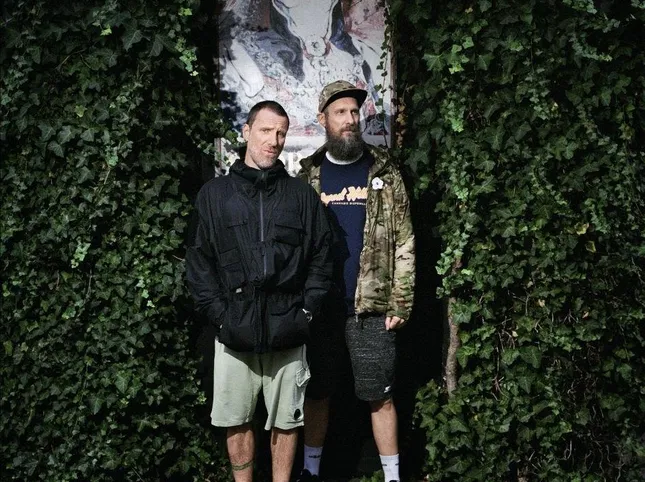
The return of the Sleaford Mods, in a post-apocalyptic era
Three years after “UK Grim”, The Sleaford Mods they return on January 16th with “The Demise of Planet X”an album that is not only the new chapter in their discography. For the English duo, formed by Jason Williamson and producer Andrew Fearn, the next album has to be a narrative, political and symbolic device that tries to give shape to an already collapsed present. Not about an apocalypse that must happen, but about what happens afterwards, about what remains when the end does not arrive in a spectacular way but slowly settles into daily life, between intact habits and exposed nerves. Williamson and Fearn set off again from that ambiguous terrain where the disaster has already occurred and yet everything continues to work, at least on the surface.
“We are living in the post-apocalypse“, said Jason Williamson in the interview for the British “Evening Standard”. Reflecting on the world events that inspired the new “The Demise of Planet X”, the frontman added:
“‘Planet
It’s a statement that works like manifesto of the album and, more generally, of the entire journey of Sleaford Modsa duo that has been observing the United Kingdom from below for over a decade, chronicling the erosion of the working class, the normalization of social collapse and the absurdity of a system that continues to produce consumption while everything around it crumbles. Where were we? To “Spare Ribs” and “UK Grim”, records that had photographed the stagnation, paralysis and post-Brexit resentment, transforming Williamson and Fearn from marginal voices to almost mainstream points of reference. “The Demise of Planet X” takes up that thread and stretches it to the limit, shifting our gaze from stasis to open devastation.
Reading the duo’s story and the “Evening Standard”‘s impressions of the new album, Andrew Fearn’s foundations remain faithful to one essential grammar taking up post-punk loops, pounding rhythms, a minimal but danceable physicality which supports Williamson’s rants, once again taking center stage with a rough, ironic, sharp vocality. It is on this system that songs like “Flood the Zone”, frontal attack on the MAGA world and its muscular and regressive aesthetic, e “The Good Life,” which captures the precariousness of contemporary stability and hosts the unexpected participation of Gwendoline Christie. “It’s impressive, I’m very careful about spelling when I write them,” said Williamson, ironically underlining the short circuit between pop culture, fandom and social criticism. The song becomes a conflictual dialogue between the desire for well-being and awareness of chaos, between aspiration and collapse.
“Bad Santa” instead pushes on the accelerator of satirenaming the four horsemen of the apocalypse according to Williamson: Donald Trump, Andrew Tate, Dapper Laughs, and a generic ordinary father on Instagram, an emblematic figure of an emptied but noisy authority, amplified by the digital ecosystem. This is where “The Demise of Planet X” shows its most clearly obsession with the social engineering of social mediafor that performative and compulsive dimension that transforms every conflict into content. In the album there is also space for a reflection, contained in “Elitist GOAT” with Aldous Harding, in response to the attacks suffered by Williamson after the Madrid concert in November 2023when a Palestinian keffiyeh was thrown repeatedly on stage and he decided to leave, before later clarifying that he condemned the deaths of civilians and wanted a ceasefire, despite being harshly attacked on social media.
“The Demise of Planet X” is thus an album that does not raise flags of salvation, but digs through the rubble with clarity and sarcasmreaffirming the Sleaford Mods’ role as chroniclers of an exhausted present.