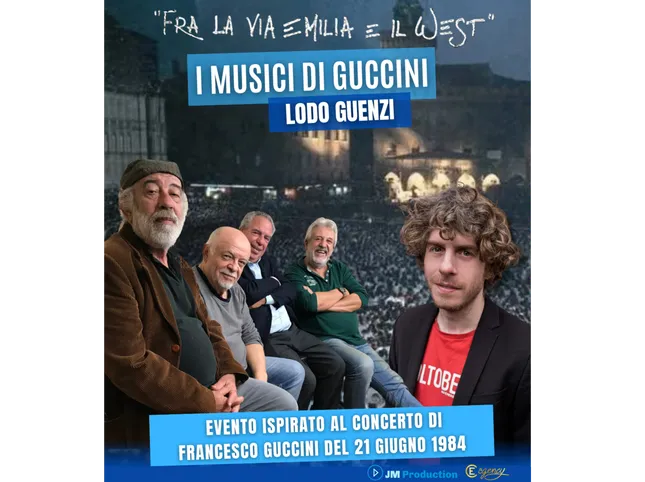
The Musicians of Guccini and Lodo Guenzi, “Between the Via Emilia and the West”
As far as music is concerned, in my life, I have only one remorse and only one regret: the remorse of not having wanted to go, like a penniless university freshman that I was, to the last concert that Fabrizio De André held in my city; the regret of not being able to go, this time for age reasons, to Francesco Guccini’s iconic concert.
June twenty-first, nineteen eighty-four, Thursday, the usual sirocco inflames Piazza Maggiore in Bologna. A crowd never seen before – 150,000 people, it is said, but Guccini himself will downplay it with estimates from Digos – pour from Piazza del Nettuno, Via D’Azeglio, Via dei Pignattari and Via Dell’Archiginnasio into that square surrounded by porticoes and, for that evening, dominated by a monumental stage. You breathe a magical air, you look for a place as close as possible to the altar, you have the clear perception that there, in that moment, history will be made, not a simple concert: singer-songwriters of the caliber of Lucio Dalla, Paolo Conte, Pierangelo Bertoli, Giorgio Gaber together with I Nomadi and Viulan have agreed to act as companions and traveling companions to the undisputed star of the evening. Families, young and old, casual customers, friends, colleagues, all there to listen and praise Francesco Guccini. No one can know, or even suspect, that that evening we are not celebrating the beginning of a new course but the end of another story, a story that from its apogee absentmindedly turns its gaze towards the abyss that awaits it: the Seventies, political commitment, creativity and the horror of terrorism. The Italy of ordinary people regains possession of the squares, unconsciously paying a very high price to the rules of consumerism, homologation and reflux which from then on will establish the rules of the game, a mediocre and repetitive attempt to imitate the models of the previous decade. This is what Fabio Zulli, director of, claims and tries to demonstrate piece theatrical “Between the Via Emilia and the West” which, alternating sung and recited words, recalls that distant day in June.
Not just a nostalgic celebration of what can never return, but the attempt to actualize and make that event immortal for those who, like myself, were unable to be present.
The idea for the show started from Flaco and Manuel Clava, owner of the booking agency GM production of I Musici, in 2024: it was born as the idea of a concert that re-proposes the same songs from that evening and evolves into a more complex theater-song project, to give the right weight to the histrionic aspect that has always animated the Maestrone’s performances. Faithful to the irreverent and self-deprecating character of Francis, the text does not give in to the flattery of rhetoric, alternating memories and experiences, nostalgia and laughter.
And then, after due okay by Guccini, the curtain opens on this generational bridge, entrusting the story to those who arrived later, to those who only indirectly and, perhaps, belatedly, discovered those songs and breathed that climate: he has the difficult task of restoring, to those who were not there, the artistic and social legacy of that event. And Lodo Guenzi, actor and former frontman of Lo Stato Sociale, from Bologna who grew up with a Guccinian sentimental education, fulfills this mission perfectly. Fabio Zulli, who had already attempted a dramaturgical reduction of Guccini’s pieces in a show entitled “Talkin’ Guccini”, organizes the staging in two parts, comparing two irremediably distant eras, trying to revive yesterday in a today that continually turns its gaze backwards, to orient itself and seek answers about tomorrow: because it is the task of the classics to give us back universal values and feelings and it is the task of the theatre, from the Greeks and for always act on emotions in a cathartic way.
And Guccini, Zulli claims, is still able to do it, his songs are still capable of giving shape to our thoughts, of comparing and sublimating our experiences in his lyrics.
In the first part of the show, Guenzi, a figural version of a 1984 Guccini, tries to put that historical event back together, recovering anecdotes and relics from the depths of the memory of those who were actually on that stage at the time: in Orphic guise, therefore, the young artist questions the Musicians so that they can tell him what the passing of time has dispersed. And the memories, as often happens, are inconsistent and fragmentary, providing a chaotic picture of what is an essential corollary of that evening, never told before: the emotions and thoughts of the protagonists in the few frantic minutes preceding the start of the concert and the confrontation with that frightening crowd.
There is Flaco who meets Deborah Kooperman’s gaze and remembers the first meeting with Guccini, amidst understandings and misunderstandings, Marangolo who would like to retreat and find comfort in a pair of slippers at his home, Bandini who thinks, moved and touching, of his father and mother, all while Guccini, as always, deals with an alleged pre-concert aphonia. And Lodo, in the midst of these re-enactments to which he does not belong, perhaps thinks of his concert in Piazza Maggiore in Bologna: but it is another June, in another era, when we still all traveled together in a van from one square to another and we couldn’t afford a single room in a hotel.
Here then is the idea, the meta-theatrical twist: to re-stage that evening to also reclaim its history, so as not to feel excluded. But how to do it? Many of the protagonists are no longer with us, time has closed in on them, as always happens, and disenchantment takes over, putting hope in crisis: it is not enough, in fact, to regret taverns that are now closed and scarred by fashion, to sing songs that revive faded or extinct passions, to hope to find an answer in the past that comforts our confusion. The Musicians, from the heights of their wisdom and their age, put the young idealist in front of an insurmountable obstacle, at least apparently: it cannot be done, “the time gone by will not return”, not even in the fiction of the theater. Then begins the “formation novel” that shapes the second part of the show: Guenzi gradually rises from an initial despondency, thanks to those who, through experience, can show him the way to follow: the ideal must leave room for a private and concrete dimension, abandon the idea of being able to take on the role of guide, seeking the end of the night on their own, without demanding definitive answers but continually questioning themselves, amidst a thousand worries and panting. In short, everyone will have to find their own, individual value in that show, reflect themselves in the characters of those old songs, breathe the atmosphere of that Bologna that no longer exists, trying to save what is still useful and immortal, because those songs still exist in reality, even without the stage fiction.
It will therefore be Flaco who will solve the enigma, who will reveal the deception of the Sphinx: you have to tell your story, you have to understand where your heart is, hold it tightly in your fist and brandish it with courage and pride, being content to sing when you can and however you can… and screw everything else!
For those who were there and for those who weren’t there, it is therefore a duty to go and see this show which, through multiple generations, pierces time, breaks through the years, opens a slit in the past and a glimmer of hope for the future.
It can be done immediately on April 29th in Bologna at the Teatro delle Celebrazioni, or in Gallitano (Lucca) on June 26th for the Festa dell’Unità and again on July 10th at the Lazzaretto in Bergamo.