The ecstasy of Radiohead’s return
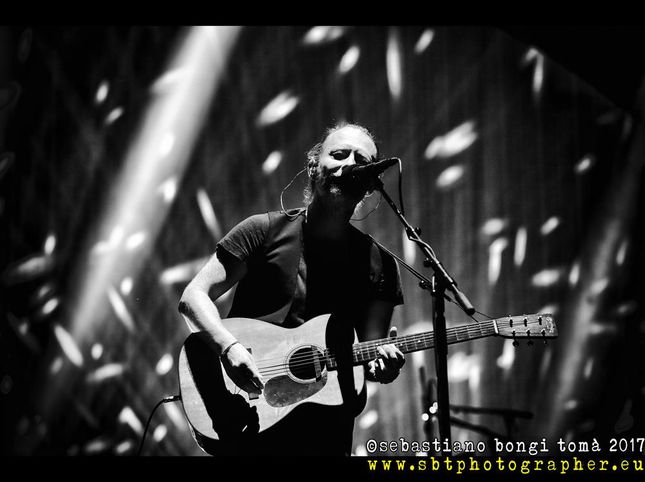
It’s a meeting of generations the one that takes shape with the arrival of Radiohead in Bologna. Already at the entrances of the Unipol Arena children and adults, Italians and foreignersthey find themselves inside an energy that surpasses the expectation of the event and is rooted in the memory of what the music of Thom Yorke and his associates represented for everyone in different generational moments. Once inside the building, the impact comes from a raised dodecagonset in the center of the room like a geometric body immersed in a cage of LED panels that surround it and rise on a circular stage. The public, willing in sections also in the parterreobserves that structure that rewrites space rather than dominates it, already suggesting the idea of a concert that does not want to offer a privileged front nor a stable experience. At 8.15pm the lights dim, letting Radiohead’s return takes shape graduallylike a prologue that leads to the actual beginning of the show. The LEDs begin to pulsate, tracing rectangles that respond to the electronic distortions and which illuminate the various sections of the Unipol Arena, from the pit to the stands, raising a thunderous response from the audience. The bars in the parterre are even closed at the request of the group, the workers say, to allow for resume the evening. The wait ceases to be such, while the fans are ready to applaud a band they’ve been waiting to see again for yearschased in his silences, in his indiscretions, and finally re-emerged. It arrives like this, on the evening of November 14ththe tour that started in Madrid and is now passing through our area to bring back the Oxford team in Italy, after eight years of absence.
When at 8.30pm the structure lights up in a single flash and the roar rises from every direction, the instruments appear beyond the panels. On a sharp synth the silhouettes of Radiohead emerge, before their entrance coincides with the guitar attack of “Planet telex“, a song chosen to open the first of the four Bolognese dates. The LEDs now project negative and stylized images of the musicians, like presences filtered by another dimension enclosed within it. The band decides not to give itself up completely yet, hiding behind the walls that surround it and moving within a visual matrix that recalls alien forms and communications.”2+2=5” then pushes the pace and the projections become clearer, until the structure lifts and allows Yorke, Jonny Greenwood, Ed O’Brien, Colin Greenwood and Philip Selway to fully appear, joined by second drummer Chris Vatalaro. On “Sit down, stand up” the frontman moves to the piano while the arena turns red, and then leaves the instrument and reaches the edge of the circle in a tense, punk, almost nervous dance. Greenwood switches from xylophone to synths with pinpoint precision, before “Bloom” unfolds his three lines of percussion and chases the electronic carpet until a long vocal suspension that brings those present into a contemplative state. While maintaining a masterful execution, the sound of the hall does not yet restore fullness and immediacybut when the yield changes in a tangible way, you enter a state of ecstasy and we return to the inner breath to follow the music, while observing and listening to the creation of a layered and artisanal sound fabric. Radiohead’s innovation thus becomes school, now reaching the status of classic.
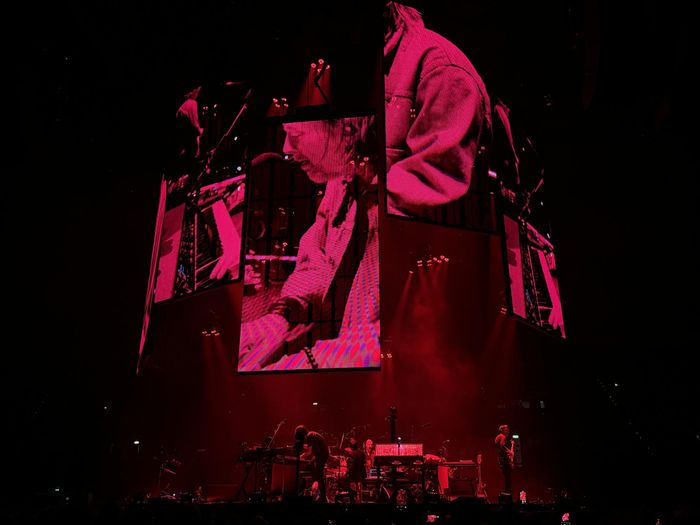
The concert proceeds as a compact flowpunctuated by twenty-five songs which, repeating the same lineup as on November 7th in Madrid, take place with absolute punctuality to go through the entire history of the group, including the best known and rarest pieces. Before “Lucky”, Yorke indulges in one of the few, short, pleasantries and quickly greets the audience in Italian: “Hi everyone, how are you?”.Full stop” leads him to complete a complete tour of the platform, while on “The gloaming“creates a dance of loops between voice and movement.”There there” arrays two drums and two percussion stations in a single rhythmic body, before “No surprises” brings Yorke back to acoustics and Greenwood to xylophone, opening the first great choral moment. “Videotape“suspends time again with the frontman on the piano and an angelic vocality, while the clear drum hits by Selway and Vatalaro build the sound environment. “Weird fishes/Arpeggi” turns on the roar and presents one of the stage movements while the musicians move continuously between keyboards, microphones and stations distributed along the entire circleallowing each sector of the arena to experience its own proximity. “Everything in its right place” sees Yorke first sitting at the keyboards and then standing again to drag the room into a contemporary dance before “15 Steps”, “The national anthem” And “Daydreaming” alternating explosions and estrangements, with the LEDs building white light grids and Yorke interrupting for a moment to ask the crowd: “Are you okay?”, when someone in the audience falls ill.

Each song becomes an autonomous sound environment, bringing the audience into ever-changing atmospheres and moods. From the intimacy of “Subterranean homesick alien“, we therefore find ourselves in an electric race with “Bodysnatchers”, before the whirlwind of “Idioteque” with Yorke returning as a dancer in a rhythmic body capable of modulating the beats of the room. The deepest meaning of the tour also finds space in this flow: a return that doesn’t rely on a new albumbut to the trajectories that the band has been able to trace previously and that each member has been following since 2018 also with parallel projects. Radiohead’s latest recording chapter remains “A moon shaped pool” from 2016, but what the group brings to Bologna is a meeting of energies that each individual path has allowed to develop, from Thom Yorke’s immersion in “Anima” to the desire to escape pressure with The Smile together with Tom Skinner and his partner Jonny Greenwood, the latter also seen going through other narrative passages with Nick Cave, in addition to the projects of Ed O’Brien, Philip Selway and Colin Greenwood. Each separate path becomes, within this illuminated dodecagon, a form of continuity that is based on a presence that is never static. Precisely for this reason, the circular stage does not build an altar, but opens a circle that breathes, closes, opens again, remembers that a Radiohead concert is a place where presences appear and disappear and then return transformed.
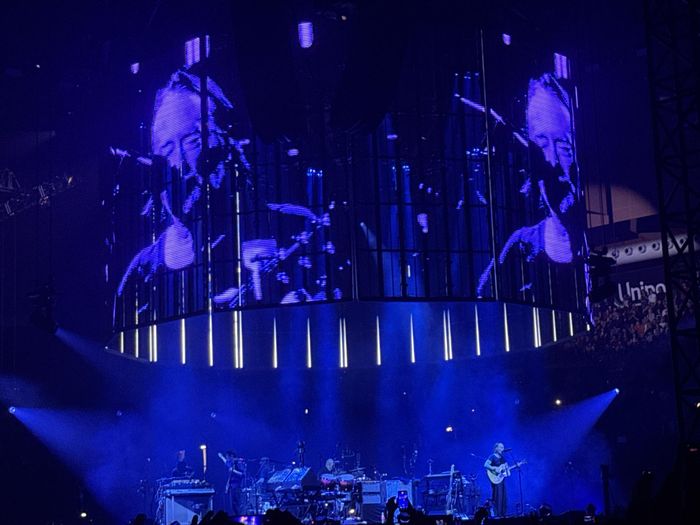
The ending it wraps around itself like a final rotation. After a short pause, for “Fake plastic trees” the structure closes again, the band gathers inside its own luminous shell and then reopens it in a moment of collective singing while cell phone flashlights turn on. “Let’s down” unleashes euphoria from the first notes, “Paranoid android” fills the room with sharp lines, “You and whose army” spreads like a quiet provocation, “A wolf at the door” sharpens the rhythmic edges, “Just” opens a straighter path, and “Karma Police” concludes everything with his formula of bewilderment and recognition. Yorke repeats: “For a minute there. I lost myself, I lost myself.” And really, at the end of a Radiohead concert, you get lost. To then find ourselves with more depthinside a place that does not ask for certainties, but rather the willingness to return to oneself with a different gaze. At the end, the band bids farewell in Italian with a “Thank you, good night!”. The exit of the spectators is therefore accompanied by the articles of the “Universal Declaration of Human Rights” that begin to scroll on the giant screens, starting from the first, the right to equality, to remind us that – in every form and every voice – we are all souls.
Here is the lineup for the first date in Bologna, November 14, 2025:
Planet Telex
2 + 2 = 5
Sit Down. Stand Up.
Bloom
Lucky
Ful Stop
The Gloaming
There There
No Surprises
Videotape
Weird Fishes/Arpeggios
Everything in Its Right Place
15 Steps
The National Anthem
Daydreaming
Subterranean Homesick Alien
Bodysnatchers
Idioteque
BIS
Fake Plastic Trees
Let Down
Paranoid Android
You and Whose Army?
A Wolf at the Door
Just
Karma Police