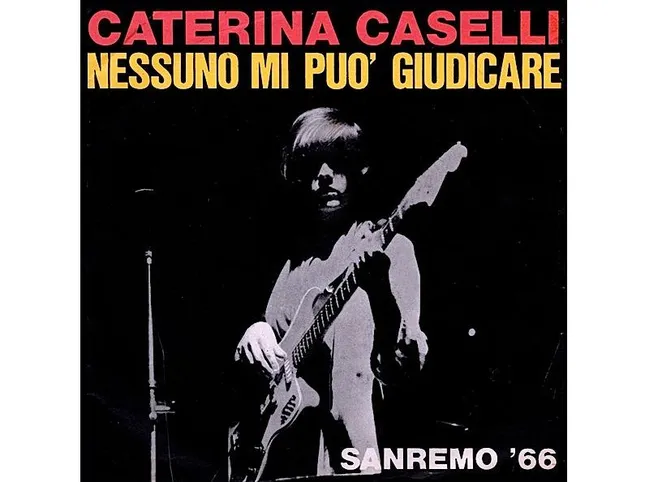
Sanremo 60 years ago: “No one can judge me” by Caterina Caselli
“No one can judge me” – Second place
Caterina Caselli / Gene Pitney – Sanremo 1966
Authors: Daniele Pace, Mario Panzeri, Luciano Beretta, Miki Del Prete
It happens that a song is intended for an interpreter and that fate decides to have a hand in it. The world of pop music is full of these stories, of crossroads and sliding doors that end up favoring careers and stopping others. The story of “Nobody can judge me”, however, it is unique in its kind, because it does not admit losers, but only winners. We are in the mid-sixties, music had become a real phenomenon of customs, as well as mass. This is demonstrated by the spread of trendy venues such as the Piper, considered by many to be the temple of a new current destined to lay the foundations of disco music, a cult that would above all characterize the following decade. The legendary Roman club was not a simple dance hall, but the representation of a dream that drew charm, inspiration and transgression from the cultural revolutions of Swinging London, Greenwich Village in Manhattan and the Summer of Love in San Francisco. Many Italian kids followed carefully what all‘abroad was created and subverted, becoming passionate about various issues, from sexual freedom to‘evolution of customs and all‘advent of the miniskirt. While the world was divided between the Beatles and the Rolling Stones, a real social rebellion was taking place. Songs, thus, became a vehicle for expressing opinions. They called it the beat generation. In this context, the sixteenth edition of the Festival was staged, which saw Domenico Modugno and Gigliola Cinquetti triumph, fourth title for him and second for her, on the notes of “God how I love you”, a proposal that at that precise historical moment sounded rather traditional. On the second step of the podium was Caterina Caselli, renamed “helmet d‘gold” from the press. The young woman rose to prominence with “Nobody can judge me”, initially intended for Adriano Celentano, who preferred to enter the race, again in 1966, with “The boy from Gluck street”.
«I listened for the first time “No one can judge me” and I exclaimed: “I’m not even dead, I’m playing a tango!” Coming from‘Emilia Romagna, that genre was associated purely with music for adults, such as the waltz and the mazurka. Ivo Callegari, my producer, intervened and promised me that the‘we would have changed, according to the musical trends that we liked in that period. We were all crazy about Anglo-Saxon music, the Beatles and the Rolling Stones. With the new arrangement, we showed up at a famous club in Bologna, the Junior Club, frequented by young university students. Behind closed doors we rehearsed the piece and it was a huge success, the kids went crazy and told me “go‘ to Sanremo and kill!'”. Then, once I was convinced, I learned that that song had been made for Adriano Celentano and that, luckily for me, he rejected it, becauseand he had written one of his most beautiful pieces, “The boy from via Gluck”. I arrived at Sanremo quite calm, sure of the persuasive power of the song. It won first place “God how I love you” by Domenico Modugno and Gigliola Cinquetti, but mine “No one can judge me” he won morally‘edition. I returned home, to the one I was at‘At the beginning it seemed like life as before. A few days later I happened upon a record shop, and tried to see if there was‘it was my 45, but I couldn’t find it. So I went to another and then another, but nothing. I called CGD, asking why my records hadn’t arrived in Modena. They answered me: “Miss, they are sold out throughout Italy. We are printing his records even at night”. There I realized that something had changed. But, beyond the more than satisfactory sales, what he gave me and continues to give me “No one can judge me” is there‘pride in having sung, in a moment of great transformation in our country, a phrase like “everyone has the right to live as they can.” “No one can judge me” has become a real anthem of freedom and redemption, a universal and always current manifesto. Yesterday as today and, hopefully, also in the future.”
Caterina Caselli
It is the story of a song that has become a sort of anthem for a generation looking for new myths and new rituals to share: between miniskirts, increasingly longer hair and a‘irrepressible desire to live without constraints. It was Caterina Caselli who gave her voice and body, who on the Casino stage wiggled with her hands and arms in time with the shake, sending out revolutionary messages. “Everyone has the right to live as they can,” is a verse from‘very powerful impact, especially if pronounced from a pulpit where, until that moment, the word love had always and only rhymed with heart. The authors, Daniele Pace, Mario Panzeri, Luciano Beretta and Miki Del Prete, had created this piece for Celentano, with the‘intent on placing it in the tango trend, a terrain already explored by Adriano with “Thank you, please, excuse me.” “The sun has gone out”. In the change of interpreter, however, we witnessed not only the passage from retro to modern, but also and above all a radical change in perspective. The text passed from masculine to feminine, and the protagonist became an emancipated woman, capable of betraying, of taking over the reins of the relationship and of being able to choose between a partner and‘other. A claim that greatly anticipated feminist themes, in a‘Deeply patriarchal Italy. The protesting power of the song did not end in the 1960s. THE‘proud affirmation of‘el. individuality‘indifference to judgment continue to embody the most authentic sense of freedom, which, although it does not rhyme with heart and love, remains a word to be honored and protected.
This text is taken, courtesy of the authors and the publisher, from “Sanremo e la classification del tempo”, by Nico Donvito and Marco Rettani (Azzurra Music, 324 pages – book + CD -, €29.90)