Paul Simon is a miniaturist
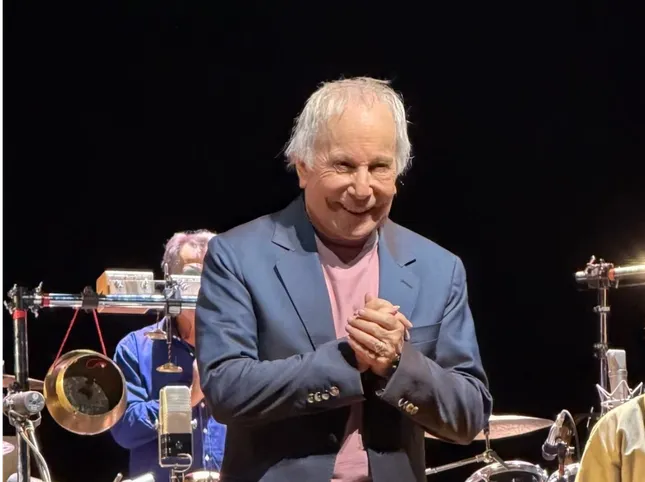
There are careers that are measured in records sold, others that are measured in kilometers traveled between different countries and cultures. Thursday 9 April, in Prague, Paul Simon he didn’t go on stage just to sing, but to retrace the sound atlas he has designed in over sixty years of music. At 84 years old, with the bright eyes of a debutant and the touch of the master, Simon has transformed the Congress Center of the Czech capital into a crossroads of times and places: from the alleys of Manhattan to the pulsations of Johannesburg. The last, great lesson from an anthropologist of melody.
The power of his dignity
Few artists know how to grow old with the dignity – intellectual, emotional, professional – of Paul Simon. Unlike many of his peers, he has made peace with ageit doesn’t force the higher registers and (by God) it doesn’t go out of its way to re-propose the songs in the original keys, where physically impossible; the voice moves in a limited range, but rich in nuance and controlled vibrato. In any case, a masterpiece remains a masterpiece even an octave lower. Accompanied by a band that sounds like a chamber orchestra lent to pop rock, made up of 11 (!) elements, including the singer-songwriter and wife Edie BrickellSimon dismantles and reassembles his classics, giving them new nuances of jazz, folk and world music. An elegant farewell, devoid of rhetoric, where formal perfection leaves room, song after song, for pure and unexpected emotion.
Especially at the beginning, when the entire 33 minutes of “Seven Psalms” (2023), the latest studio album: an acoustic performance to be performed in its entirety, without breaks, to which the singer-songwriter from Newark is evidently very spiritually attached. A change compared to the first farewell tour, the “Farewell tour” of 2018, after which the live appearances became rarer also due to the almost total loss of hearing in his left ear. Simon is a sound perfectionisttherefore, if he gives a concert, everything must be taken care of down to the smallest detail. In fact, in the long pause after “Seven Psalms”, a member of the crew goes on stage to measure the height of the microphones with a tape measure. And, coincidentally, the acoustics in Prague are perfect.
The precision of a miniaturist
In these latest, exclusive dates (which do not involve Italy), Simon has given up the role of the world-famous singer-songwriter to take on those of the miniaturist. Despite a particularly crowded stage, the timbric transparency is absolute. His ensemble is hybrid: it blends folk sensitivity with the rigor of classical music. There is no trace of redundant drums, on the contrary: the rhythm section is entrusted almost entirely to tonal percussion, that is, to those percussions which, unlike those with an indeterminate sound such as snare drums or cymbals, are capable of emitting notes of a defined and measurable height, to work on the medium frequencies without overpowering the voice, now thinner but equally effective.
The overall volume of the concert is significantly lower than current standards. AND an invitation to analytical listeningwhere every note shines with clarity. The guitar fingerstyle by Simon – still technically impeccable and influenced by Delta blues and the cultured music of the twentieth century – becomes the narrative pivot. His touch on the strings is dry, without frills. During solo passages, that unique ability to blend independent bass lines and melodic counterpoints emerges. Historical pieces like “Graceland” or “Me and Julio Down by the Schoolyard” are deconstructed: the more extreme worldbeat impulse disappears in favor of minimalist arrangements.
AND a lesson in humility. He doesn’t seek the easy applause of sing alongbut imposes an almost sacred listening discipline. It’s proof that music doesn’t need decibels to be devastating, it is the courage of subtraction. Simon’s vulnerability is also his strength: in front of that voice that at times cracks and then finds perfect intonation, one is moved. Especially in the grand finale.
The perfect farewell
After two hours of complex rhythms, polyphonies and stories from Queens or South Africa, only him remains on the Prague stage. Without the protection of his monumental band, Paul Simon appears for what he is today: a craftsman of the word who has crossed time, surviving the distortions of a world that never deserved him. Hidden under the visor of his baseball cap, he picks up his acoustic guitar and gives us a version of “The Sound of Silence“to be eternalized throughout the centuries.
The silence in the room is total and profound. In the heart of his farewell tour, one of the giants of international songwriting chooses to say goodbye without special effects, returning to where it all began, in 1964, in the dark bathroom of his home. Alone on stage, in the dim light, Simon gives the audience the last, touching caress of a career that has said it all. Because despite the world tours and the Grammys, every revolution starts from there: from a man, from an idea and from the courage to speak to silence. Not a sad farewell, in fact, the opposite: the power of his stature overwhelms you like a speeding locomotive.
Paul Simon says goodbye to the spotlight, letting the music, not the show, say the last word. A concert that demonstrates how, in the final phase of life, the sound of silence is no longer a youthful oxymoron, but a spiritual condition achieved.