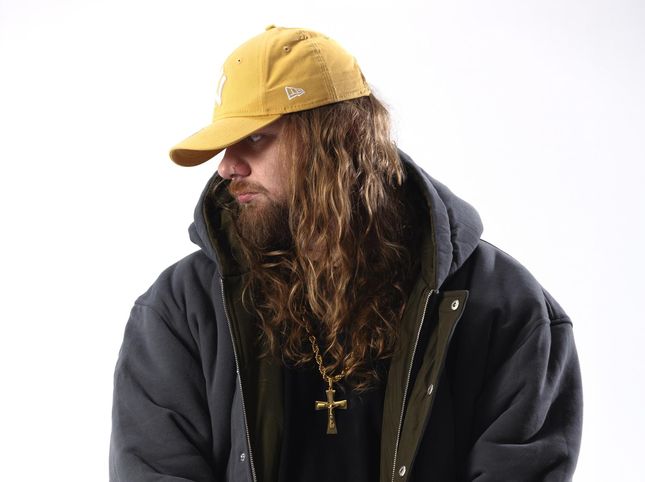
Nitro: “The best people know how to say ‘sorry’ and ‘thank you’”
An album full of anxiety and truth, between sharp bars and dystopian images. An act of love towards rap and a denunciation against the aesthetic drift that suffocates the scene, but also a finger pointed at himself. Nitro with “Incubi”, released two years after “Outsider”, spares no one and like “Travis Barker” in “Taxi Driver” he even points a gun to his head while looking in the mirror. The project is psychedelic, full of different sounds, with an underground flavour, and with guests Silent Bob, Sally Cruz, 22simba, Niky Savage, Madman, Nerone, Tormento and Salmo. “The dreams ended, I realized the nightmares” is not only the closing of the verse of “Story of an artist”, but also the beginning of an investigation into a climb between success and emptiness.
The origins of this project?
Let’s say it was born from a period of radical change, including personal change. It’s my most psychedelic work and it started when I started looking for more. It was a huge influence on the fact that, two years ago, I bought a camper and started getting away when I needed to. I wrote practically three quarters of the album in the camper, in front of a lake. I started writing “Escape”, which in my opinion anticipates a lot of what happened: it’s a bit of an escape from oneself, but not to erase what one has been, but rather to look at oneself from the outside and better understand how to face the next steps with more awareness. So here, I escaped from myself a bit, I lost myself to find myself.
The “Are nightmares also a form of awakening from an anesthetized reality?
Yes, a form of shock therapy, that might be the right term. In the sense that, sometimes, I write in strong colours, but I don’t do it with the intent to shock. It is not provocation as an end in itself: it is rather a way to stimulate the critical spirit, to instill doubts, to give rise to questions. To make people question even certainties. I have never liked the concept of “imposed order”. I’m more interested in chaos, in turning things upside down. And this album, in my opinion, reflects a lot of my way of thinking.
In “Story of an artist” you open like a book: you talk about alcoholism, therapy and depression, without sparing yourself.
In my opinion, my generation owes a lot to Eminem for this approach. It’s a bit like the tactic of “8 Mile”, in the last challenge: I insult myself so much that in the end you can’t say anything to me anymore, because no one can be meaner to me than I am myself. For me it’s a way to exorcise the things that hurt me. It’s like when you confide a secret that weighs you down to a friend: even if it risks changing the way he looks at you, telling him is liberating, it takes a burden off your shoulders. For me, writing on paper is this: saying things, putting them out. In that track I can say “I lowered my defenses”. Now everyone knows those things. And this, for me, is a starting point: recognizing the problem is always the first step to solving it.
Have you thought about whether to do it or not?
When you are emerging you have battles to win. Then when you grow up and people for whom “you’re fine, you’re fine” etc. you have to make them understand that maybe it’s not really like that, it’s not simple. Many artists who have built their credibility on being infallible would collapse in the face of such an openness, while I try to make it my strong point.
Do you think songs should have a recipient?
More than thinking about who I’m writing to, I think about what moment I’m writing for. Maybe I think: this song must reach a person who in the morning, waiting for the bus to go to school, must get excited or angry. Or he must speak to those who have moved city and find themselves thinking back to their provincial town, from which they had to leave. I think a lot about moments, because songs are moments more than letters dedicated to someone. Often a piece doesn’t strike you because you haven’t experienced that moment yet, but when you experience it and listen to it again, it sticks to you. Here, I started to reflect on songs as moments, not as open letters to someone.
The album is musically very varied: how did you work?
From a sound point of view I made music telling myself: “every day I do what inspires me”. Because in the past, even in previous records, sometimes I tried to force the pieces, like: “I have to close that song over there, which talks about that stuff over there”. And so it almost became a mechanical job. For this album, however, I started working immediately as soon as “Outsider” was released. I took more time. I made music doing, every day, what I felt like. I listened to Korn for two weeks, for example, and “Elon Musk” came out, a song that I particularly care about.
How do you come to choose?
Sixty, seventy pieces came out, then I started skimming. I put many things aside for the future, others I left out because it wasn’t the right time. Let’s say that I have acquired a greater awareness: I no longer feel the need to say everything in a single album. Because if in every project you have to say everything, then in the next one you have nothing left to say.
There are several bars against obsessing over numbers too.
There are records that sell little at first, but after years they change the culture. Or records that don’t sell one hundred thousand copies the first week, but stay in the charts for six years. So how do we evaluate those numbers? We can’t say they are worth less.
And what do you think of your successful pieces?
The piece that makes me stream the most on a record is not a piece to be repeated: it is the Trojan horse, the one that opens the door to the mass audience, to also make it reach the other songs that perhaps are not designed for that type of audience. The fact that a piece like “Pleasantville” then allows me to make those coming from there listen to “Suicidol”, with verses of forty, sixty bars, without a chorus, is an achievement for me.
So where do you fit in?
My goal is to have mainstream numbers, but remain, paradoxically, a very underground rapper. I don’t bend to the rules of easy refrains or standard languages. Doing it like this, in my way, is rewarding. If, however, to be “number one” I have to become like others, or become what others want, then I am no longer number one: because I had to give up myself to be so.
The Trojan Horse of “Nightmares”?
I would say that a Trojan horse is the piece with Salmo and Sally Cruz (Of the death of love, ed.)or “Without you”. It’s a very “funny” song, almost summery, and it was born like this, in one afternoon. It wasn’t meant to be a single, but it became one. I was in the studio, listening to a lot of Bloodhound Gang that week. As a child I loved them, because they mixed genres: each record had three or four different sounds, they went from electronic to punk. I also really liked the singer’s vocal approach: he almost seems like a commentator. “Without you” talks about a bad thing, but with light sentences. When you say something sad with a smile it’s even scarier.
The songs you hope will be heard?
“Vipers”, “Elon Musk”, “Limousine”, “Time”. More experimental songs, or which deviate from the “typical sound” of Nitro, but which still convey a strong message. Because even where there is no Nitro on a sonic level, there is one hundred percent Nitro on a textual level.
“Nightmares” also talks about self-love. Is the only way to make peace with yourself is to accept yourself?
Absolutely. And in my opinion this is also evident in the cover, which is very symbolic. I used a hill because, as I said, it’s a reference to Cypress Hill. For me it represents a bit of my climb, the path I took from the beginning. At the top there is a tree, which represents life, achievement, the goal, but also rest after hard work: that moment when you stop and can finally look back. However, the hill is dotted with eyes, because my climb was not a solitary climb: it was observed by everyone. But the reconciliation, on the cover, is there: the panorama seems like a nightmare, but my position is not. I am not troubled, I am lying down, serene, dreaming. This represents the message well: you don’t have to hate your dark sides or hate yourself for having them, but accept them and try to smooth them out, to make them constructive instead of destructive.
In “I hate rap” you say that if rap isn’t shining at the moment it’s “also our fault”. Do you point the finger at yourself?
In my opinion there is no man more man than he who has the courage to say “sorry” and “thank you”. Knowing how to admit your mistakes also gives more value to when you then tell your truths, at least as I see it. So yes, it is right to make a mea culpa. I asked myself: Was my rise in the scene really about helping others, about being part of a culture where everyone can have their moment to shine? Or did I let myself be caged by my ego, wanting to always and only be the center of attention? This is a question many artists should ask themselves. Sometimes you support a rapper not because you think he’s really cool, but because it’s convenient for you. Another big mistake was judging younger kids instead of trying to understand them. Instead of asking “why do you do this?”, “why don’t you respect this rule?”, we should have become curious, dialogue, not judge from a distance.
Are you referring to the 2016 generation?
I understand the “trap generation” very well. We reached a point of technical exasperation, where at the peak there were me, Salmo, Gemitaiz, MadMan, Nayt, and others: all “pro-rappers”, as they call them in America, that is, tightrope walkers of the word, of metrics. Once they reached that extreme, the new rappers had to break that system to disrupt, because if they tried to do what we did, they couldn’t overcome it. So I understand them: they had to change the rules to exist. The problem is that, if there had been more intergenerational dialogue, instead of divisions and judgements, today there wouldn’t be this air of crisis where everything is polarised, where only two factions exist: either you rap “like this” or you rap “like that”. But the truth is, I want to do it all. I am someone who has earned my place and truly loves this culture. I don’t do cultural appropriation: if I want to make a reggaeton piece, I ask a reggaeton artist to recommend his favorite records, I study that culture, I try to understand it and understand what contribution I can make. I don’t use it as a t-shirt that you put on today and take off tomorrow.
How to conclude?
That if we had treated all this more like a culture and less like something “disposable”, today we wouldn’t find ourselves in this dullness where we are surprised if an artist like me says things that, in reality, everyone thinks. I didn’t say anything revolutionary, they are common thoughts, it’s just that no one has the courage to say them. And when a piece like this “cause a sensation”, it means two things: that I had the courage to expose them, but also that there is a systemic problem, because everyone else doesn’t do it.