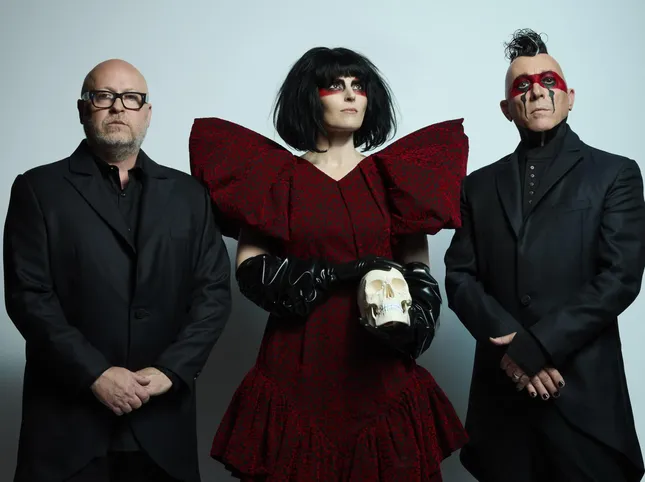
Maynard James Keenan: “From Italian grandparents, I am rebellious by nature”
February 6 i Puscifer they return with “Normal isn’t”, a new album that arrives more than five years after “Existential reckoning” (here is our review) and which is part of a further chapter of a project now recognizable for its expressive freedom, conceptual tension and continuous mutation. The band’s fifth work is a record that looks back without nostalgia, recovering post-punk and gothic suggestions linked to the first musical experiences of its members, but which at the same time sinks into darker and more restless territories, where guitar, bass and drums intertwine with electronics and experimentation. “That punk sensibility, that way of looking at the world sideways and constantly questioning what’s happening, is an integral part of my DNA. I’m rebellious by nature,” he says Maynard James Keenan to Rockol by telephoneunderlining how this return to the origins is less an operation of style and more a question of identity, almost genetic. Around the nucleus composed of Keenan, Mat Mitchell and Carina Round, the album is enriched by the contribution of Greg Edwards on bass, Gunnar Olsen and Sarah Jones on drums, as well as guests such as Tony Levin, Danny Carey and Ian Ross, called upon to further strengthen an already dense and layered sound narrative.
Central and transversal figure of contemporary music, Maynard James Keenan arrives at “Normal isn’t” together with Puscifer after years in which his artistic activity has never stopped questioning the present, divided between Toolsreturned to Italy in 2024, and the A Perfect Circleexpected in our country for a concert on 13 June 2026 at the Ferrara Summer Festival. In this conversation, the artist reflects on the very concept of normality, on the urgency of observing and describing a world that appears increasingly unbalanced, and on the role of music as a space for interpretation, not pre-packaged responses. “Our job is to observe and then interpret through our eyes, through our experiences,” he explains Keenanclarifying how “Normal isn’t” does not seek solutions, but stages the conflict, leaving the listener with the task and responsibility of making sense of it.
What sensations, emotions, expectations or fears accompany the release of Puscifer’s new album, “Normal isn’t”?
Maynard James Keenan: I’m excited. And un a little nervous. We spent a lot of time making this record. It’s a bit like seeing a baby being born. I know it’s not exactly the same thing, but the emotions are similar – not necessarily the sensation itself, of course.
Our last conversation was for “Existential reckoning” in 2020. What happened in the meantime? When did you start working on this new album and how did it go?
Maynard James Keenan: Some of the work started immediately after the release of “Existential reckoning”: we went straight back to work, making small pieces, exchanging files and folders with various ideas. Then the tours started again, there were new breaks, but when we finally managed to take “Existential reckoning” on tour, we started working in a more focused way. Obviously a lot has happened in recent years. And it seemed like a good time to write about it.
Thinking about the title, “Normal isn’t”, it sounds direct but at the same time open. What does “normal” mean to you today, and why with this title did it seem important to you to deny it rather than define it?
Maynard James Keenan: I am 61 years old, so I have experienced many things, I have seen and felt the world go through changes. The ebbs and flows, the ebbs and flows of progress, of regression: all these dynamics. And I can confidently say that the current situation is something new. Maybe not new to someone who lived a hundred years ago. But it’s new to us. And certain behaviors, the way we treat each other: I don’t think they’re normal.
Announcing the new album, you said: “We’re definitely going back to our early influences. It’s where goth meets punk. That’s where we’re coming from.” Is it more of a musical reference or rather a mentality, an attitude towards structure, urgency and expression?
Maynard James Keenan: Both.
I come from marginalized people. It’s always been like this for me, since childhood: I’ve always felt like an outsider. That punk sensibility, that way of looking at the world sideways and constantly questioning what’s happening, is an integral part of my DNA. I am rebellious by nature.
My great-grandmother, my grandmother, my great-grandfather, my great-great-grandfather and other relatives come from Val di Susa, where Venaus is, where they continually try to pass the high-speed railway. So we literally lie down in the middle of the road to stop that train from passing. This is my DNA. We are rebels by nature. We protest.
Listening to “Normal isn’t”, several passages of the song lyrics are striking for their messages. On a narrative level, how does the new album reflect the historical moment we are experiencing? From what type of observation was this album born?
Maynard James Keenan: It’s hard for me to change my process, because I’ve been doing my job for a long time. I believe our job is to observe and then interpret through our eyes, through our experiences. And then bring all this back in the best way we know how. For me it’s through food, wine, music, words. I don’t really paint. I draw a little, but my art comes from food, wine and songs. And if the situations we observe degenerate in strange and unexpected ways, as an artist you have to tell them. You have to talk about it. It’s part of what we should do. It’s my job.
Looking at the world, for this new album, what elements did you focus on most while writing?
Maynard James Keenan: A lot of it has to do with balance. You focus on the technical balance within the piece as a piece of music. You balance the emotion and the story, and how it all fits together in the song. But you also focus on the balance of the imbalance you are observing. In many cases, you start from the conflict. Like in books or stories: there is the initial setup, then you introduce the conflict, and finally its resolution. In these songs, we’re not necessarily offering a solution. We are highlighting the conflict and asking listeners to reflect and find solutions.
When listening to this album, what do you hope audiences take away? Is there a message, something you would like to receive?
Maynard James Keenan: I would not know. I don’t want to tell people how to think or what to do. But if these songs inspire someone to make someone else’s day better, then that’s okay. I have an eleven-year-old daughter and one of the things we try to teach her – and it’s difficult at that age, because they don’t want to feel anything, they just want to do what they like – is the idea of leaving things better than you found them. And that doesn’t mean, you know, don’t kill people. It means finding ways forward through diplomacy. At home, outside the home, in interpersonal relationships and globally.
Speaking instead of the music of this album, from the bass lines that vigorously open “Thrust”, to the drums and electronic patterns of songs like “Self evident”, when listening you get the feeling that “Normal isn’t” is more immediate than other Puscifer records. Was there a conscious decision about the musical direction to take? And how did this choice influence the sound and structure of the album?
Maynard James Keenan: We are not very objective about what influenced us and how this emerged. But I think a lot about the live show, because we never want to repeat ourselves. Some artists do that, they regurgitate the same thing over and over again because it worked once before. But Puscifer sit back, listen to what they’ve done, and challenge themselves to go in a different direction each time. There is no album that sounds like another. With “Existential reckoning” there was a lot of landscape, a lot of cinematic dimension. That’s why it was perfect to do our first pay-per-view concert outdoors, in Arcosanti, in the middle of the Arizona desert. It made sense for those atmospheres.
You chose to present “Normal isn’t” live to a small audience months ago, and then turn that experience into a concert film. What do the stage and community space say about the way you think music should circulate and be experienced today?
Maynard James Keenan: The live show was filmed in the old Stock Exchange in Downtown Los Angeles, the building is actually called “The Exchange”. And if you think about the chaos, the energy of the stock market, of the brokers, of the trading… and then you connect it to downtown Los Angeles, which is constantly going through strange changes, very dynamic, safe and then unsafe… It’s not that different from walking around the alleys of Milan or Rome. There are places you don’t want to end up, especially at night. Well, that film reflects the music. It was the perfect environment to present this album, because in a way it’s very full, not stressful, but immediate.
Considering your “no phones” policy at concerts: what is your idea of a musical experience today?
Maynard James Keenan: When we put on a show, especially with all my bands, there is an introduction.
It’s not people who go on stage and regurgitate songs at the audience. And we don’t have that kind of vampire ego where, you know, Taylor Swift wants you to film her concerts because she can’t get enough of herself. That’s not it. Our shows are a presentation, like a theater show, like an opera, like an orchestra and, in a way, like a funeral. So put the fucking phone away.
This is inappropriate behavior for this type of experience. And then you annoy the person behind you. You’re ruining someone else’s experience by forcing them to look at your phone for something that will never actually be caught. This experience, what you are experiencing at that moment, will not be captured. The sensation you experience will not be captured by your iPhone. At the end of the concert, however, we let you film the last two songs, so you have a souvenir of the evening. But otherwise, stop annoying those behind you. It’s selfish and disrespectful.