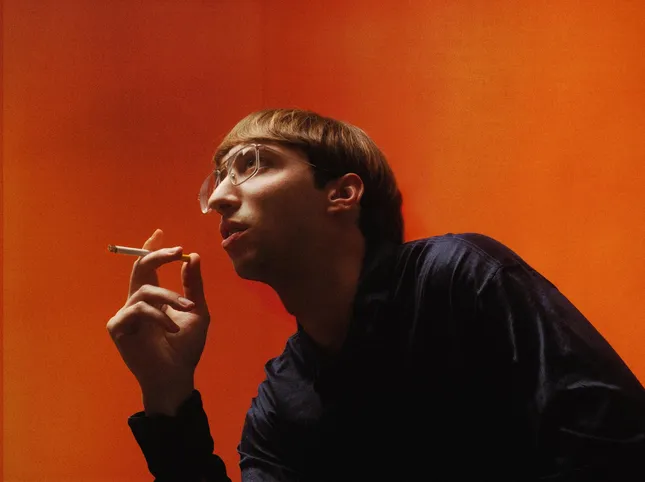
Lumiero, a light in the darkness of musical homologation
When a new album comes out in Italy, in 2025, you already know more or less what you will encounter. The rankings speak for themselves, the genres that are popular are there for everyone to see – and hear. The lyrics hardly surprise, the instruments are almost always sacrificed in favor of artificial bases and the music is the victim of that general flattening that has been affecting it for some years now. Then comes the new album by Lumiero. On the contrary, “Lumiero’s first great album”, produced by Marquis: the time machine of an artist who finds happiness in the Sixties, in the music played, with real musicians, ranging from chanson of the past to auteur pop up to certain jazz atmospheres. And you wonder: what space-time loop did he pop out of?
Lumiero, where did you come from? Why this choice back in 2025?
I’ll be honest: it’s not a particularly constructed idea. It’s more of a need. It is a work born from my passion for this type of sound, this way of singing, until at a certain point I found myself inside the vortex of research for this type of songs. I realized that it is the genre that, among the various types of music, most reflects my idea of happiness, which is a little hidden, has no boundaries, on the contrary, it is as if it were an idea, an impressionist painting, without well-defined lines. The sense of lightness of those years has always guided me in doing things, it’s a type of music that makes me feel very good. So why not recover a tradition that moves me so much inside every time I listen to it?
Do you think it could also be a form of rejection of the music of the present?
Perhaps there is also a sort of unconscious response to the flatness that I actually find around a bit lately; fortunately not totally, in the sense that there is a large undergrowth of emerging music that is really reshuffling the cards, but mine is certainly also an unconscious response to this feeling of flatness that I felt around me on a musical level.
Your album has an almost orchestral structure. In the next live shows do you imagine yourself with a well-fed band behind you?
Good question. So far I have carried these songs around, still in the form of unreleased songs, mostly with a reduced lineup, i.e. guitar and vocals, sometimes with two guitars and vocals. Only once did I happen to bring it in full bandand I must say that it was extremely fun and very beautiful, because you manage to convey the complexity of sounds behind it. So I would love to and it will definitely happen if there is an opportunity. For now the accompaniment has been functional in giving light to the voice, which still has a fairly main place in the song, as was once customary; but the idea is to go in that direction there, also adding percussion lines. In all of this I can only thank the musicians who have accompanied me so far in these first live experiences – and all the musicians who played on the album. It’s all played, instrumental music, which therefore has within it not only my and Marquis’ vision, but also all the input on both a technical and artistic level of the people who played it.
Lumiero. Where did this stage name come from?
Some time ago, when I began to take my first steps in writing songs and producing music, I was looking for a name that spoke about me, and I found this image in a French name, Lumière, which means light. I found a sort of union between two worlds: on the one hand that of knowledge, as a form of both individual and collective maturation; on the other, a figure that brought and brought back a bit of romance and passion to the centre. Then I discovered that, if I’m not mistaken, in Salento there is a similar word: lumieruthat is, wine. Since then it has also acquired this third meaning which, I must say, suits me very well, because I like wine very much.
You go back to the music of the past because it makes you feel good. Is there anyone in particular who is – or was – important to your music?
There isn’t a real one referenceso to speak. It was a research that ranged throughout that world without ever concentrating or fixating too much on a certain author or a certain singer, so perhaps there isn’t one name that stands out more than others. There are certainly favorite authors and artists: among all, within the Genoese school, Gino Paoli, who has a very strong influence on me, especially on an authorial level. Instead, in terms of singing models, type of interpretation, I think that the two who inspired me the most were Tony Renis and, in the female world, Mina. But there is a whole planet of equally important names, from Caterina Caselli to Umberto Bindi to Luigi Tenco. They are giant models, obviously, but perhaps for this reason they also give a little space to the dream.
How would you describe your album to those who haven’t listened to it yet?
I don’t know if I could describe it in an overall way, because it isn’t born like concept and it is not built as such. It becomes so in this promised provocation which is a bit like the title itself: it’s meant to be a slightly divisive record, right? Both in the content and in the container. On the one hand he wants to please, because this is also right; on the other hand, however, he also wants to create division, he wants to be criticized, to stimulate reflections on music – and on today’s music in particular. In my head it is a set of songs that in their singularity meant different things to me. It’s a record that talks about love, but does so with disillusionment. And, despite the musical genre, for me it is also a fairly contemporary album, especially on an authorial level.
Davide Van De Sfroos always dedicates the last song of each of his albums to the wind. In yours, the wind appears in two titles. Does it have a particular meaning for you too or is it random?
Both my “Semi nel vento” and the cover of “Io sono il vento” by Marino Marini mention the wind and it is not accidental. In the album – and in general in my writing – natural elements often emerge. Indeed there are many references within my songs to elements that are part of the natural world: the river, the wind, are elements that I find in my imagination, where nature has a fairly strong relevance.
Besides nature, what inspires you in everyday life? What makes your songs come about?
The poetic nature of things. Even those that may seem more normal, more everyday, become strong for me when a bit of poetry is inserted into these images. Of course, love is a central focus, which however does not end in itself in love, but is built with a lot of other lateral images which in this narrative acquire poetic value.
We talked about the big names who inspired you. But thinking about the present, is there any artist you dream of collaborating with?
Maybe it’s obvious, but the idea of being able to collaborate with an artist like Andrea Laszlo De Simone, who fully fits into this trend of revival of this type of music, would really excite me. Then, coming from the urban world, I would like to find a way to set up collaborations with someone who comes from the world of rap. It would be a great challenge that I would really enjoy.
Do you like Sanremo? Would you see each other?
For me, but I think it is a bit for everyone, it is the temple of Italian music, considering all the historicity that is in that name, in that stage, in that place. And for me it would obviously be a dream, especially because I have as a reference the great editions of the past, in which the greatest pens and voices of Italian music graced that stage. So from that point of view it would be a huge honor for me, a dream that I hope will come true sooner or later.
Plans for the future?
Lots of songs, lots of new and increasingly challenging music, both from a singing and above all authorial point of view. It’s a great challenge to be able to tell more and more, to bring out the themes that are closest to my heart and also to be able to untangle myself with my own music, which I have discovered to be – especially in recent times – a great tool for self-knowledge. The goal is to continue making music, music that makes me feel good and that allows me to get to know myself more and more.
What would you like someone who listens to you for the first time to get away with you?
I would probably choose emotion. Being able to ensure that a person who listens to me for the first time is able to feel the emotion behind each song, that vibration that accompanied me in building and creating these songs. Going back to what we said at the beginning, I would like lightness to arrive too, or that protohappiness that was much stronger and possible at the time of the economic boom. It would be wonderful to be able to make people feel the same sensations with my music that I feel when I listen to the music of those years, while updating it.