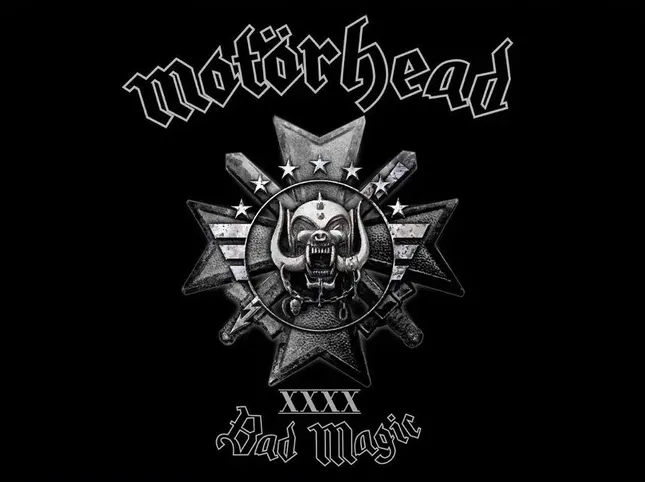
Lemmy and Motörhead’s latest album, timeless rock and roll
“Victory or die!“. Lemmy’s voice, as if filtered through a club saturated with smoke and Jack Daniel’s, breaks the silence. Rough and irreducible sounds, driven by the impulse of his bass, hit at full speed, like a monolith of decades of rock history. It’s the impact of “Bad magic”, Motörhead’s latest studio album released on August 28, 2015as the band embarked on a tour to celebrate the fortieth anniversary of their sonic legend. Today, December 28, on the occasion of the tenth anniversary of the passing of the iconic Motörhead frontman, Rockol dedicates a special to Lemmy Kilmister with a “mixtape” that collects some of the most significant tracks of his career (available at this link).
Recorded in Los Angeles under the production of Cameron Webb, “Bad magic” represents now a powerful summary of Motörhead’s historyof their musical philosophy and of Lemmy’s unique style, based on a bass that can be both rhythmic and melodic. As the frontman said in his last interview for “Guitar World”: “I was born to play bass, basically… very well (laughs). I was a mediocre guitarist, I couldn’t play lead, but I was a great rhythm guitarist. I have a sense of rhythm, it probably comes from there.”
The band, with Phil Campbell on guitars and Mikkey Dee on drums, continued on build your own songs as if they were livewith immediate riffs, tight grooves and a sound that seems out of time, capable of crossing eras without losing intensity. “Bad magic” begins with the urgency of “Victory or die”, followed by pieces like “Shoot out all of your lights” and “Evil eye”, in which the energy and power of the trio remain absolutely unmistakable. In the interview with “Guitar World to present “Bad magic”, the question was inevitable: “Many Motörhead songs have a direct rock & roll vibe, but they often credit you as the inventor of speed metal. Does it bother you?” This was Lemmy’s response:
“I know. It’s stupid. It happened because we had long hair. The mods had short hair, so the rockers had to have long hair. They labeled us heavy metal, but we’re hard rock – we’ve got a lot of blues in us.”
“Bad magic” was not only a return to the direct and genuine sound of Motörhead, but also an album that explores Lemmy’s most introspective dimensionas in the ballad “‘Till the end“, where the frontman alternates his hoarse voice with melodic bass lines, creating contrasts that bring out the depth of his unique style. And when the closing comes with “Sympathy for the devil”, the band does not try to imitate the Rolling Stones, but reinvents them, leaving its own mark. Twenty-two double albums, forty years of career and an immortal rock’n’roll lesson, “Bad magic” remains the sonic testament of a legend who, even today, never stops make the speakers vibrate.
The following is the review we published at that time Andrea Valentini.
After 40 years of an honored career, Motörhead are one of the most typical examples of rock brands: iconic logo, unmistakable sound, credibility in practice a priori (the hours of flight they have on their backs are objectively many, many). By virtue of this status they transcend the more brisk dynamics of the music biz so when they return with a record – and “Bad magic” is their twenty-second in the studio, for the record – the event is guaranteed. A bit like what happens with those writers of great best sellers like Stephen King.
So what kind of event is it? We don’t back down.
“Bad magic” is simply (necessarily?) a new Motörhead album, that is, an additional chapter to the saga that began in 1975. A saga that is now difficult to move and make surprising, but which pleases as it is – and does not require twists or twists.
It is no coincidence at all that the first sound to come out of the speakers is that of Lemmy’s sulfuric acid voice, which says: “Victory or die” – which is also the title of the opener, a tense, hard and violent mid tempo that immediately makes it clear that everything is in its place. Lemmy is back, shouting in our faces that his mission is to win or die. This is good, also in light of the health problems of the good Kilmister, who has struggled quite a bit in the last two years, worrying the fans.
All the following songs flow smoothly, for a listen that motörheadbangers will undoubtedly appreciate: the craft is all there, the band’s honor is held high, Cameron Webb’s production is expert, as per the manual… mission accomplished. Like it or not, these have always been Motörhead and the only possible option is to take a position on one side or the other of the barricade. Love them or not.
The result, therefore, is in line with the production of the last 20 (full) years of the band. As we well know, Lemmy’s classics have been forged for some time, let’s say between the second half of the Seventies and the second half of the Eighties… but – after all – no one buys an album of this type in search of new anthems and new manifesto pieces. That part of the work has already been done (very well). Now we are in a maintenance regime, so each new album is, in practice, a declaration of good health and – above all – a delicious excuse to play (and listen) live to the pieces that have made this group a legend.
The monolith has served its purpose, we can say… even if it is not exactly the evocative and fascinating object of “2001: A Space Odyssey”. Wanting to tease Lemmy a bit, we can say that the songwriting doesn’t give any big shocks, nor does it show noteworthy peaks of inspiration, settling on a good level, but slightly flat (after 22 albums the Motörhead-sound formula doesn’t offer too many loopholes). Then there’s that cameo by Brian May (who performs the solo on “The devil”), which doesn’t add or take away anything from the song, but is just a good selling point to be used in environments that aren’t necessarily metal. The same can be said for the cover of “Sympathy for the devil” by the Stones: fun, it may attract some non-fans or non-initiated… but in the end it’s a little too obvious, in fact we would expect it from a Motörhead tribute band, rather than from the originals.
In conclusion: it’s nice to know that Lemmy and his band are still there and always manage to be convincing with their metal-punk-hard-rock’n’roll, rather than pathetic; therefore “Bad magic” is a record that fans cannot ignore, if only to renew their support and loyalty to the band.