How to rewrite the rules of the concert, according to David Byrne
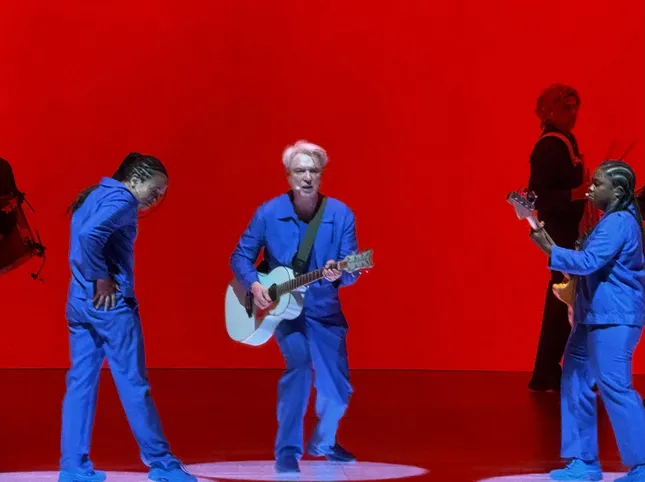
Thirteen people all dressed the same in blue bow towards the audience. David Byrne, who has just finished singing “Burning down the house”, takes a step back, a final farewell and the curtain closes.
Thus ends, in a theatrical way, the return of the former Talking Heads to Italy after eight years. And they really brought that theater down, as the last song said, with an enchanted, adoring audience on their feet dancing for a good part of the show. Even before the start you could feel the air of an evening not to be missed, with an audience of historic fans, artists and professionals (despite Sanremo just around the corner).
But defining what was seen on the stage of the Teatro degli Arcimboldi is difficult: a concert, a musical, an immersive show with a giant screen that envelops the performance, with the musicians moving freely, without fixed positions, following precise choreographies. After all, Byrne’s ballets have been legendary since well before TikTok, and it’s no surprise that a new generation has rediscovered him for the power of his songs and his stage presence.
From “American Utopia” to the immersive screen
This show focuses both on the latest “Who Is the Sky” and on the Talking Heads’ repertoire and is a direct offspring of the one brought out eight years ago with “American Utopia”, but it is the expanded and more spectacular version. Back then the space was defined by the metal wires that delimited the stage; today, in their place, there is a giant screen that continuously transforms the environment.
The show opens shortly after 8, with many seats still unoccupied, with Byrne singing “Heaven” for voice, keyboards and strings, with the earth seen from the lunar surface. Then, little by little, the rest of the band enters and the screen, from time to time, transforms the space: they become the streets and rooftops of New York, a forest during “This Must Be the Place”, a warehouse, the Italian balconies celebrating April 25th during the lockdown, a starry sky, the sea, a dressing room, his apartment, which as a song from the latest album says is his friend (“My apartment is my friend”).
Byrne moves with that apparent clumsiness that has actually become a choreographic signature over the years. In just under two hours he dismantles and reconstructs the scene for each song, the space is continuously reconfigured, while he divides his time between ballets and guitars. There is no fixed position on stage: even keyboard players and percussionists have instruments attached to their bodies, without wires or connections to a stable point. The twelve members of the band move continuously, performing one choreography after another, while the screen behind them expands or contracts the space.
And even the space of the audience changes, with the audience often getting up to dance even if they should be sitting down: before the concert it was Byrne himself, in a voice-over, who said that everyone was free to do what they wanted. And he had suggested limiting the use of phones for photos and videos, but it’s hard not to want to capture every moment. As well as being musically stupendous, it is a perfectly instagrammable concert, hyper-spectacular but in a way that is opposite to the prevailing gigantism of live performances. No special effects, just bodies in motion. David Byrne has rewritten the rules of the concert with a few ideas, as simple as they are effective.
Love and kindness
At a certain point Byrne talks about love and kindness as true forms of resistance. His music is, in the most ironic moments – he begins by saying “Hello, we are the Canadian luge team” – and in the most intense moments: in “Life During Wartime” images of anti-Trump marches appear, of people escaping ICE or protesting against conflicts.
It is one of the many Talking Heads songs in the setlist that sound very current in their sounds and ideas, and that trigger a reaction from the audience, in particular “This Must Be the Place”, which is the first to bring the audience to their feet, “Psycho Killer”, welcomed with a roar as soon as the bass line is recognised, or “Once in a Lifetime”, which closes the main set.
But even the new ones are no joke: “T-Shirt”, a single released after the album, is an ode to T-shirt activism (“Make America Gay Again”, “No King” or even “Milan Kicks Ass” are some of the writings that can be read on the screen), “Everybody’s Coming to My House” blends perfectly with the final “Burning Down the House”. There is also space for a cover of “Hard Times” by Paramore – a band that is also linked to Byrne through various covers and homages. There is no continuity between the Talking Heads songs and the solo ones: sound, movement and staging keep them in the same flow.
In the end, as well as a great concert, it is also a lesson on “How music works”, as one of his books says: on how it can work when you have great songs and ideas, simple but brilliant, to bring them on stage.
The ladder
Heaven
Everybody Laughs
And She Was
Strange Overtones
Houses In Motion
T-Shirts
Nothing But Flowers
This Must Be The Place
What Is The Reason For It?
Like Humans Do
Don’t Be Like That
Independence Day
Slippery People
Moisturizing Thing
My Apartment Is My Friend
Hard Times
Psycho Killer
Life During Wartime
Once In A Lifetime
Everybody’s Coming To My House
Burning Down The House