
How difficult is that Van Halen song
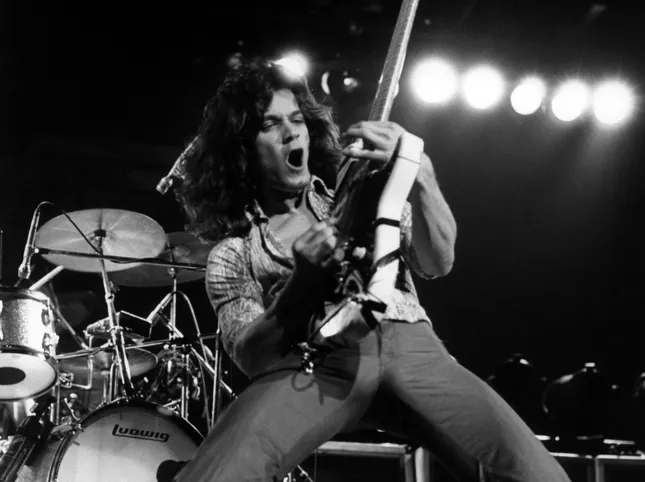
If we were to identify milestones in the history of the electric guitar, one of these would bear the name of Eddie Van Halen. Although he was not exactly the inventor of the tapping in an absolute sense – other jazz and prog guitarists had already experimented with it in rudimentary forms – Eddie transformed it from a technical curiosity to a complete and mass phenomenon. Everyone (or almost everyone) cites “Eruption” (1978) as an example: it fits, it is undoubtedly the most famous. But it’s not in that song that you fully understand how difficult it is to sound like EVH.
What is the tapping
For those who don’t know, the tapping consists of using both hands on the neck of the guitar: the left hand presses the notes as in the traditional technique, while the right hand “plugs” the neck to produce new notes with speed and fluidity impossible to obtain with the left hand alone. This approach opens up a world of tied passages, instant arpeggios, and note combinations that seem to come from two guitars at once.
The fundamental cycle of tapping by Van Halen can be expressed as a fluid sequence of three movements:
-
Tap: the right hand hits a high note;
-
Pull-offs: the same hand releases the string making the note pressed by the left hand sound.
-
Hammer on: the left hand presses a new note without picking.
This triplet creates a constant flow of notes which, when executed with Eddie’s precision, produces the “waterfall” effect.
Do you remember her…
1984’s “Hot for Teacher”? It is there that his technique reached unprecedented maturity and complexity. In that piece, the tapping it stops being an isolated solo and becomes an integral part of a groove frenetic.
The song’s introduction is legendary for the dialogue between Alex Van Halen’s double bass drums and Eddie’s guitar. Here, the tapping is purely percussive: Eddie uses both hands on the keyboard to create a riff that mimics the drum beat. In addition to playing, it builds a complex rhythmic texture where the silence between the “taps” is as important as the sound itself. The result is a trend swing; let’s not forget that the two were the sons of a jazz clarinetist and saxophonist, who had a huge impact on their musical influences.
Unlike many imitators who use the tapping only for linear scales, in “Hot for Teacher“ Eddie performs rope jumps and sweeping arpeggios. The difficulty lies not only in the speed of the right hand, but in the coordination: the left hand must maintain a bending or a fixed position while the right dances frantically through octave or fifth intervals.
To ensure that the tapping of “Hot for Teacher” sounded so clean, Eddie used his iconic “brown sound“: a warm, saturated distortion that allowed tied notes to have the same volume as picked ones, making the distinction between the two hands almost invisible to the ear.
Eddie’s revolution in this song (and not only) taught the world that extreme technique can also be extremely funny. Many ’80s “shredder” guitarists fell into the trap of cold mechanical playing; Eddie, on the other hand, always maintained that almost jazzy swing mentioned before, different from Deep Purple’s shuffle and very difficult to make work in rock.
