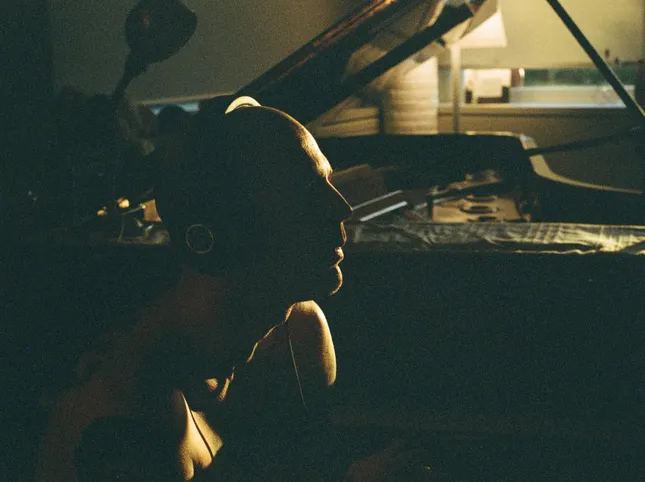
Gemitaiz: “We need to break the spell of standardized music”
“Elsewhere”, Gemitaiz’s new album (here the review) is intense, rich in sounds, ideas, social and personal stories. It is an emotional and sonic journey that deserves to be explored in depth, in particular by investigating the intentions that brought it to light. The Roman rapper was moved by the natural desire to stand out, to take less crowded paths, ending up realizing one of the most important projects of his career. An alien and unexpected record. A firefly in the darkness.
“Elsewhere” sounds like an invitation to break away from conformism, even if the album is firmly planted in today. What does the concept of “elsewhere” mean to you?
I found myself starting to write this record with the idea of just making a new album. I started jotting down things: some samples, some references that I liked. Then, when I moved on to actually writing the pieces, I realized that I wasn’t satisfied with the approach I was using, because it was the same one I had adopted in previous works. The dedication, the commitment, those have always been at the maximum, obviously, but I realized that at least for me there was a need for more.
Did you feel like you had to go “elsewhere” right away?
In recent years I have found myself listening to less and less rap, to the point of almost not listening to it anymore. The Italian one, in particular, no longer existed for me. Because I couldn’t find interest in what was said, in the messages. At a certain point I asked myself if I wanted to write a record that gave people the same feeling that I felt listening to certain albums, and the answer was “no”. From there I understood that I had to make a breakup album, certainly on a musical level, but also on a lyrical level. I felt the need to go back, in quotes, to how I was at the beginning: when social denunciation and everything I experienced inside were more important than the positive part of my life.
What do you remember about those beginnings?
When I started, there was little positive, both on an artistic and work level. Music, at that time, wasn’t even really a job. However, it was something necessary, especially from a human point of view. It was an unwritten necessity: to talk, address certain topics, show off all the discomfort I had in that period. I think this album is, in a certain sense, a return to that attitude. As they say, sometimes you come full circle and start over. I also have the feeling that, on a musical level, both on the world scene and in Italy, we are returning in that direction.
To understand it, did you have to move away?
Even before the individual songs, the idea was clear: this had to be a record that, yes, completely distanced itself from everything that today, in 2025, is considered a rap record. Especially in Italy.
It’s a dense album on a musical level. You worked on it the “old” way, which doesn’t mean in the “old way”, but as it was done in the past, that is, all together, “as a band”.
I have to thank Mace for this, because in recent years I have always organized sessions with musicians, producers, people with whom I can then lock myself away somewhere to work on records. It has always been like this: we closed ourselves in a space and built the project. The difference, however, was Simone, Mace.
Mace what made you understand?
In recent years I have participated in many sessions, including for his records, and I noticed something that made me reflect. Up until that point, I worked differently: maybe I took a villa, divided it into three parts and put three different pairs of producers/musicians to work on three different things at the same time. It’s not a bad method, and in fact for a long time I was very happy with it. But when I saw how Simone worked with all the musicians together in the same room, I thought: “Ok, this is how I want to do it too”.
It’s all in the working method…
Yes, I don’t know how to play instruments, but I feel like I have that kind of imprint, like Rick Rubin: I know exactly what I want to achieve. And I’m also lucky enough to be able to express myself clearly, to make myself understood by musicians. This approach, for me, was truly fundamental. My records were also played before, but it was different as I explained.
“Flowman” is a tough, but also funny piece, against the market and the industry. Rappi: “These majors compete to see who can do worse.” Is anything saved today?
I think of Young Thug. It broke what, at a certain point, had become the panorama of American trap: stuff that was strong, yes, but which all seemed to be made in the same way. And we’re still talking about someone who is best friends with Future, who comes from that world, from Atlanta, together with people like Gucci Mane, that is, the founders of that scene. But he, in my opinion, has always had an edge: in the flow, in the melodies, in the approach. He has always been a disruptive person, someone who does what he wants. At a certain point, he said: “You know what? I want to follow a completely different way of making music”, and he started to experiment, to use the guitar, to go outside the canons. Even XXX Tentacion, for example, had done it before. So, to answer the question: the point, for me, is to break the spell of music that has become dull.
Why is rap becoming homogenized?
It’s boring, for example, that there are always the same featurings, even if we’re talking about very strong rappers. And I too am involved in this reasoning despite the fact that over the years I have always called the featurings based on how well they looked on the beat, not based on the streams. I do everything myself. I don’t talk about market strategies with anyone, I don’t talk about record titles, I don’t talk about how to “invent” a record: there is no artistic aspect that someone else can decide for me.
Do you underline this because there are other-directed artists?
Many artists, perhaps younger or from another generation, immediately enter into a major label mechanism as soon as they come out with a song. It’s not necessarily wrong, but it’s a system that risks crushing them. Someone comes along and tells you: “Look, to get into the rankings we have to do this”, or “you need this feat”. And maybe the artist believes it, that technique really works, you make numbers, you get results, which are not wrong. But the the problem is that this way you get used to no longer doing everything yourself, to delegating creative choices, to quantifying everything based on the result. And when you see that certain mechanisms actually lead to something concrete, you risk poisoning your creative, musical and artistic independence.
But it’s not the fault of these young rappers…
I agree. It’s a mentality, cultural problem. A big part of the blame for this boring music is that everyone wants to finish first. Everyone wants to go all out, do more streams than everyone else. But music is not that. The numbers don’t really tell the truth. Because then you see artists with millions of listeners on Spotify opening a tour and not selling tickets.
Do you also make it a question of changing “times”?
No, I don’t want to come off as someone who says “ah no, the stuff now sucks”. It’s not like that. I listen to everything, I listen to many artists who are perhaps very far from what I’m saying now, but who rock. Tastes change. If I were twenty years old today, if I were a young rap fan, I probably would have had a different evolution. I defend my personal choice. I don’t want to lecture anyone. In fact, I’m the first to say that there’s magic even in the kid who locks himself in the studio with his trusted producer to make a record just the two of them, isolated from the world. There’s magic there too, without a doubt. But it must be a necessity, not a strategy. That’s the question.
In the album there is the theme of “representing”. You rap “I do it for you who feel different and heal those deep cuts” or you say you are on the side of those who “have never had a choice”.
Empathy towards others today is almost non-existent. On the other hand, I am still easily moved by beautiful things and deeply angry by others. I know my fans feel this sensitivity. I need my position to be clear, to be understood without misunderstandings. There are different ways to do this, and over the years I may have made mistakes…
Have you made mistakes in your ways of communicating?
Many times I have indulged in comments with a basis of justice, but put down with too much anger. Yes, maybe I was wrong in the method, but not in the positioning. That was clear, and I don’t regret that. Maybe I’m a little sorry about the way I communicated it, but not the substance. However, I have noticed that, in doing so, I risk being misunderstood, appearing to be in the wrong, not being understood as I would like. This is why today I believe that music is the best way to make people understand what I really think and what I would like to see change. I hope to continue on this path and leave the “outbursts” alone.
Meg, gives voice to the night. How did your relationship begin?
Maria started working with Frenetik, with Asian Fake, so we became closer as a result. I remember saying to her: “Why don’t you make a record?”. He did it (“Vesuvia”, ed.). Over time I met her several times, we shared many musical and non-musical moments, and therefore it was natural to think of organizing a piece together. Maria has a theatricality all her own, so I sent her an audition and said: “I would like you to personify the night, this is a storytelling about one of our parties: I want you to embrace everything”. The one he sent me was already perfect. There was also a small acting part, but in the end I decided not to include it because it made the piece a little too long. I wanted it to be something that, listened to in two minutes, would leave you speechless and that would make you want to listen to it again several times..
In the finale, with “Apathy”, we perceive the theme of the internal struggle against indifference. There is some positivity. This is not a dark album. What do you think?
I read that you called this album “nocturnal”. I’ll take it on. It’s a nocturnal record because I perceive music that way. When I imagine someone listening to it for the first time, I like to think that they do it at night: it’s an intimate, personal moment, even if you’re in company. The night is more magical than the day: during the day there are noises, distractions, thoughts everywhere. Music, in my opinion, should be listened to calmly, if possible. It’s not a dark or heavy record. There are moments of light that give breath and lightness. I thought about the tracklist for a long time: I wanted to start in a more intense way, then give a more “sunny” passage and then return to more serious pieces at the end. I also like the idea of surprising, of giving an emotional jolt. It’s a bit like a roller coaster: intense moments, moments of breathing, and in the end that feeling of traveling inside the music remains.
That “sooner or later, I shine” that you repeat in “Apatia”?
It’s a statement. It is a message, a signal that reaches those who can grasp it. “Apatia” is full of details, there are a thousand things to listen to. It’s relaxing, it’s one of those songs you could hear even on the beach. But at the base there is always the same message: don’t give up. Try to see the glass half full, even when it’s not easy. Trying to emerge victorious from battles that are personal, intimate, and that everyone carries with them in their own way.
In “Up in the Clouds” you say “I saw my father, his illness”. You have already addressed the theme of lack, of family emptiness in the past. Here he returns in a very explicit and even touching way. Is there anything you’ve discovered or metabolised?
Over the years, through analysis and various experiences, I faced what I needed to face. The shock of losing a parent at 13-14 years old remains, it is inevitable that in all my records, whatever time of my life I make them, there is something about my father. I think about it every day. It’s not something I do on purpose: it’s just the way it is. Certain chords or harmonies bring me back to him rather than anything else. It’s a conversation I’ll probably carry on forever. It is no coincidence that what you quote is a piece with Florian (Tre Beats, stage name of Florian Sehr Gola, ed.), one of the very few friends of mine that my father met.
The tour?
With me there will be the musicians who worked on the album. We will play it in the true sense of the word. There will be many of us.