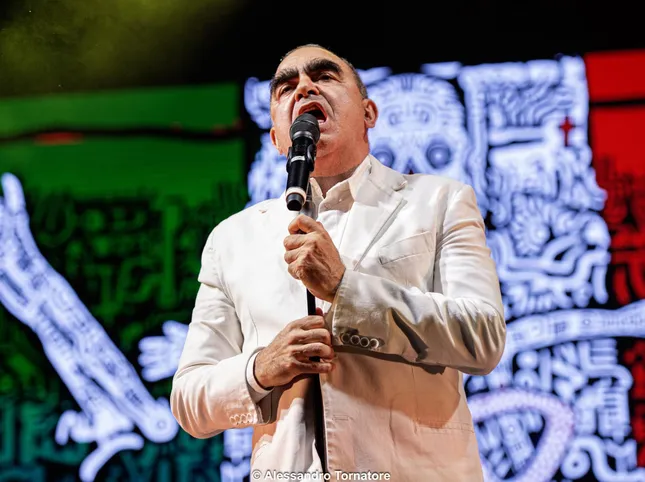
Elio and the Tese Stories: 30 years of “The land of persimmons”
«Italy yes, Italy no…»: “La terra dei cachi” by Elio e le Storie Tese turns 30. It was 1996 when the Milanese group presented itself, as total outsiders, competing at the Sanremo Festival with this song destined to enter the collective imagination of Italians. Performed for the first time on the Ariston stage on 20 February 1996, the song was released the following day as a single, before being included in the album “Eat the phikis” in March.
“The land of persimmons”, which with ferocious irony portrayed Italy and its paradoxes, including scandals, collective obsessions and clichés (playing with the popular tradition of pizza, mafia, football and spaghetti), ranked second in that edition of the Festival, however winning the “Mia Martini” Critics’ Award. The winners of that edition of the Festival were Ron and Tosca with “I would like to meet you in a hundred years”. The group’s performances on the Ariston stage are iconic. During the second evening Elio appeared with a fake arm, and then pulled the real one out from under his sweater. On the evening in which the Festival’s competitors had only one minute to perform an extract of their song (and everyone had opted to perform only the chorus), Elii together with maestro Beppe Vessicchio found an expedient to perform a good part of their song, speeding up the tempo to the maximum for a total of 55 seconds. Finally, on the last evening, the band members performed in alien clothes and with shaved heads colored silver (a tribute to the Rokets’ look).
After the conclusion of the Sanremo Festival, the Milan Prosecutor’s Office opened an investigation into alleged irregularities in the voting. At the center of the investigation were rumors that Elio and the Storie Tese were in fact the real winners, but the result had been altered. A joke made on “Striscia la notizia” by Enzo Iacchetti before the final also contributed to fueling the suspicions: by mentioning three names an acrostic was formed (“Rosa Lino Vince”) which seemed to anticipate the victory of Ron (whose real name is Rosalino). The police detected some suspicious ballots and thus the legend was born that the presenter Pippo Baudo had manipulated the results. The company in charge of managing the opinion poll juries denied any irregularity, claiming that the counts confirmed Ron’s victory even considering any invalid ballots. In the following years, Elio himself downplayed the story, stating that there is no concrete evidence that his group had actually won.
Three decades later, the piece remains not only a symbol of Elio e le Storie Tese’s repertoire but also a portrait of Italy – and Italians – seen through the comic and intelligent kaleidoscope of one of the most original bands on the Italian scene.