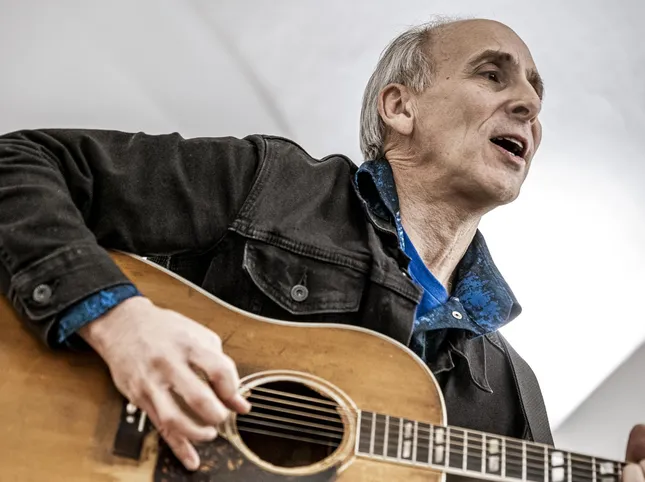
Elijah Wald: “I don’t know why Bob Dylan chose me”
In the eyes of Elijah Wald there is the enthusiasm of someone who has lived a thousand lives and can’t wait to live a thousand more. He has been performing for almost fifty years in a repertoire that ranges from blues to folk, from ragtime to swing, from country to Swahili pop. He started traveling the world as a teenager buskers wandering and won a Grammy in 2002. He helped Dave Van Ronk (Bob Dylan’s close friend and a reference figure for New York’s Greenwich Village) write his autobiography, “The Mayor of MacDougal Street”, which inspired the Coen brothers’ film “Inside Llewyn Davis”. A bit like what happened with “Dylan Goes Electric!”, the book chosen by Dylan himself to make the docufilm “A Complete Unknown”.
Elijah, how do you choose the protagonists of your books?
It really depends on the book. Sometimes it’s something that fascinates me, like the book about Dave Van Ronk. Other times, like the book about Bob Dylan, honestly… it’s just about money (laughs). When I realized that Dylan’s 50th anniversary at the Newport Folk Festival would be in 2015, I realized that if I wrote the book for that moment it would then pay off enough for me to write less easy-to-sell books.
Did you ever expect everything that came next? The film and its success?
No, it was total madness. There are only two films that deal with the New York folk scene of the 1960s – and both were born from two of my books. I won the lottery twice. It’s absurd. And the Dylan case is particularly incredible because it was his idea: it was Dylan himself who picked up the phone and said to use my book for the film. I still have no idea why, but I’m happy about it.
The next story you would like to tell?
A completely different one. In my latest book on Jelly Roll Morton I reported the name of a woman called “Ready Money”, considered by the pianist to be the best pickpocket in New Orleans in the early twentieth century. I did some research to see if I could find out more about her: now I have enough material for a biography. She ended up owning the largest black-owned hotel in Southern California. I mean, it’s a crazy story. Let’s see if I can turn it into a book.
How is your approach to musical research different from that of “traditional” critics?
I think a big difference is that most critics look at artists, whereas I don’t think history works that way. I think if you really want to understand the story, you have to look at the audience, not the artists. Obviously in the book about Dylan I also consider him, but I always try to understand the surrounding world. It’s more interesting to me. If Dylan hadn’t moved in that world, he wouldn’t have been Bob Dylan. So I think sometimes people focus too much on the artists and not enough on the context and the world around them.
So I won’t ask you what aspect of Dylan you wanted to highlight with your book…
(Laughs). I’m sincere when I say I did it for money, but it’s equally true that when you delve into something, looking at it closely, then you discover a different aspect. And it fascinated me. One of the things I didn’t understand was how rock and roll Dylan was already in his early days. Peter Stampfel, founder of the Holy Modal Rounders and then member of the Fugs, was the one who changed my perspective because he saw Dylan when he had just arrived in New York, and even then he said: “I always loved rhythm and blues and hillbilly music, but I always thought they were separate worlds; then I saw Dylan on stage. He played hillbilly music as if it were rock and roll and I realized that you could mix it all together.” I, like everyone, thought that Dylan arrived in New York playing Woody Guthrie, but that’s not true.
You found out how things really happened.
It’s true that he had the energy of rock and roll – which is why Columbia Records signed him – but most people didn’t discover Dylan by listening to Dylan: they discovered him by listening to Peter, Paul and Mary. So it was always put in a separate box. That’s what interested me the most about that part of the story. The other thing is, when I started writing the book, I wanted to tell the story of the folk scene, and how Dylan got into it; then I realized I could tell the whole story of the folk scene by just talking about Pete Seeger.
In fact, he is also a key figure in the film.
That’s the one thing that was really taken from my book: the idea of telling the story from both Dylan’s and Seeger’s points of view. But in order to do it in the movie, they had to make it all up. In reality, the two were very, very rarely in the same room. I used it as a narrative device, while in the film they invented many scenes in which Dylan and Seeger are together. Mine is not a criticism: they did it very well. Edward Norton as Seeger is incredible.
You said that if you could go back to the ’60s, you would go and listen to John Coltrane and Aretha Franklin instead of Dylan.
At that time this was also happening in Greenwich Village and, I’m sorry, but… that’s a better concert! I mean, Aretha Franklin opening for John Coltrane… After all, I write books about stories that seem interesting to me, which don’t necessarily coincide with my favorite music. If you ask me who the most important and influential artist of the 1960s is, I’ll tell you James Brown. The Beatles, Dylan… ok. But James Brown changed the world. Look what happened after him: disco, rap, etc. James Brown was the future.
Let’s focus on the audience, as you teach us: didn’t the Beatles have more impact on people than James Brown?
It depends on the audience we are referring to. Yes, it’s true that rock and roll followed Dylan and the Beatles… but rock hasn’t done anything really interesting since then. While black music continued to evolve.
In “Escaping the Delta,” you present a different take on the blues and Robert Johnson. How has your view on the blues changed after that book?
My view on the blues changed even before that book. People in the rock world thought that book was a new idea, while people related to the blues didn’t think so. All the blues historians knew what I was talking about, while the rock historians had a “mystical” idea of the blues. They didn’t think of Robert Johnson as a person: they thought of him as a mystical figure who sold his soul to the devil. What I tried to do in that book was say something really obvious, which was that black people in 1930s Mississippi listened to music differently than white people in 1960s London or New York. Robert Johnson was interesting to people in his world because he absorbed all the sounds he heard from records at the time, but he became interesting to white people in the ’60s because he brought the old Delta sound. Some have said that I criticized or demystified it: maybe. But we must recognize that he was a genius, yes, but not because he invented everything he did. I liken him to Ray Charles: Ray Charles didn’t do anything new, but he took a lot of things that already existed and put them together like no one else had done before.
The music has changed, as is normal, but… you like it as has it changed?
Dave Van Ronk, my mentor, said that if you ask any guy of a certain age what he thinks of the modern world, the answer is always “of course it was better before, when I still took the steps three at a time”. I still hear things I like. For example, I love Beyoncé’s concert film. I’ve never seen her live, but I would love to. It’s a great show. I don’t listen to his records, but it’s a great show. I still find things I like, but the older you get, the more you find yourself thinking “ah, yeah, I’ve heard that before.” Then, let’s face it: today they don’t make records for people like me. The last time I heard a new sound that really surprised me was probably with the rap of the early nineties: NWA, Goodie Mob and many others… Snoop Dogg! That, as far as I can remember, was the last time I heard something on the radio in the car that made me pull over to listen better. But now we’re talking about thirty years ago. Since then, I haven’t heard anything as exciting.
Rap, like folk, was highly politicized. Are we more fearful today?
There is a lot of music that still talks about politics today, despite everything. Even in rock, in folk… not to mention other parts of the world. There is a lot of African music that talks about politics. Our listening patterns only convey to us a small portion of what is happening in the world. I wrote a book on Mexican corridos and that medium is still used there to tell what happens in politics. A friend of mine sent me some Christmas carol lyrics rewritten after what ICE (the agency that controls immigration in the United States, ed.) is doing and you can hear them singing in the streets these days. The media may ignore it, but it is not a spirit that has been lost.
Music cannot change the world…
Absolutely not.
…but it can influence people.
It depends on the person, the music and the moment. Of course, if I want to dance I don’t listen to the same music I would listen to if I wanted to sleep. To the meeting politicians in the United States now we have many brass bands. I think they’re much better than folk singers, especially when it’s cold, because they warm you up inside. A tradition that you also have in Italy. Bob Dylan type stuff has never been appropriate for a political meeting: it’s just another type of speech made with a guitar. A Pete Seeger concert was like a political rally: he managed to get everyone singing and moving energy.
Your life was and still is on the road. Is there a memory, an event or a person that has changed you?
For many years I hitchhiked and, if I had to say where my vision of the world came from, I would say that I really understood it while hitchhiking. Although it gives you a very optimistic view of the world because you only meet people who are willing to stop to help hitchhikers. If I had to point to one person in particular, I would say Dave Van Ronk. It shaped me. Not just musically: my understanding of the story comes from him. When I started writing, he would give me books and say, “If you want to be a writer, then read this, this, and this.” He was a brilliant man, an interesting political thinker, a Marxist anarchist who raised me in his world.
A great Italian singer-songwriter, Giorgio Gaber, said: “There is only the road you can count on”.
There’s one thing many don’t understand about Bob Dylan’s enthusiasm for Woody Guthrie. Guthrie wrote a book called “Bound for Glory” and I think that book was Guthrie’s most important work for Dylan. It certainly is for me. It’s about going out into the world, even if Dylan never really did it because he became “Bob Dylan” the moment he arrived in New York, without needing so many trips. I left home at 18. I came to Europe and spent the next 15 years travelling. Music was a means of travel. I love music, but for me the road is the road. After that, my grandmother used to say that a horse can travel around the world, but when it comes home it remains a horse: many people travel and then remain the same. When I visit a country, especially Italy, I try new foods, visit churches, go into museums, because this is why I travel. But not everyone does it and it doesn’t mean that my way is better or worse than others. It depends on your soul. Then you can also travel while sitting at home: reading books. Reading books is simply another way of learning about the world. And I did it that way too.