Ele A: “I love Mac Miller and I wish I had Madame’s courage”
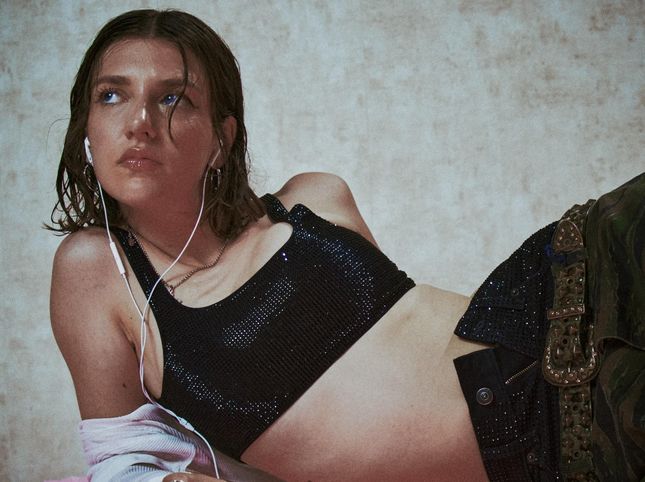
It is no coincidence that water, that of Lake Lugano, is the element to which Ele A is most linked for human and territorial issues. She’s crystal clear, her image is in her music, not that of others. And this is a fundamental aspect: he loves Mac Miller, Madame, Calcutta and Massimo Pericolo, but it is not a copy of any of his landmarks or other names that are doing the rounds today. He has an image that aims to be increasingly focused, as the cover of his latest project suggests, but he already has a striking identity. Eleonora Antognini, born in 2002, is one of the brightest talents, not only in the rap scene. Blessed by Neffa, Fabri Fibra and Gué, “il guaglione” explained that it was she who made him want to rap again, she is about to leave for the new presentation tour in Europe of her first album “Pixel” (review here).
What image is formed by combining pixels?
The thread that binds almost all the tracks is nostalgia. And another aspect that I wanted to include, but the public must say whether I succeeded or not, is greater energy. Even talking to my producer Dice, I realized that, in live performances, the tracks I least liked to bring to the stage were the ones with less energy. And so I worked on this aspect. I made a lot of chill tracks before this project, but I couldn’t translate that feeling into live performances. At this time when I’m angry I’m really angry, when I’m sad or happy the same.
What kind of nostalgia are you talking about?
The one that takes into account the beauty of memory, but that doesn’t feel sorry for itself and that doesn’t regret the past. A nostalgia that does not renounce the present, but rather projects itself into the future.
This album, compared to the previous more jazzy and nocturnal projects, is more open and in some cases pop. Is it in the studio that you understood the direction of the work?
No, this project was not born under a concept like previous works. Until we definitively established the tracklist of the pieces, I was also very open to the idea of changing them with others. The opening you are talking about was therefore not built on a drawing board, but is the result of necessity. But I didn’t want to take the pop step, it just came naturally.
The roots of this?
I think they’re in the ratings. I haven’t been listening to much rap lately. I listen to a lot of music with melodies, a lot of South American music. I repeat, it’s a process that is also linked to live shows: doing only rap shows makes me tired. I want to broaden my sounds. I really like singing.
More than rapping?
No, if not I would just do that and that’s it. I know very well, at the moment, that I can’t push my voice who knows where, but I felt the need to try to do something else. I say it in a song: “I grew up with Biggie, I don’t know how to do pop” (I’ll wait for you, ed.). And it’s true. But I’m not a purist, so I want to open up. But I want to say something else….
Please.
An artist who makes pop would never define my record as “pop”. I want to underline this. My rap roots are very present in this project.
The start is straight ahead. In “I’ll wait for you” you rap: “Don’t tell me how to dress, and don’t tell me when I have to undress, I do this because I have no alternatives, you’re on the sidelines like showgirls”. In “Wolf’s Tooth”: “Men are armed more than the military. But when there is a woman, they feel threatened.” Are you referring to your rap colleagues?
This bar was born in the studio with Night Skinny. He told me that some guys were there at his place, they were all yo yo yo, then the Skinny girl arrived and they went silent. He told me this in an innocuous way, but it made me smile. It’s a nice contrast, the one between male and female power. The bars you mentioned, beyond the stories, are important to me because they offer a female perspective in rap.
What is rare?
Oh yes, it’s really missing. Because there are few women in the scene. But I’ll also tell you something else: it’s not just a female issue, but one of sensitivity. Mac Miller for me also had a feminine perspective in which a woman could and can see herself again. It is no coincidence that he wrote “The Divine Feminine”.
Are you positive about the future?
Yes, I repeat it even if they called me an ass-kisser: the fact that Anna managed to do what she did is a sign. It opened a sea of doors. When I started getting into rap as a child, there was nothing like it….
Don’t you think Madame also played a fundamental role?
Absolutely. When I listened to “17” by Madame I no longer felt alone. She always talked about a struggle with her body, about feeling ugly…all things that I too experienced like 99% of girls, and she did it in an incredible way. Madame is my favorite artist in Italy. I wish I had his courage, but I don’t. I didn’t mention it to you first because when you are so connected to someone or something, as I am with Madame’s music, you take that connection completely as an established fact. As if it were part of you, not something external to you.
You mentioned Mac Miller: are you always convinced, as you told us last year, of putting on live shows with instrumental arrangements and not just with a DJ?
Yes. My favorite Mac Miller record is live. That type of context is unsurpassable for me. Some time ago Nerone told me something interesting: “Rappers often lie. They say phrases they don’t mean and when you see them live you realize it because they say those phrases without looking the audience in the face.” Well, if you listen to Mac Miller’s live album you can notice that some phrases, perhaps overlooked in the studio version, are shouted. Because he really believed it. The music is too good not to do it with someone, I want a great band around me, but without ever losing the punch of hip hop. And I’ll tell you more: I would like to play live too.
What is the phrase that you will undoubtedly say while looking the audience in the eye, like Mac Miller?
“One hundred thousand images. But I’m looking for you and you’re not there. Who are you?”.
You produced “Atlantis”. Are you the one who plays the piano?
Yes. The more I progress with music, the more I will want to produce and play, I feel it. This doesn’t mean I won’t collaborate with producers anymore, but there are very few female producers. The female point of view, as in the lyrics, is also necessary in the music. This perspective is also important. PinkPantheres is very strong, it produces a lot of its own music, it’s a beacon.
Do you set limits?
I know this is what I want to do my whole life. My dream was to make a living from music and now that I’m succeeding, I don’t want to skip ahead. I want to grow hand in hand with my music. I would also like to have a secret side project with which to do guitar, alternative rock and unexpected things: if one day you see a strange profile on Spotify… (smiles, ed.).
Is the Sanremo Festival in your plans?
At the moment I’m not interested in the Festival. It’s a beautiful showcase, important, but you have to do it well, with a song that wasn’t written for Sanremo. That is, not with a specially constructed piece. I would like to one day write a song and be able to say in a natural way “yes, this could actually be right for Sanremo”. Not the opposite like: “I have to write a song for the Festival”. Then they told me about Sanremo as a real shocker, on a physical and psychological level. If you don’t go there with a song that is truly yours it’s a problem, you attract an audience that has nothing to do with you.
There are several collaborations on the album: from the more telephoned one with Gué to the unexpected one with Colapesce. How did you find working with him?
Very good. I’ve always listened to a lot of indie. Among my favorite artists, in addition to Madame, there is also Calcutta. It’s not a genre that I feel is mine, that I would be able to do. With Colapesce we had a session without budgeting for the creation of a piece, much less for my project. Yet she was born. I believe that all songs should be born like this, without planning. It also happened that they sent me a piece remotely to insert some of my verses and that moved me a lot. This is to say: there is no rule. But the songs born as “Ombre di città” are magical.
Speaking of perspectives: does your being Swiss and your still living in Switzerland and not, for example, in Milan, allow you to travel towards other musical directions, without homologizing yourself?
The beauty of music is that it can be made anywhere. For me it is essential to separate music from the music business. Milan is a fundamental city, without which I wouldn’t be here. Coming from the province is a plus for me, because you are forced to invent what isn’t there. Look at Massimo Pericolo, he is the king of the story of the province. 22Simba is also doing some nice work on that front. Talking about the city seems cooler than talking about the province or a forest, but those who do it and do it well manage to represent people in a more identifying way.
Where do you live?
Outside Lugano. To go to the studio I take the bus and wait for it somewhere in the middle of the woods. In “Windy days” you can feel that atmosphere, I wrote the text during the journey to the studio, in those moments of waiting. I actually “recovered” it with Voloco in the woods. It’s not an urban piece, it has a beat linked to nature.