
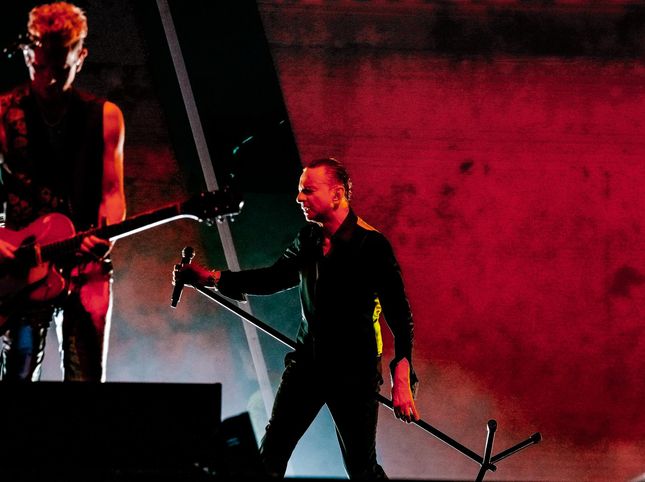
Depeche Mode, 4 songs for the end of the “Memento Mori” era
The careers of singers and bands are long stories, made up of chapters, passages, transitions. It’s always been like this, even if we now call them “eras” using a term that has entered pop language in recent years thanks to Taylor Swift.
Applying this metaphor to Depeche Mode, the release of the live “Memento Mori: Mexico City” and the four unreleased songs recorded during the album sessions represents the formal closure of the “Memento Mori” era, which began two and a half years ago. An era that actually began in Italy, in Sanremo, when Depeche Mode returned to a stage as a duo for the first time after the death of Andy Fletcher. Then the album, with a recovery of classic electronics and a reflection on mortality, and a tour that lasted a year and a half, between stadiums and arenas.
The new project, released on December 5, presents itself as a hybrid object, which unites the different souls of this era. On the one hand, the live album, the document of one of the most intense stages of the world tour with over 3 million spectators, that of Mexico City, celebrated by the concert film “Depeche Mode: M” by Fernando Frías, in theaters a few weeks ago. But also a mini-album, with the recovery of four outtakes that had not been included in the tracklist of the 2023 album but which fully belong to its thematic and sonic universe. We listened to them in preview.
Mortality and classical electronics
The four unreleased tracks – “In the End”, “Give Yourself to Me”, “Life 2.0” and “Survive” – are consistent with the minimal, dark and classically electronic aesthetic of the mother album. The echoes of Kraftwerk and the electronica of the early ’80s, the one in which Depeche grew up, return in all the tracks – together with the theme of mortality, which continues to be the narrative center of the band’s recent production.
“In the End”, already known to fans because it was used in the film’s closing credits, and therefore already heard since its preview at the Tribeca Film Festival weeks ago, could have been a single: linear, spare, immediately recognisable. Produced by James Ford, it maintains the somberness of the album with an intimate and reflective, almost meditative tone. The lines “You’re no one, going nowhere / We’re all nothing in the end” refer directly to the underlying theme of “Memento Mori”: the awareness of the precariousness of the human condition.
Even darker is “Give Yourself to Me”, built on a vintage texture, oscillating between analog synths and a slow pace, with a melodic crescendo typical of the band. “Life 2.0” instead plays on a mix of guitar, a pulsating synth and a robotic voice. “Survive” is the piece closest to Depeche Mode’s pop approach: the guitar is central, the rhythm robotic, the immediate refrain (“we’ll survive”), with a balance between darkness and melody that could easily have found space in the original album.
Songs that work well as a parallel EP, a coherent completion of an aesthetic and imagery carried forward for over two years.
The live show: an integral document, beyond the film
“Memento Mori: Mexico City” is above all a wonderful live album, a genre that the band has been frequenting since the ’80s with the monumental “101”. Unlike the film, which selected parts of the performance, it collects the complete setlist of the show. There are over two hours of music that faithfully reproduce the atmosphere of the three Mexican dates, among the most energetic and popular of the tour. Those who have seen “Depeche Mode: M” or the concert will find some key moments – the intensity of “Ghosts Again”, the emotionality of the minimal acoustic segments, represented here by “Soul With Me” and a wonderful version of “Waiting for the Night” that opens the encore. Then there are the classics, especially “Enjoy the Silence”, once again the symbolic and ritual pivot of every performance of the band, with its long instrumental coda: the 2023-2024 version is not as good as the one from the “Songs of Faith and Devotion” tour, which recently went viral on TikTok, but it remains one of the most emotional songs of the last 40 years, and live it is even better.
A path that ends, an uncertain future
Some fans welcomed the release of these recordings with a mixed feeling: on the one hand, they are new songs. On the other hand, it was hoped that Depeche Mode would immediately get to work on a new album. The publication of the unreleased tracks indicates that they will not be kept for future work, and therefore the closing of the era without opening a new one. We don’t know what will happen to Depeche in the near future: they have always taken long breaks between one phase and another. Meanwhile, the release of “Memento Mori: Mexico City” – between live, film and unreleased songs – closes a cycle in the most coherent way possible: with music that looks the theme of mortality in the face, but which continues to find a sacred space in the song form and in the live dimension. There is only something to be grateful for this era of Depeche Mode.
