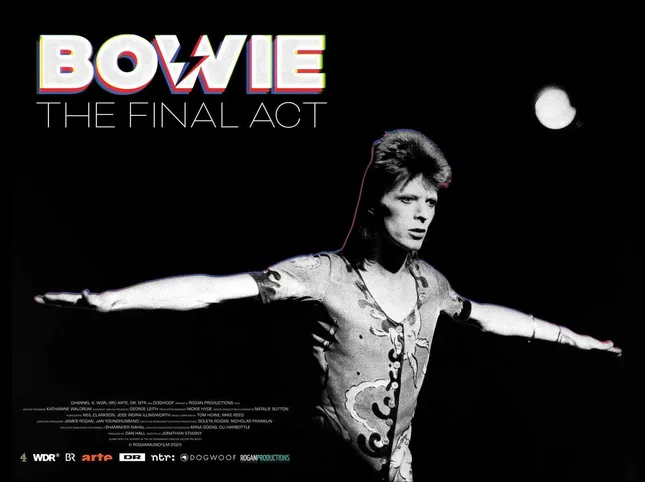
“David Bowie – The final act”: the interview with the director
Jonathan Stianty presents his David Bowie – The Final Act in Turin, at the SeeYouSound Festival (tonight the screening is sold out at 9pm, there will be another one tomorrow at 8.30pm). The comments on his documentary released after the London premiere two months ago range from unconditional approval to perplexity, a difference of opinion that ultimately recalls the reception given to certain particularly ambitious Bowie albums. Although the viewing is overall pleasant and interesting even for those who have already seen several documentaries on the subject in question, some of its choices may seem surprising: each viewer will be free to evaluate their legitimacy for the purposes of the overall impression. Rockol’s review will be published tomorrow.
The first question concerns the title: The Final Act seems to suggest a particular emphasis on the latest album Blackstar. Which, however, is only reached after an hour and a quarter of the story.
I’m sorry it gave you this impression, because it’s not correct. The title of a film is a complicated matter, it is difficult to find three words that exactly express the meaning of a work. But I don’t think I will apologize for this choice, because in addition to liking it, it underlines that the part that interests me is not the climb to success, but the final part of the journey. Including leave, but not only.
However, there are large portions covering other phases of the journey. For example, the rather rare audio of a tremor Changes performed at Glastonbury 1971, at dawn, for a few sleeping spectators. There are many details about the concert at the Hammersmith Odeon in London in 1973. On the other hand, it seems that they never existed Heroes And Hunger, Under Pressure And Station To Station, Scary Monsters And Low. And it seems Carlos Alomar, Nile Rodgers, Iggy Pop, Brian Eno, Gail Ann Dorsey never existed.
They were not people who were next to him in moments of artistic difficulty, which are the moments I wanted to privilege.
There’s Dana Gillespie and Rick Wakeman.
They were with him when no one bought his records or followed him, like for example in that first edition of Glastonbury. I know some have found my choices disconcerting. But mine is not a film about Bowie’s career, rather an attempt to explore his creativity and the power of creativity in general, mortality, art. It’s not a typical hagiography of genius.
This is actually one of the aspects that I appreciated the most. For example, I don’t know how many people are ready to accept that Bowie cries because someone writes that he’s “finished”.
Here, I wanted to make known above all the most complex parts of his career, in particular the phase after the years in which he always seemed to obtain the results he wanted. When at a certain point he begins to face the end of success, and then the end of life. I consider myself a storyteller and I tried to make a film about emotions, not facts. I didn’t want the complete playlist of hits, there are already documentaries with a menu for all tastes. In my opinion, however, we learn more from an artist who has internal conflicts and strives to renew himself, even with difficulty, than from contemplating his successes.
What are your favorite documentaries?
…Why do you ask me this?
Because you made a music documentary, I watch music documentaries and I think the readers too.
So, right off the bat, I can say that I really liked it Some Kind Of Monsterabout Metallica, then we’ll see… Who Killed the KLF. Ah, and also what’s here in Turin these days, A 2-Tone Story about Pauline Black and the Selecters. But just because I like them doesn’t mean that what I did resembles them.
It was just a curiosity. I’m afraid I have another one. Can I ask you how old you are and where you are from?
I’m 42 years old, and I’m from London. Again: why the question?
Because it explains a certain London-centric point of view. Which is very widespread, and doesn’t shock me: in my own small way, being a non-British biographer of Bowie I have learned to accept it. There is no English biography or documentary on Bowie that takes into account interviews in foreign newspapers or TV appearances abroad. Too bad for you, though.
Are you saying we missed a lot?
Several interesting statements. Or topical moments. Like the time he almost lost control on a TV program, on an Italian show.
Really?
I’ve seen appearances on German, Dutch, French, Danish TV shows, and I’ve never seen him so irritated.
Oh, really? But what had happened?
They were asking him silly questions. And speaking of silly questions… I asked you how old you are because I’m interested in knowing what your first Bowie was.
I grew up in the 80s, and he was just everywhere. Let’s Dance it was huge in those years. But the first real awareness I have of him is as Goblin King, in Labyrinth! I was a child and he was so magnetic… This is my first memory of him, but the first David Bowie record I bought was Earthlingin 1997. A record that received very divergent reviews.
Not the only one.
I liked it a lot. I think all of his 90s were looked at in a superficial way. For me it was very difficult to leave out, for example Outside from the story. But in a 90-minute film you have to make painful decisions.
Are there any images that you were unable to obtain due to rights issues?
I used all the images I was interested in and I didn’t have any particular problems getting them. Let’s be clear, making a film is a complicated process, but I am a storyteller, my approach to a film must not be influenced by these aspects.
The part you dedicate to the Glastonbury 2000 mega-concert has particular importance, also from the point of view of running time.
For me it was very important. I was in the audience and I interpreted that moment as I think he experienced it: a catharsis. I think there he left behind many of the problems he had encountered from the late 1980s onwards.
Speaking of problems, are there any of the interviewees who were more difficult to convince?
No, they were all very helpful. Even if someone has already spoken elsewhere about his relationship with Bowie, my feeling is that everyone considers it a privilege to have been able to work with him in a phase of their and his life, and for them doing so is as pleasant as it is important.
At a certain point, among all those slightly unusual interviewees, I hoped that the mysterious Erdal Kizilcay, the Turkish accomplice of the Swiss albums, would emerge.
Hahaha, it’s very difficult to find. It would have been interesting but I didn’t insist, also because I already had 18 interviewees, and an hour and a half of time: at the risk of repeating myself, something must be given up. While interviewing Reeves Gabrels was fundamental because he was at Bowie’s side for a very long, intense and difficult period, but few know his version.
Who are you particularly satisfied with?
Of everyone, because they made a very important contribution, speaking very sincerely. But as a personal satisfaction, I was very happy to have Hanif Kureishi talk about Bowie, and some of the people who worked on Blackstar.