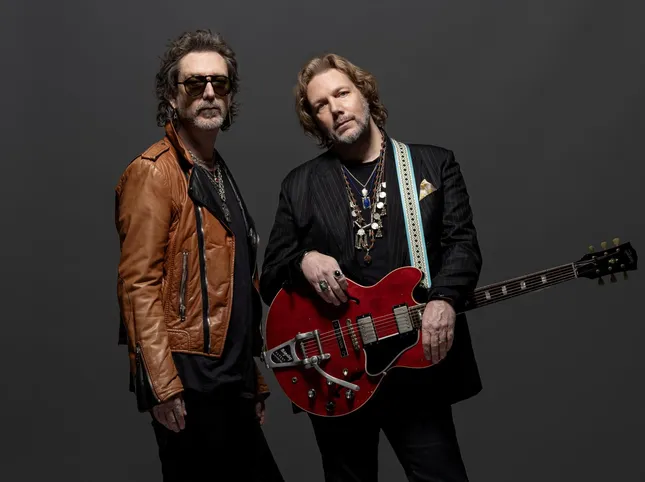
Black Crowes: “Moving forward is our only way”
Rich Robinson, guitarist of the Black Crowes, presented us with “A Pound of Feathers”, the band’s new album out on March 13th for Silver Arrow Records, the “family” label: the newfound harmony with his brother Chris, the past and present of the group in full awareness of their legacy.
Has having your own label changed the Black Crowes’ creative process and your perspective on the recording industry and the way you work on albums?
I would say that as a band we’ve always done things our own way, continuing to make records exactly the way we wanted, without ever dawdling or worrying about any pressure from the industry. Having your own label is a fantastic thing because it gives you absolute freedom over the creative process, as well as the ability to publish other artists. In this way we avoid submitting to other people’s rules or arguing about the right sound to adopt and similar things.
How do you place “A Pound of Feathers” in your discography in terms of importance?
I wouldn’t know precisely because I’m not in the habit of looking at the things we do from a chronological point of view. What’s certain is that we’re all happy to have made exactly the record we wanted to make, and that’s all that makes us feel satisfied. The same was true for “Happiness Bastards”, our previous work. What really moves us is the awareness that we are in a position of absolute happiness in playing and that we can feel proud of this. We used the studio as a channel from which to let our ideas flow and it took us very little to compose all the songs on the album.
It is a rather varied work in terms of sounds….
I never expected to write things like “Eros Blues” or “Doomsday Doggerel” with the band. However, the real challenge, what allows us to stay active, is the idea of constantly improving as authors, incorporating new stimuli without sticking to a more specific formula. This applies to me, as well as to my brother Chris.
“A Pound of Feathers” was recorded in a week or so. In an age of endless post-production, how did your sense of urgency shape the record?
We actually worked quickly by preparing the material in advance — me, Chris and our drummer — before working on it with the rest of the band. In fact, as soon as we entered the studio we immediately started recording, completing two songs a day. This allowed us to better focus on refining the material later by inserting additional guitar or keyboard and piano tracks. Checking the result from time to time, we were always surprised and delighted to realize that we had created something magical. The enthusiasm was so high that after just five days in the studio we already had nine songs done and finished. We took advantage of the importance of the moment and the fact that it was all naturally organic. This allowed us greater flexibility in understanding how to move and where to go, aware that it would have been counterproductive to linger any longer on every single track. The excitement of the moment is fundamental and you cannot think of recreating it by perhaps trying to record the same material more accurately to obtain a “better” result. I think what this record exudes is vitality, pure vitality.
How do you and Chris work on songs?
I feel the need to clarify a fundamental aspect: Chris writes the lyrics, I write the music. Our songs take shape from the convergence of these two worlds. It’s always been like this. When Chris hears a melody that strikes him, he uses that emotion to give voice to what’s inside him. Music, after all, is a transmission system; represents the “heartstrings” that connect you to the song. The new album is full of deep lyrics, but then Chris has never been a superficial lyricist. However, I remain convinced of one thing: when you write a great song, people end up making it their own, establishing an intimate relationship with it. This connection ignites the imagination and pushes us to visualize how that piece could have been born in the studio: a mystery that amplifies the perception of what we listen to. I get into this mode with “Let It Be”, for example.
After the reunion, you and Chris started being prolific again. How has your creative understanding and way of communicating evolved after the years spent apart?
Well, for us not much has ever changed, in a certain sense; our way of interfacing and working together is almost the same as always: we have immediate ways of communicating. I send him an idea, he sends it back with the addition of a chorus or a verse. Then of course, compared to the past, today there is much more positivity around us. We no longer argue like we used to because keeping our relationship active is a priority. And even though we may have different opinions on something, we always try to benefit from what we create or discuss.
Between Magpie Salute and your other side projects, how have those experiences expanded your musical vocabulary and influenced the sound of the Black Crowes today?
I believe that every accumulated experience finds its meaning in the moment of creation. Experience inevitably influences what we produce, whether it is a song, a painting or a book. In my brother’s and my case, the distance that separated us for those five or six years, during which we each focused on our own projects, proved necessary. It allowed us to focus on the communication problems we were carrying with us and to address them to actually solve them. Finding ourselves, therefore, has made us more solid; it strengthened mutual respect and gave us the tools to understand each other more deeply. Today we are capable of truly listening to each other, respecting each other’s difficulties and limits.
You often cite Jimmy Page as one of your favorite guitarists. I gather that the concerts and the collaborative album that came out in 1999, “Live at the Greek”, represented a decisive career transition for you and the Black Crowes. Are you always in contact with Page?
Yes, just last year we flew to London to do an interview with him on the occasion of the expanded reissue of “Live at the Greek”. Jimmy then came to hear us live, again in London, during the “Happiness Bastards” tour, which pleased us enormously. We love Page, he is a dear person and a great friend to us, as well as a stellar musician. Having listened to the original tapes of that live show with him and hearing his opinion was a special occasion; Collaborating with him at the time was undoubtedly a defining moment in our career. You know, not everyone gets to do something like that with Jimmy Page. We approached him with all due reverence and respect, and it was a privilege to discuss together the songs to be performed during those concerts. Both we and he worked hard and with humility, and even today I am proud of that project.
You have sold over thirty million copies and received, most recently, a nomination for the Rock & Roll Hall of Fame 2025. How do you reflect on the commercial and critical impact that the Black Crowes have had so far?
It is a recognition that honors us. It may seem trivial, but for me having received that nomination is already enough to feel good about myself. It is an honor to see one’s value recognized in this way and that nomination is the symbol of this. Although, as important as it is, it kind of makes us think that maybe we’ve gotten a little too old for the Hall of Fame (laughs). But that’s okay, that’s a great thing.
If you think about the future of the Black Crowes, do you think you will end up like the Rolling Stones, that is, remaining active as long as your health allows?
I have no idea, honestly; only time will tell. It’s already hard to imagine what the world will be like in five years, with everything that is happening. Better not to make predictions.
Yet you have survived all the eras, from your origins to today…
This is true, also because inactivity is not reconcilable with our way of being. Our only path is to proceed; the rest will come by itself.
Your most successful period, in the early nineties, coincided with the arrival of grunge. Despite being different from you, many of those groups shared an interest in 70s classic rock. What did you think of them?
For me they were valuable bands, but compared to us they had a different “packaging” (laughs). Ours was a more romanticized vision of music, linked to the Rolling Stones and therefore to a certain type of drama and beauty. The Seattle bands looked back to the Seventies, but above all to heavier things like Black Sabbath, therefore with a greater attraction for dark sounds. With Alice In Chains, however, we were on good terms. And I remember Soundgarden came to see us in Seattle, while at the ’92 MTV VMAs I spoke at length with Dave Grohl and Krist Novoselic from Nirvana. There was harmony with all of them and I have fond memories of those years.
You’ll tour this spring before joining Guns N’ Roses for summer stadium dates. With them you have known each other for a long time and together. Do you see this new adventure as a celebration of brotherhood?
Absolutely I would say, given that we respect Guns N’ Roses a lot. We’re very close to Slash and Duff, and also Izzy Stradlin. Izzy hasn’t been with them for a long time, obviously, but he’s one of the architects of that band and we still talk to him. What can I say, we are anxiously waiting: we can’t wait to play with them again because we are sure that something explosive will come out.
Speaking of Izzy Stradlin, however: is it true that you offered him a place in your band after he left Guns?
We tried to involve him, that’s true, but only to take him on tour with us at the time of Ju Ju Hounds, his first solo project. We were already very good friends back then, both with him and with the members of his band. However, Izzy rejected the proposal, which disappointed us quite a bit, but we were understanding and in all these years we have never stopped respecting him.
By contrast, your former guitarist, Marc Ford, rejected Slash’s offer to replace Izzy. Did you ever talk to Marc about how things would have gone if he had accepted that job?
Sure things would have changed a lot for him, but not so much for us as a band. The core of the Black Crowes has always been Chris and I: we’ve always followed our own path writing our own songs. We never really discussed Marc’s possible involvement in GN’R, but I imagine that if he had agreed to play with them he would not have survived the decadence that reigned in that band at the time.