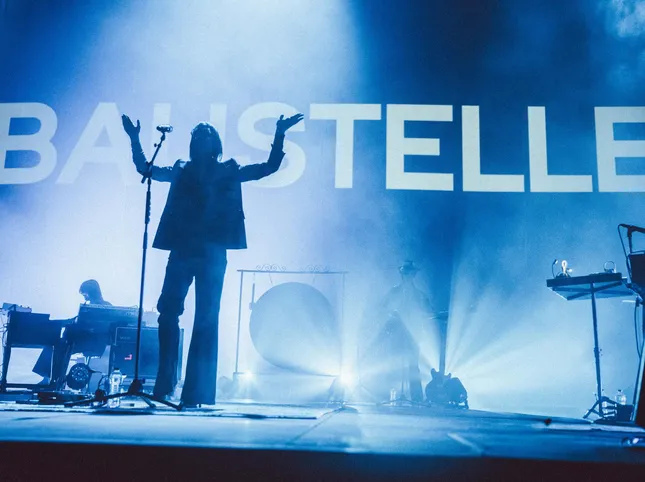
Baustelle: the Forum as a popular and radical act
An intense and refined concert, in which Francesco Bianconi, Claudio Brasini and Rachele Bastreghi have crossed their musical imagination with elegance and sonic strengthconfirming once again Baustelle’s ability to evolve without ever betraying the sound that made them one of the most influential groups in Italian music. One last collective party took place at the Forum in Assago before a break for the band: a time necessary to slow down, settle and recharge. A special occasion to celebrate together with the public, in a stadium that is not sold out but still packed, a decisive year full of “firsts”which saw Baustelle compete on new stages, publish “El Galactico” and move towards the prestigious Tenco Lifetime Achievement Award.
The band presents itself with a seven-piece lineup, capable of giving depth and breadth to a now stratified repertoire: the three are joined by Alberto Bazzoli (piano, organ, synthesizers), Milo Scaglioni (Bass), Giulia Formica (drums), Lorenzo Fornabaio (guitars). However, more than anything else, it is striking the way in which they decide to inhabit a space like the Forum, consciously choosing to renounce the spectacularization that usually characterizes it. The scenography is reduced to the essentials: no large LED walls, no pyrotechnics, no visual excess. The Baustelle Forum is direct, almost radical, built around music rather than image. Behind the stage, projected writings appear at times, dry and evocative, which recall a Nick Cave aestheticwhile the work of light and shadow, never invasive, distantly refers, more by spirit than by quotation, to certain Velvet Underground operations. At the center of the scene stands a gongwhich is played as if to mark the transition from one chapter of the live show to another. A clear narrative scansion, which accompanies the alternation of registers: more electric and tense moments, followed by a more intimate and intimate central parenthesis which has its real start with “Love affair”.
It is here that the concert becomes further stripped and the Forum changes dimension. The setup becomes acoustic and Francesco Bianconi introduces the segment with a programmatic statement: “From now on you must imagine the Forum as if it were the living room of your home“. An invitation to emotional proximity that overturns, at least for a moment, the scale of the arena. Only in the end the large white sheet behind the band falls, leaving room for a more open and powerful light system. The show finds its only true visual expansion there, accompanying a more celebratory final act, built around some of the repertoire’s most recognizable hits. A coherent and rigorous aesthetic choice that reaffirms the Baustelle’s desire to put “music at the centre”an overused but in this case true phrase, which however also leaves an ambiguous feeling: in a context conceived as a celebration and career assessment, perhaps a visual or musical sign is missing, the setlist is in fact only a little longer than those in the clubs, capable of fixing the event in the collective memory as a unique event. It is also true that we are now so used to concerts with “illuminated signs that attract owls”, as they sing the CCCPsthat a live like this, pure, musical, almost extremist on certain choices, it is partly alienating, but also fascinating in its rigor. The only guest of the evening is Tananai on “Boxers gone mad”a presence that does not disfigure and indeed fits naturally into the story, demonstrating a respectful harmony and full awareness of the stage and the moment.
The greatness of the Baustelle emerges definitively precisely from this Forum. It lies in having written songs of a profoundly popular nature, in the noblest sense of the term pop: songs that belong to the peopleas can be understood from the way the audience sings, participates and lets themselves be emotionally affected by those stories. But, at the same time, their strength lies in the ability to transform forgotten events – like that of “Alfredo”, linked to the Vermicino drama, for example – in stories capable of lasting over time and of leave a trace also on the level of social reflection. Their songs bring together micro and macro, private pain and political gaze. Small news stories, often uncomfortable or painful, are intertwined with broader reasoning on liberalism, capitalism, individual freedom, personal affirmation in a present that tends to crush fragility. It is this continuous balance between apparently irreconcilable dimensions that makes Baustelle a special animal in the Italian musical panorama. Twenty-five years later, the secret of their longevity lies here: in having built a recognizable, personal language, and in having managed to surf naturally between small worlds and enormous worlds, between clubs and arenas, without ever losing identity and without compromising. They are joyful and desperate, they are in and out of time.
Ladder:
The provincials
The art of letting go
The merciless
The Gospel of John
Death
The reformatory song
Veronica
The park song
Baudelaire
Alfredo
Love affair
A romantic in Milan
The frogs
Moment of improvisation (with homage to Piero Umiliani)
Boxers gone crazy (feat. Tananai)
Undress me
Amanda
Monumental
Nobody
Nebuchadnezzar
A story
Against the world
Liberalism’s days are numbered
The war is over
Eraser
Charlie surfs