“Sad music makes me happy”
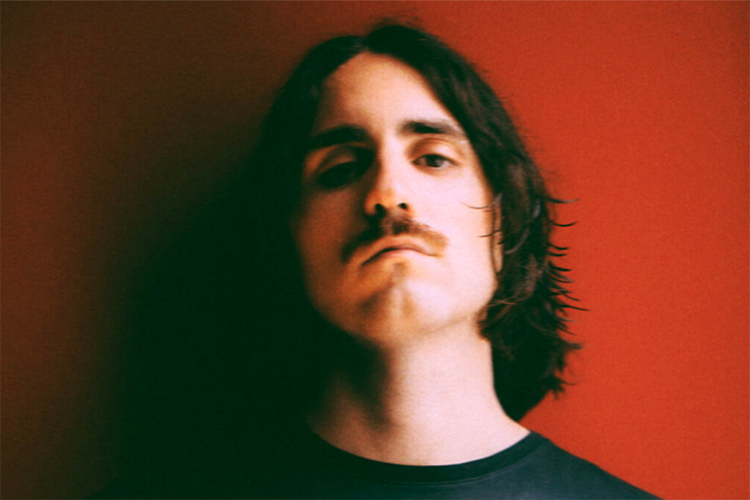
Resendless is the personal project of Adrián Camáñez, guitarist and keyboardist of the Valencian band Gazella, and “Nostalgia” (VELA, 26) is his first album. A work full of cinematic passages that revolves around some of his particular obsessions: essentially, the fear of death.
While waiting for Gazella to release their third album (and while their drummer, Lluisen Capafons, also expands on his solo project, Rey Don Perro), I spoke with Adrián about this notable handful of new compositions.
How did this album come about?
Of ideas that I had been accumulating for a long time. Since we started Gazella. I was only a guitarist, but I started buying devices, after studying piano in a way that didn’t convince me, because it was more oriented towards music theory and that didn’t fulfill me. Since I already had piano technique, and I was interested in theory, I learned harmony. I did it the opposite of almost everyone else, but I understood the instrument. I was gaining fluency, something that, together with the fact that I started buying instruments with which you can save sequences, I began to have a good time by myself, in the home studio. I had fun creating sequences in which everything was abstract, without giving it shape. Then I dared to take it live, for a year and a half, outlining the songs a little more. I found a common link: they all seemed like a lament. All very sad. Very intense. Like World War II (laughs). And I started to think about where that was taking me. And it was towards my fear of death, what existence entails… all very dense, but I felt good doing it. And I structured the songs around that idea. About how I take life knowing that we are going to die.
Is it the music that makes you think about that or was it the other way around?
No, completely the other way around.
It didn’t occur to me to think that one day I would die – and without worrying much – until I was thirty-five, that happy. Or unconscious. Yours is much earlier.
It happened to me when I was eight or nine years old. My father always tells me that I was a very jovial, very happy child, until, around the age of ten, I became taciturn. Very obtuse. Always reading dead authors. What happened to you when you were thirty-five happened to me when you were ten, but not because any of my relatives died. Sometimes it happened to me that when I couldn’t sleep at night, that was why. And it still happens to me. It is something very recurring in my life. And when I listen to music, I look for that feeling. That’s why I like Radiohead so much. Because they are crying all day (laughs). Or the requiems. Chopin. Very romantic things. I feel good about music that shows empathy with that feeling. And I feel a little better, even if it’s a little bit bad (laughs).
“Revendless takes me more to IDM. Towards something more orchestral, but with synthesizers”
Well, we all need sad music from time to time when we are down, to feel accompanied.
Sad music makes me happy. And many times, it happens to me that when I listen to very happy music, it makes me very sad. I don’t really understand why. At least with the excessively happy music. When Vampire Weekend came out, which looked like they were danceable, they made me very sad. Maybe it’s because I felt very alien. Then I would put on Radiohead or Rachmaninov and think, “This, yes, what a relief.” People told me that I was getting very annoying.
To what extent does Revendless allow you to do things you don’t do in Gazella?
With Gazella the ideas emerge depending on the instruments we can play with, and thinking a lot about the live performance. Although not always. But I think more of a band format, five people making music. With what I do alone I try to ensure that whatever sounds I can do live alone, programming synths, and I do have in mind a goal for the music to be more progressive, to be even less formal than that of Gazella. I think I only have two songs with minimally defined choruses and verses. Revendless takes me more to IDM. Towards something more orchestral, but with synthesizers.
Each song has its own atmosphere: despite being a conceptual album thematically, it is by no means monolithic sonically. Despite being eminently instrumental. I think it’s not boring. On the contrary.
Yes, I organized them so that they were in the order they are on the disk. The order is very important. Because it tells a story. The first part is dense, intense and can lead you to despair, about the idea of realizing (or realizing) that I am going to die. Towards the middle part there is calmer because it reflects the acceptance of that idea, there is a reference to Lorca that links more with the celestial, it is more hopeful. And in the final part my mother’s voice appears talking about our family in the thirties, a song like “Caronte”, which reveals a lot of anger, and the requiem at the end, with “Requiem”. Although it is instrumental, the idea is that each song on the album has at least one detail that moves you a little. Let it not be a flat speech. I always think about this, although I have a very silly example: when you buy a four-cheese pizza and you find a piece of blue cheese in the middle… well, in each of my songs I need a piece of blue cheese, of that intensity. Which makes you squirm a little. Which plays a little with your attention, and makes you go from intensity to something that then drops.
Have you heard anything recently that influenced you?
Well, a lot of classical music. For two years now. And contemporary classic. Johnny Greenwood alone, although his work is more avant-garde than classical. Or Floating Points. To Jon Hopkins. To Chet Baker. To Rival Consoles. Although they are electronic musicians, not exactly classical. I pay a lot of attention to their progressions, more than the sound. In the type of compositions.
Gazella you continue with a new singer, who replaces Raquel Palomino, who – by the way – collaborates with you on this album.
Yes, we are already composing for the third album. We have already done some concerts with Irene Ricart, our new vocalist. We have been very lucky, because he has adapted very well in all aspects, also on a personal level, which is important.