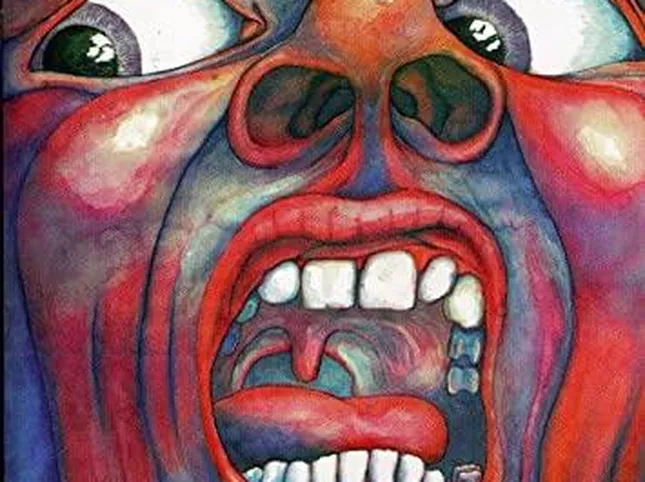
What world would it be without Robert Fripp?
What a world it would be without Robert Fripp? To answer the question, we should first understand who Robert Fripp is. And it’s not easy. Depending on the period examined, Fripp can be a revolutionary of prog, a philosopher, a pioneer of electronics, a maximalist, a minimalist, a critic of discographic customs; more often it is all of this together, at the same time, because geniuses are shape-shifters – and if it is true that “genius” is a somewhat overused name, it is equally true that the founder of King Crimson he deserves it all. These lines certainly don’t serve to prove it, but let’s take the opportunity of his 80th birthday to remember him.
The Big Bang
There is a before and an after In the Court of the Crimson King. In 1969, King Crimson gave history one of the best recording debuts ever. While the world was still looking at the free inspiration of Woodstock, Fripp and his companions imposed an almost martial discipline, fusing jazz, classical music and a guitar distortion that had no equal for its surgical precision.
From that moment – especially after Greg Lake’s farewell in 1970 – the history of King Crimson has been the history of “Frippian metamorphoses”: the first years of jazz rock experiments (whose peak is, for this writer, Islandsbut also Larks’ Tongues in Aspic And Red they’re not joking); there new wave reinvention of the 80s with Disciplinesinfluenced by gamelan (traditional Indonesian orchestral ensemble) and the minimalism of Steve Reich; The “double trio” of the 90s and the three-drum formations of the new millennium (the three-headed polyrhythmic monster composed of Pat Mastelotto, Gavin Harrison and Bill Rieflin, where “monster” stands for “monstrously exceptional”).
A visionary
Robert Fripp expanded the physical (and not just physical) boundaries of the guitar. From collaboration with Brian Eno in the 70s the Frippertronicsa loop system based on two tape recorders that allowed orchestral layering to be created in real time. This technique evolved in the 1990s Soundscapesdigital streams of consciousness where the guitar ceases to be a stringed instrument to become a generator of sound cathedrals. This is where the most spiritual Fripp emerges, the one who seeks something else beyond the noise.
Although all this may lead us to consider it a nerd (in the most positive sense of the term), one should not be fooled by his acrobatic and hyper-layered progressive prodigies: Fripp knew how to be iconic and immediate on a large scale. An example above all? The lacerating and melancholy feedback that sustains Heroes Of David Bowierecorded in Berlin in a legendary session. But he also lent his genius to many others, including Peter Gabriel, Talking Heads, Blondie and Daryl Hall, with an eclecticism that makes him impossible to pigeonhole.
Breaking the mold, literally
In recent years, the image of the “cold surveyor of prog rock” has been unexpectedly softened by the videos of the “Sunday Lunch” series with his wife Toyah Willcox: seeing the master of rigor show off funny dance steps or mime Metallica riffs a cappella with unlikely ties revealed a human and ironic side that the most fundamentalist fans had never dared to imagine.
This is because Fripp, a brilliant shape-shifter, likes to amaze, as he teaches those who want to follow in his footsteps. Through its academy, the Guitar Craft (now Guitar Circle), has trained generations of musicians based on a discipline that combines physical posture with mental presence, translated into New Standard Tuninga tuning he invented to break the mental patterns of guitarists. The feeling is that today, at 80 years old, he hasn’t finished shedding his skin yet – and that’s the best wish one can give him: to continue living like a crazy chameleon.