Uwe Schmidt: Senor Coconut and Kraftwerk in Chilean sauce
The genesis of El Baile Alemán
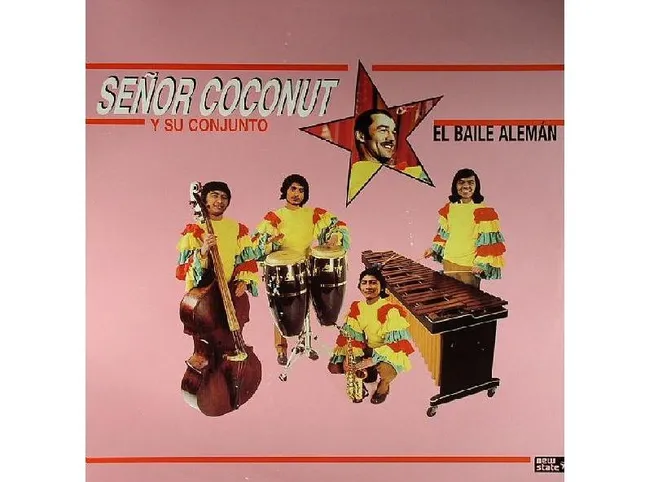
The idea of transforming Kraftwerk into a Latin American orchestra was born at the end of the 90s, when the German musician Uwe Schmidt moves from Frankfurt to Chileestablishing himself in the electronic scene of Santiago. There he came into contact with musicians, percussionists and arrangers linked to the local tropical tradition: cumbia, merengue, mambo, bolero.
That rhythmic vitality strikes him to the point of conceiving a project that merges two apparently irreconcilable worlds.
Schmidt, who had already been experimenting with multiple sound identities for years, then imagined the figure of “Señor Coconut”a semi-fictitious character: a tropical crooner, elegant and ironic, who reinterprets European electronic music as if it were a repertoire of South American standards.
The choice of Kraftwerk as source material it is anything but coincidental. Schmidt considers them a universal language: simple melodies, geometric structures, a minimalism that can be recoded in any context. However, the operation requires meticulous work. Each song is reconstructed from scratch, conceived not as a remix but as orchestral cover: horns, vibraphone, marimba, full rhythm section. The samples leave room for real musicians, chosen from the Chilean scene.
In 2000 Uwe Schmidt, under the pseudonym Señor Coconut, published El Baile Alemánone of the most audacious and successful experiments in the field of musical reinterpretations. The album rereads Kraftwerk’s electronic canon in a Latin American key, transforming some of the German band’s most iconic songs into a repertoire of cha-cha-cha, mambo and merengue with surprising formal rigor.
Far from being a simple parody, El Baile Alemán is a meticulously constructed tribute: Schmidt employs a full band, horn arrangements and a wide range of percussion, converting the Kraftwerkian robotic aesthetic into a warm and festive context without distorting its melodic structures. The result is an album that has won over both electronic enthusiasts and tropical music fans, becoming a reference for musical cultural crossover.
Tracklist – El Baile Alemán (2000)
Autobahn
Showroom Dummies
Trans Europe Express
The Robots
Neon Lights
Radioactivity
The Man Machine
The formula was replicated, with less surprise, in 2003 with “Fiesta Songs”, which contains re-readings of, among other things, “Riders on the storm”, “Beat it” and “Smoke on the water”,
and in the following (2008) “Around the world with Senor Coconut”, but “El baile alemán” remains the most coherent and successful project.
Who is Uwe Schmidt
Uwe Schmidt was born in Frankfurt am Main in 1968. His early fascination with synthesizers, drum machines and reel-to-reel recorders led him to experiment with sounds and tapes from a very young age.
In the 80s he embraced the first underground scenes: EBM, industrial, synth-pop. His debut takes place under the name Lassigue Bendthauswith which he publishes Matter (1991), an album that will immediately attract attention for its attention to sound design and cybernetic aesthetics. At the same time he started a parallel production as Atom Hearta project that would become his main signature for almost a decade. Here Schmidt develops a language that combines radical experimentation and technical rigor, anticipating the minimal-digital aesthetic that will explode only years later.
The 90s: the proliferation of identities
During the 90s Schmidt established himself as one of the most protean artists on the world electronic scene. Work with a constellation of aliases — HEAD, DATAcide, Lisa Carbon, Flanger, Geeez’n’Gosh — each of which represents an autonomous aesthetic universe.
His approach is almost theoretical: each pseudonym is a rule of the game, a sound grammar. His production crosses techno, ambient, electronic improvisation, micro-sound, abstract jazz, deconstruction of house.
The move to Chile: a cultural turning point
At the end of the 90s Schmidt makes a radical choice: he leaves Europe and moves to Chilewhere he will settle permanently. Santiago becomes a key place in his artistic transformation.
Here he came into contact with the community of local musicians, with tropical culture and with genres such as mambo, merengue, bolero, cumbia.
From this meeting his most famous alias was born: Señor Coconut.
The new millennium: the Atom™ era
Since the 2000s, Schmidt has progressively concentrated its activities under the name Atom™: in this period he developed extremely digital, often conceptual music, in which glitch, minimal techno and “high definition” aesthetics blended into a highly recognizable language.
Among the over one hundred pseudonyms used by Uwe Schmidt for his production, here are the most significant, in chronological order.
Lassigue Bendthaus (since 1988)
The first major project. Industrial electronics, EBM, cybernetic aesthetics.
Key albums: Matter (1991).
Atom Heart (since 1989)
The name with which Schmidt makes himself known on the international electronic scene.
360° experimentation: ambient, techno, IDM, sound design.
+N (Plus N) (1990–1993)
Abstract and minimalist electronics, often collaborative.
DATacide (with Tetsu Inoue, since 1993)
Psychotropic and deep atmosphere.
HEAD (Hallucinogenic Ecstatic Acid Disco) (1992–1995)
Acid, techno and experimental variations with an ironic approach.
Lisa Carbon Trio / Lisa Carbon (1993–1996)
Electro, downtempo and melodic experimentation with an almost pop sensibility.
Geeez’n’Gosh (since 1997)
Conceptual reconstruction of “ultra-minimal” house, almost mathematically deconstructed.
Flanger (with Burnt Friedman, since 1997)
Electronic jazz, complex rhythms, aesthetics between post-bop and glitch-funk.
Atom™ (since 1998)
It will become his main alias in the 2000s.
Ultra-digital aesthetics: glitch, minimal, conceptual techno, synthetic and ironic pop.
Señor Coconut (since 1996, active since 2000)
Electronics and Latin rhythms reinterpreted in an orchestral key.
Key albums: El Baile Alemán (2000).
Los Samplers (late ’90s)
Side project exploring extreme sampling and digital humor.
Atom™ HD / HD (2005–2010)
“High definition” version of his digital style: hyper-lucid, ultra-sequential aesthetic.
CMYK (2000s)
Chromatic-sound experiments based on digital printing and decomposition concepts.
The Roger Tubesound Ensemble
Parody/homage to easy listening music and vintage synthesizers.
Uwe Schmidt
Used for more personal or less conceptually disguised works.
Atom™
It becomes its main brand, incorporating many previous practices:
minimalist techno, rigorous glitch, abstract digital pop, audiovisual works.
This article was created with the help of AI