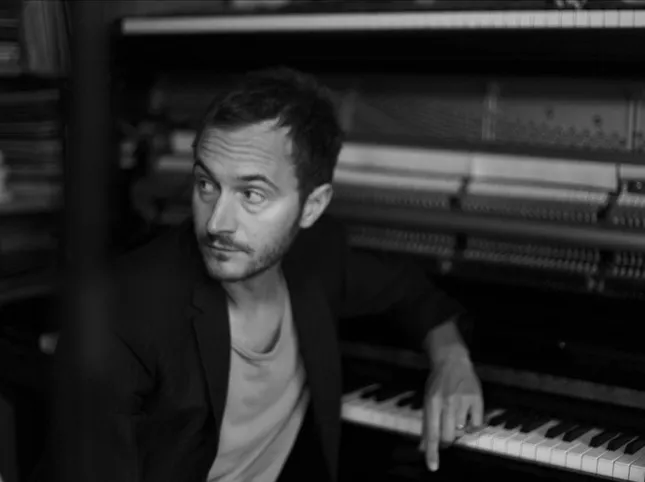
Tom Smith without the Editors: “I have never been so sincere”
“There Is Nothing In The Dark That Isn’t There In The Light” is released on December 5th, the album that marks the solo debut of Tom Smith. With the help of producer Iain Archer, the Editors frontman laid bare “the most heartfelt lyrics I’ve ever written”.
In the past you have said several times that you like change. Is this the reason you chose to pursue a solo career?
Maybe “change” sounds a little dramatic: I like to evolve, move and try to do different and new things. And yet, I think in some ways my record is more about doing what I’ve always done. As if it were a reflection of how I write songs, how I’ve always written them. I will always write around an acoustic guitar or a piano. Even when the Editors were in their most electronic or aggressive phase, the songs themselves were always born acoustically. Maybe the audience experiences a bit of a change listening to me like this, but for me it was quite natural and I feel like I’m doing what I’ve always done, somehow.
What new aspects of Tom Smith do we discover for the first time with this album?
I definitely feel like these songs, especially lyrically, are more personal; I feel like I was perhaps even more sincere than I have ever been in the past. With the band things can be more exaggerated, or somewhat ambiguous, which is what makes it more fun, I think. Go beyond the limits, as rock and roll should be. But when I decided to record a solo album, it was partly precisely because I felt the urgency of collecting in a single work the songs that I was writing and that I felt were more mine, more sincere.
The album has a very evocative title.
Yes, there is a lot of hope and a lot of warmth around the album. I wanted to sing about the people in my life, the ones close to me – and how they helped me get through the toughest times and moments. Unity is strength, as they say. I wanted to focus on that kind of light at the end of the tunnel, that kind of optimism, because you know, given the times we’re living in, it can be hard to see hope, or feel it. Focusing on the people I love has helped me most of the time. There’s a song on the record, “Deep Dive,” that sums it all up nicely.
The present affects you a lot.
Absolutely. It can be really intense, can’t it? It can be difficult to escape from the noise and how people are, especially seeing how we experience the world these days, that is, non-stop, without stopping for a moment. The disagreements and anger and problems we are constantly bombarded with can overwhelm you.
How long did it take you to write the songs and record? A rapid stream of consciousness or a more fragmented process?
I had a lot of material to work with before I started recording. But a lot of that material, when I got into the studio with Iain, then got molded, thrown away or turned into new material. Iain helped me a lot in writing: he helped me make more sense of my project and thanks to him I understood better what I wanted to communicate. It made everything clearer. The whole recording process took about a year, but we did it in very short sessions. Some of the ideas from which the album was born come from songs I wrote five years ago, plus other things we wrote in the studio. So yes, it took us a while, but when we started recording I didn’t expect such an effective collaboration. In the end the songs went beyond my expectations – and that’s a great thing.
Is there a song you are most attached to?
My favorite is the third, “Endings Are Breaking My Heart”. Obviously I’m proud of the whole album, for the work we did musically to grow the arrangements, from the rhythm section to the string instruments – and they’re fantastic; but all this especially applies to the second half of the album. My favorite is the first, when we hadn’t yet put all that work together, and the songs remained more bare, in a certain sense more raw and essential. And that song in particular, “Endings”… I was fascinated by the idea of this lyric where I listed things that come to an end. They can be serious, worrying things, but also everyday things, like the last glass of an evening at the pub, or flowers wilting. It seemed like a good idea for a song, I saw a sense of beauty in that list.
Do you feel more vulnerable without the band’s support behind you?
Maybe, I don’t know. I mean, it’s not something permanent, right? When I walk around I don’t feel in a fixed state of vulnerability. But, of course, I am aware that I have exposed myself with this album which, as I said before, is the most sincere I have ever written. So, you know, there’s actually a little part of me that’s anxious about this. But at the same time I am aware that I would not have been able to write it before, in my thirties. When I was young I needed time, water to flow under the bridge, that self-confidence that only doing this job for 20 years can give you, to feel comfortable in your own skin. I’m proud of the record and letting it go out there and trying not to let vulnerabilities ruin my day. The experience helps me move forward and I’m now at that stage in my life and career where it’s ok to come out of my shell.
In November you played in Milan and Parma and you have other dates scheduled in these parts in 2026. What relationship do you have with Italy?
The band and I always felt welcomed, like we were at home, right from the start. We have played many fantastic concerts and have unforgettable memories. There is a strong emotional connection in the music we make and it’s as if it were given back to us by the super warm fans we have in Italy, as if by looking at them we were looking at ourselves in the mirror. You can see they care a lot. Even on the last tour we did we found Italians everywhere, even in the most remote parts of England and Ireland. It’s great for us to have this kind of bond. On top of that, it’s also a wonderful place to play, so hopefully I can continue to do that.
Do the live shows reflect this new, more intimate dimension of your music?
That’s right. They are stripped down to the bare bones, very very quiet and there will perhaps be that slightly awkward silence, but yes, they are just like that. An intimate and fragile space that can also be very fun.
Did you change any perspective while writing the album? About you or the world around you?
I don’t think so. I don’t have anything so ingrained in myself, or a “black and white” view of the world. But I have to say that working with Iain, the way he pushed me towards the type of lyrics on the album was definitely a new thing for me. I’ve made many records in the past, even with the band my job is to write the lyrics and that’s fantastic, but no one had ever told me before “no, throw this away, it’s rubbish”; no one had ever really pushed me to think more about what I wrote. So I’ve definitely changed my perspective on this and it’s something I’ll take with me in the future when I write new songs.