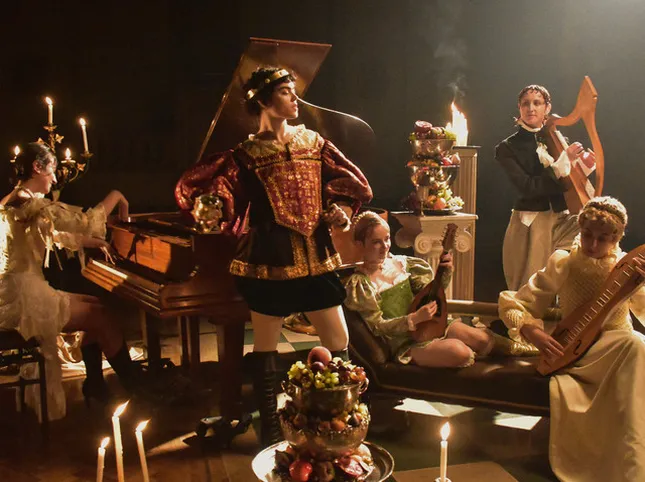
The meaning of the Last Dinner Party in 2026, in concert in Milan
Does it make sense today, in 2026, in the midst of streaming and the chorus that must arrive after less than a minute, a band that blatantly harks back to the glam rock of the 70s? Which cites the most refined and “arty” pop of Kate Bush or Roxy Music or which even takes as a model a band that is outside the box (but from which many have taken a lot) like the Sparks, not to mention the usually abused David Bowie? It makes sense indeed, and proof of this was the Last Dinner Party concert at the Fabrique in Milan. The all-female London quintet, with their second album released last autumn, “From the Pyre”, demonstrated that the success of the debut of “Prelude To Ecstasy” was neither a coincidence nor a flash in the pan. And even if the numbers were slightly lower than the first release (which also earned two Brit Awards), the Milanese concert in a packed Fabrique demonstrated that their proposal had taken root. A varied and colorful audience, without too many age barriers (ranging from 17 to 60 years old, mostly young people), ready to sing from the first to the last song made the eyes of singer Abigail Morris shine with emotion, who thanked her several times with emotion, remembering how less than two years ago they had given their first concert in Milan in a decidedly smaller club.
In the live version, the baroque structure of Last Dinner Party’s music (already more nuanced in the second album compared to the first) often gives way in favor of a more energetic impact, with great space given to the guitars of Lizzy Mayland and Emily Roberts. But above all, the almost mystical and ancestral strength of songs emerges at various moments which here and there blend elements of folk tradition with glam and art rock. And in all this the role of Abigail Morris is fundamental to involve the public in a show that moves sinuously between the party itself and a festive Sabbath: Morris sings, dances, plays with the public, laughs and jokes in Italian, not to mention the great space given to the thanks to the support group Sunday (1994) and the crew, something that is not seen every day, and to the appeals to donate to the Banco Alimentare Foundation with which the TLDP have entered into a collaboration for this Italian date (demonstrating the constant political and social commitment of the group, which has already emerged with a strong position on the massacres in Gaza). But he also manages to be the protagonist without his histrionics prevailing over the group, so much so that from mid-show onwards he often disappears, leaving the lead role to Mayland (“Rifle”) and Aurora Nishevci (“I Hold Your Anger”), who, between piano, keyboards, keytar and saxophone, acts as an essential link to all the sound elements of the band.
The intense and engaging moments are different: after the start on the soft and enveloping tones of “Agnus Dei” and the single “Count the Ways”, a triptych from the first album, “The Feminine Urge” and “Ceasar on a TV Screen” and “On Your Side”, ballads of rare expressive power, put the concert on the right tracks. The most layered songs that showcase the darker side of the writing of the five artists make up the central block of the show: “Woman Is a Tree”, with its a cappella introduction, “Rifle”, with the epic chorus of the chorus, and “The Scythe”, could very well rank among the highest moments of the almost two-hour concert. In the setlist almost divided in equal parts between the extracts from “Prelude To Ecstasy” and those from “From the Pyre”, there are also two never-recorded songs, “Big Dog”, present in their concerts since 2023, the new “Knocking at the Sky”, which can certainly be included in the group’s easier repertoire, so much so that it is left as the penultimate piece of the regular set, a moment before the explosion of “Nothing Matters”, their most successful single to date. The inevitable encore ritual is entrusted to the engaging “This is the Killer Speaking”, complete with a lesson from Morris to the audience on how to perform the choreography for the chorus, and then by a reprise of “Agnus Dei”, which closes the circle in the best way before the audience leaves the venue to the tune of “In Every Dream Home a Heartache” by Roxy Music, to reiterate what the TLDP references are. To return to the initial question: does a band like this make sense in 2026? Not only does it make sense today, but it is also hope for the future.
Here is the lineup:
Agnus Dei
Count the Ways
The Feminine Urge
Caesar on a TV Screen
On Your Side
Second Best
I Hold Your Anger
Woman Is a Tree
Gjuha
Rifle
Big Dog
Burn Alive
The Scythe
Sail Away
Sinner
My Lady of Mercy
Hell
Knocking at the Sky
Nothing Matters
BIS
This Is the Killer Speaking
Agnus Dei