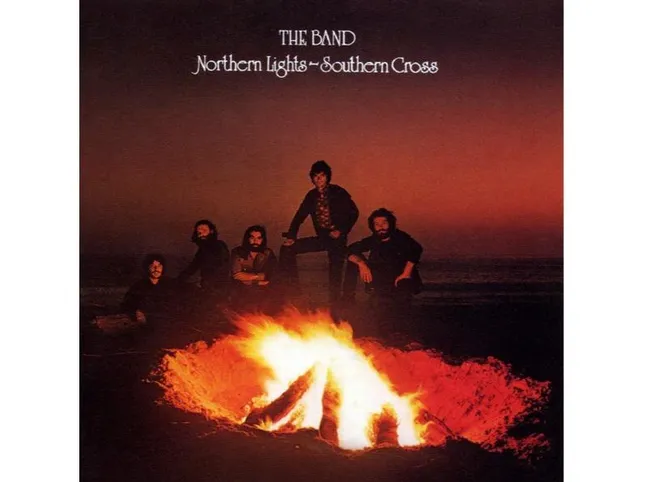
The Band played for us around the campfire, 50 years ago
In November 1975 The Band delivered to the world what, half a century later, still sounds like the perfect balance between their sonic legacy and a bitter narrative maturity: let’s talk about “Northern Lights – Southern Cross“, the album that marked the quintet’s return to unreleased material after years of fragmented activity; the album that represents, for many, their last great creative act before the definitive symbolic caesura of “The Last Waltz”.
Recorded in the musicians’ new home-studio, the Shangri-La above Zuma Beach, the album was the first to benefit from a superior technical availability: 24-track recordings that allowed denser arrangements and an unusual timbral stratification for the group. It was Garth Hudson in particular who exploited the multilayer possibilities to multiply the colors and accents of his keyboard. These production choices made the sound perhaps more “packaged” compared to the rough intimacy of “Music From Big Pink”, but at the same time they opened up new expressive spaces, especially in the long and cinematic ballads that dominate the B-side.
The tired soul of Robbie Robertson
Significantly, all songs are credited to Robbie Robertson: it is not just a contractual issue, but the demonstration of how, in those years, all the compositional strength of the ensemble resided in him. The songs of “Northern Lights – Southern Cross” build a emotional geography ranging from private remorse to collective saga; think of “It Makes No Difference”, the poignant heart of the album, and of “Acadian Driftwood”, a great historical fresco that translates the Acadian diaspora into an epic folk-rock drama. Robertson does not erase the voices of others, but fits them together as characters in a choral story that looks over his shoulder, towards the American dream, with tired eyes.
“Northern Lights” is a record that contains within itself many wonders. “It Makes No Difference” is a ballad that embodies the painful lyricism of Richard Manuel and the voice of Levon Helm, a sort of summa of the pathos of the group; “Ophelia” is the single with a bouncy rhythm and a contagious chorus; “Acadian Driftwood” is a long suite that combines storytelling and folk orchestral arrangement, a litmus test of the album’s narrative ambition. It is also one of the pieces chosen for the collective farewell, the “Last Waltz”, because it is central to the Band’s repertoire.
A contrasting atmosphere
The move to a “home” studio and more elaborate technology brought with it a internal contradiction: the warmth of the group must coexist with a more lucid and controlled sound. If on the one hand one can feel the lack of other more “raw” and genuine works, on the other the technical cleanliness amplifies the talent of the singles, as if the new means had pushed The Band to reflect, retouch and bring every nuance into focus. Many critics of the time recognized the album as their best work since “Stage Fright”, just as contemporary critics consider it one of their most coherent and mature works.
In fact, the album has been put back into circulation in remastered editions, a sign of interest on the part of an audience that continues to rediscover (or discover) the depth of “Northern Lights – Southern Cross”. The reissue helps to reread the work with today’s eyes, now that roots and folk have finally found their place in the history of rock.
Why continue listening to “Northern Lights – Southern Cross” after 50 years? Because there is nothing out of place; because the arrangements are not never sterile exhibitionism but always refinement; because the particular meets the universal, where intimate stories of loss (drugs, broken relationships, nostalgia) coexist with collective narratives; because it enters the listener’s heart without bombarding him with stimuli, without shouting at him but rather welcoming him into the bonfire around which the musicians are sitting, as on the cover; because the union between popular song and songwriting is a precious gift to cherish and to be preserved over time.