The 10 most iconic covers in the history of prog
Two necessary premises. The first: every classification is arbitrary, limited and limiting; there will always be illustrious exclusions and other names who deserve to appear among those “best ten”. The ranking is a game, food for thought and an opportunity to remember those who have left a mark on history. The second: in our ranking of the 10 most iconic prog covers, we looked a balance between Italian and international progbecause we often forget about the rare pearls we have in our home, because the neighbor’s grass always seems greener, etc.
So here are 10 prog covers that, once you see them once, you never forget. Five Italian, five international.
5. Hosanna – Palepoli (1973)
“Palepoli“is the creative summit of Osanna, a Neapolitan group that mixes progressive rock, theatre, mythology and Mediterranean tradition. The cover represents an ancient city with an aura of mystery, which evokes the cultural stratification of Naples and the concept of “Palepoli”, the archaic city that sleeps under the metropolis modern. The image oscillates between history, art and spirituality, like the music on the record, suspended between ritual and psychedelia. A bridge between rock and visual art.
4. Area – Arbeit Macht Frei (1973)

The cover of Area’s debut album is a punch in the stomachstarting from the title: “Arbeit Macht Frei”, which brings with it all the horrendous and painful Nazi imagery of the concentration camps. A direct image, a political and provocative symbol, published in the midst of Italian protest. With this album Area take a clear stand against fascism, capitalism and any form of alienation. The album, musically a hybrid between jazz-rock, avant-garde and political commitment, finds a perfect visual equivalent in this cover, between anxiety and denunciation. Uone of the strongest and most controversial images of Italian music.
3. Premiata Forneria Marconi – One minute story (1972)

“One minute story“is the first PFM album, as well as the first album by an Italian musical group to reach the top of the national charts. The cover, created by Caesar Monti, Wanda Spinello and Marco Damiani, is a pictorial-surrealist artwork. The image seems to have come from the genius of Giorgio De Chirico and tells the life of a common man, precisely the songs of this masterpiece which contains, among other things, the eternal “September Impressions”.
2. The Footsteps – Felona and Sorona (1973)

Designed by the painter Lanfranco, the cover of “Felona and Sorona” represents two anthropomorphic planets: Felona and Sorona. The dualism between light and shadow, male and female, life and death, is expressed with a pictorial style that recalls visionary surrealism and fantastic painting. The illustration perfectly reflects the concept of the album: a cosmic parable on the alternation of opposites and the complementarity of forces. An aesthetic masterpiece.
1. Mutual Aid Bank – Mutual Aid Bank (1972)
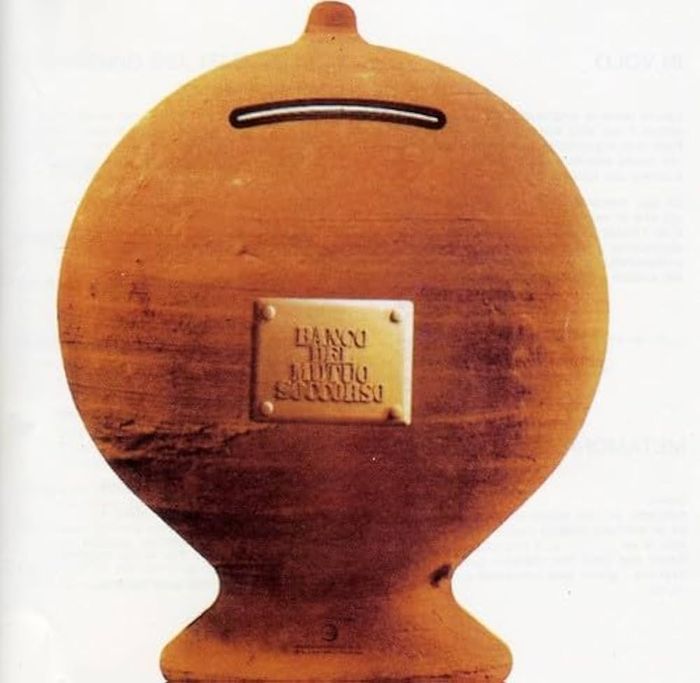
The debut of the Banco is one of the most iconic works also from a design point of view. The cover of the original vinyl edition was shaped like a piggy bankand from the slit you could extract a strip of cardboard with the faces of the group members. The most famous piggy bank in the history of music is the work of illustrator Mimmo Mellino, an aesthetic manifesto: the group “guards” their music like a treasure, but invites the listener to open the safe and discover the secrets contained inside. The object itself was extraordinary for its time, one of the first Italian experiments with “pop-up” covers. The idea also reflects the name of the band itself, with irony.
INTERNATIONAL COVERS
5. Jethro Tull – Aqualung (1971)

The cover of “Aqualung” is an oil painting by the American illustrator Burton Silverman. The subject is acritical observation of societyreligion and moral hypocrisy. Simply a prog classic.
4. Emerson, Lake & Palmer – Tarkus (1971)

The cover of “Tarkus” is one of the most recognizable in prog. The front image shows an imaginary creature half armadillo and half tank, equipped with mechanical tracks and natural armor; on the back and inside the gatefold (in the editions that include it) a real one develops mini-bestarium which tells the story of Tarkus: a series of hybrid creatures (a mechanical pterodactyl, an armed insect, etc.) who embody the conflict between nature and technology. Despite the war/futurist theme, the graphic tone remains ironic and deliberately anti-realistic. The edgy style and acid colors highlight that blend of grandeur and humor typical of ELP. The image has become an icon of prog because it manages to be simultaneously fantastical, conceptual and instantly recognisable.
3. Genesis – Foxtrot (1972)

The surreal image of a fox in red dress walking on water has become synonymous with Peter Gabriel-era Genesis. The artist Paul Whitehead, already author of the previous covers (Trespass, Nursery Cryme), constructed an ambiguous and symbolic scene, suspended between fable and social criticism. The figure of the fox represents the elegance and deception, but also the theatricality of the group, which Gabriel will then bring on stage wearing the famous fox mask. The autumn colors and the seascape evoke a decadent, surreal world, where myth and reality mix.
2. King Crimson – In the Court of the Crimson King (1969)

The screaming face on the cover of “In the Court of the Crimson King” And one of the most disturbing and powerful images of rock history. Painted by Barry Godber, a programmer and amateur artist who died shortly after the album’s release, it represents a “schizophrenic man”, a metaphor for modern alienation. The exasperated expression, the violent colors and the pictorial material rendering create a very strong visual impact, perfectly in line with the sound content: an explosion of drama, chaos and beauty. It is the cover that more than any other has embodied the visionary sensitivity of the project. Today the original painting is preserved by Robert Fripp, leader of the group.
1. Pink Floyd – The Dark Side of the Moon (1973)

There will come those, the usual ones, who will say: “Pink Floyd are not prog”. Sure, and Jimi Hendrix wasn’t a good guitarist. At most one can say that they are not Alone prog, and it’s true: Pink Floyd is everything. And even beyond. There is certainly an axiom that cannot be denied: the cover of “The Dark Side of the Moon” is iconic, and should be in any ranking. Regardless. A prism that refracts a ray of light on a black background: a universal icon of twentieth-century visual culture. The design was born from an idea of conceptual simplicity: to represent the precision and abstraction of Pink Floyd’s music, eliminating any superfluous element. The prism becomes a symbol of reflection, of the decomposition of reality and perception, central themes also in the texts. Minimalist graphics that revolutionized the language of covers, shifting the focus from the band to the concept. So powerful that it is recognizable without the need to add a title or any name.