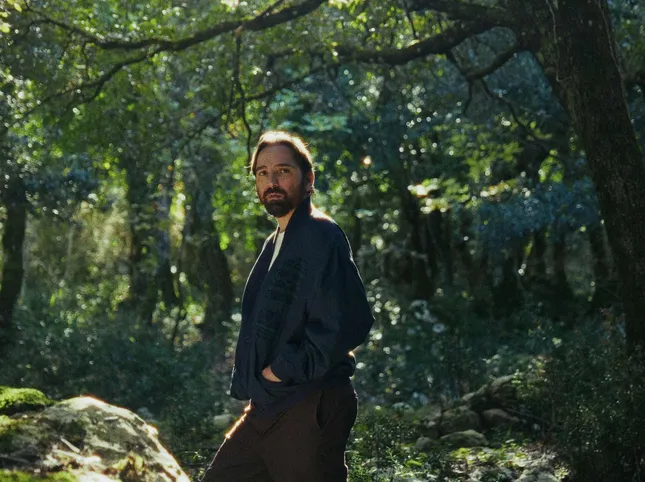
“Slowness is a political act”: Dimartino returns as a soloist
7 years have passed since “Afrodite”, the last solo album released by Dimartino. In between there are two albums, two Sanremos and a film with Colapesce which projected him into a decidedly more mainstream dimension. Antonio Dimartino brings his artistic path back towards personal writing and literary suggestions, which have always been present in his career with “L’improbabile fiore dell’Oreto”, his fifth studio album, available from today, 8 May.
A deeply personal work, in which Dimartino chooses not to open himself up to collaborations. “This album is very much influenced by my individuality and there are no collaborations because, when there are, they are the result of artistic rather than discographic reasons. In this case there was the need to have a single voice, mine”.
“We talk to Colapesce every day”
A return to the solo dimension that restores the poetic and metaphysical vision of the Palermo author. “I’m enjoying this return as a soloist very well,” he says. “It is a record that I like and that I consider important for my career because it tells of a period, a way of making music, and which is part of a path that began years ago and has never been interrupted. I feel very at ease. In these seven years I have changed as a human being – he adds – many things have happened, many shared with Lorenzo (Colapesce). The voice has changed, but a common thread remains in my records, which are the writing intentions. There is always the desire to tell something intimate that can become universal”. In the meantime, the bond with Colapesce remains solid, beyond external readings. “With Lorenzo, despite what has been said, we talk every day and we work together. We were born with two separate projects, then we joined together and now we have simply returned to our own paths. The exploits of recent years have led the general public to misunderstand our solo paths, but those who have always followed us know that the one with Colapesce was a parenthesis, albeit a beautiful one. Writing with him is an enrichment, I think it’s mutual, and we don’t rule out future collaborations.”
The river and flow of music
At the center of the album there remains a suspended question, which runs through all the tracks: are we still capable of truly getting excited? “My answer is yes, but I prefer to leave the question to the listener. This emotional fullness is unlikely, but not impossible. Over time it is easy to dry up, but it is equally possible to be reborn, to flourish again, to leave the possibility for emotions to overflow.”
The single “Agua, ¿dónde vas?” it is a musical adaptation of a poem by Federico García Lorca, which already sets the tone of the project: the album, produced by Roberto Cammarata, takes shape between Milan and Palermo in a period of personal and artistic transformation. The Oreto river becomes the symbolic center of the project: a real and at the same time narrative presence, capable of containing memory, contradictions and the possibility of rebirth. The songs follow one another without interruptions, linked by instrumental codas that build a continuous flow and ask the listener for time and immersion.
“It is certainly not a record that responds to the current logic of use. I wanted, almost from a political point of view, to claim a certain slowness and the idea that an artist’s messages do not necessarily have to be immediate, like a slogan. It is important to understand where ideas come from, how they develop and how they can be shared and discussed. Even the instrumental codas fall within this vision: a writing that goes against the current which, precisely because it distances itself from the general flattening of the sound, can find more listening space, regardless of whether one likes it or not”.
This tension is also reflected in the sound construction of the album, which chooses subtraction instead of accumulation: few elements, pauses, silences that become an integral part of listening. “If removing arises from an artistic need, then we can say that it is a value. The pauses in music are fundamental for assimilating the songs and I simply followed this flow. Remaining in the metaphor of the river, its flow is difficult to stop”.
Music and literature
Literary suggestions and personal imagery coexist in the album: in addition to Lorca, references to “Heart of Darkness” by Joseph Conrad emerge, together with elements of familiar folklore such as the mythological figure of “U sugghio”, also reproduced in the artwork created by Igor Scalisi Palminteri. A plot that confirms the song as an open narrative space, capable of welcoming complexity and mystery. “The song has the limit of having to say everything in three and a half minutes. I’ve always been fascinated by music that takes its time, that gives itself space and claims autonomy. I’m interested when a songwriter follows a personal vision, beyond the verse-chorus scheme.”
Live
The album’s essential approach is also reflected in the live dimension: a series of unplugged concerts in intimate and unconventional places, designed to bring listening back to the center.
“It’s a choice that reflects the album. I supported its nature, built around an acoustic guitar, with a choir of five female voices led by Serena Ganci, the strings of Alessandro Trabace, a small orchestra and incursions of organic electronics. Bringing it live in this first phase in guitar and voice form seemed ideal to me, also to take back a personal space in the performance. Playing in particular places helps the audience to listen. No sensationalism, no effects pyrotechnic: just someone sitting on a chair telling stories. For me it’s a small revolution.”
“The improbable flood of the Oreto Tour 2026” will start on May 8th from the Waldensian Church in Rome and will pass through various Italian cities – it will stop on May 11th at the Teatro Filodrammatici Milano – until it ends on December 19th in its hometown Palermo with “An improbable finale”.