Side B: Bill Haley’s “Rock Around the Clock”
Bill Haley & His Comets
(We’rear Gonna) Rock Around the Clock
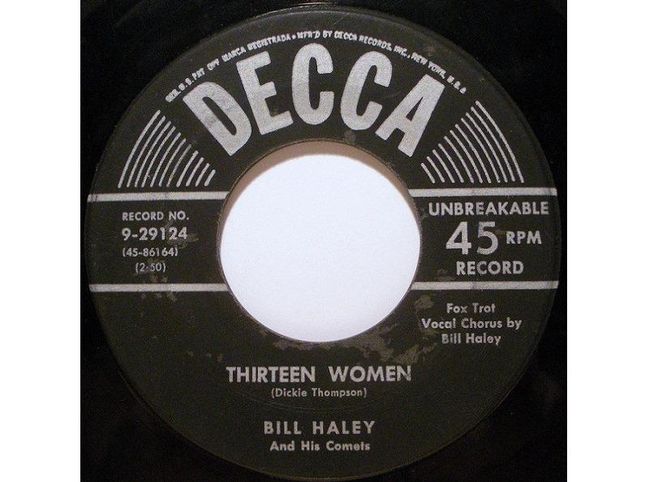
B-side of Thirteen Women (and only one man in Town)
Decca, 1954
Billboard One thing says: the recent history of music must be divided between 1890-1954 and 1955-price. There in the middle, to shine like epochal watershed and unwavering point of reference for the birth of rock’n’roll, there is the most famous and influential B-Side of the whole history of this kind. A pearl of music that is still today’s line of demarcation between the dawn of rock and the musical industry as it was so far. Rock Around the Clock It is not only the abbreviation of Happy Days and the soundtrack of American Graffiti, Jungle Blackboard, Superman And another string of films, shows and TV series. It is simply the first rock’n’roll song in history that has collected success in every part of the world. That thanks to which Elvis Presley, Little Richards and Buddy Holly conquered space and subjects for their kingdom. Thanks to which the whole planet began to find a new direction of travel, to shake off the ashes of the war to start dancing.
But the historic US weekly magazine, particularly known to draw up very detailed rankings, also says more: Rock Around the Clock It was the first album of the genre to reach position 1 position in the American and British mainstream ranking. A stuff unthinkable until just a year earlier, when in 1954 the sweet ballads of Kitty Kallen, Perry Como and Rosemary Clooney dominated. Then the fuse and fire, suddenly flared up. A fire that we consumed very quickly because then the king arrived to take everything (already in 1956, 5 singles of Presley were among the first 15 in the standings, of which Heartbreak Hotel And DON’T BE CRUEL to numbers 1 and 2). But the flame of that exceptional cultural revolution had the traces of immortality in its DNA. To date Rock Around the Clock It is in fact the most most sold Rock’n’roll Rock’n’roll with over 25 million copies. An approximate figure, however. But enough to the Guinness Book of World Records to insert the piece behind the alone White Christmas of Bing Crosby among the best -selling pop songs ever.
Rock Around the Clock The day of grace was engraved 12 April 1954 by Bill Haley and his group, the comets. Name chosen due to its assonance with the famous Halley comet, suggested by Bob Johnson to Bill a couple of years earlier, when the two were colleagues at the WPWA radio. It was not a simple day: during the journey towards the Pythian Temple recording studio in New York, the ferry on which they traveled incurred in a sandbench on the section of the Delaware River between Chester and the Big Apple. This greatly reduced the time available to the band to record their pieces: “We only had three and a half hours” recalls the bassist Marshall Lytle. Decca Records Milt Gabler manufacturer insisted that it was immediately engraved Thirteen Women (and only one man in Town)chosen by him as the first single. “We had never heard that song first and so we took three hours to finish it. We only stayed half an hour for Rock Around the Clockbut fortunately we already had an arrangement made in the basement of Bill in Pennsylvania and we made it in two take. The piece was magically leaving. “Despite the recording made quickly and fury because Sammy Davis Jr. was waiting for his turn outside the study. Only later did the Decca technicians combine the two versions in the official one.
The single Thirteen Women (and Only One Man in Town) / Rock Around the Clock He was launched on May 20, 1954 but commercially was a failure. It had to wait a year for this incredible rock hymn to receive justice. Chosen as the opening song of the film Jungle Blackboard of 1955, RATC He took off definitively
towards the myth. The song written by Max C. Freedman and James Myers was initially offered to an Italian-American group called Sonny Dae and his Knights who recorded a version on March 20, 1954, a month before Haley. Myers highlighted several times how the composition had been conceived specifically for Bill and his band, but for legal reasons the commes could not put their hand until April of the same year. In fact, it seems that Myers had no good relations with Dave Miller, the Essex Records manufacturer to which Bill Haley & His Comets belonged to that moment. Miller pinned Bill several times in possession of the sheet of paper where there was the song and every time he tired him in the face: “Jimmy and Dave did not like each other” recalls the singer. “I brought the piece to the studio three times and every time Miller snatched him and threw him away. I never managed to record it.” Haley then made the extreme decision to abandon the Essex and sign for the Decca in that spring of 1954.
A year later the miracle was completed, which hides a curious fact. The director of Jungle Blackboard Richard Brooks was just looking for a Main Theme For his film and often went to visit Glenn Ford at home, the protagonist of the film. And his son Peter Ford was a great black music enthusiast: “I was the only white boy ” color ‘of all Beverly Hills” recalls, referring to his love for jazz music and R&B. “And I was proud of it!” It is necessary that Peter adored Bill Haley and that he owned a copy of Rock Around the Clock at home. “I remember that during one of his visits, Richard Brooks borrowed that album.” And so it is very likely that it was thanks to the son of the protagonist of the film that Bill Haley & His Comets were chosen for the soundtrack! The film came out on March 19, 1955 and the sensational success of the song threw the public in total confusion, which was convinced was a single, an a-side. And therefore that were looking for, in North America and school record stores. The sudden request that plunged the Decca back forced the record label to reprint the piece, this time as an official single in June 1955: 8 weeks in the lead to the ranking of Billboard. “I turned the radio knob in the car and I felt our piece,” says Lytle. “I changed the station, and it was still there. I was still running and there was always him. At a certain point he was playing simultaneously on five different stations. In five minutes I will have listened to him a dozen times. When you listen to something at the same time on many different broadcasters you understand that you have made a cursed Monster Hit“. From that moment the story is known: it is estimated that more than 10,000 artists have recorded their version of them over the decades and that there were about 200 million copies sold in all for each engraved version.” We were the first “said Haley a Rolling Stone In 1967. “We put the country & western together with the Rhythm’n’blues. That was the rock. The first three years were ours, all of ours. until Elvis arrived.” It is said that every minute of every day that God sends on earth, someone around the globe plays on his own or passes through RATC On the radio or on television or on the net. You do the accounts on the royalties that come out of it.
“The national anthem of rock’n’roll”, as Dick Clark called him, the inventor of the American Music Awards, was therefore the fortune of the Comets and their leader William John Clifton Haley, a boy of Highland Park (Michigan) with a murderer and blind tirabaci with a left eye from a very young age. Disappeared at the age of 55 officially of natural death (the medical certificate spoke of a heart attack), 3 wives and 10 children on the curriculum, the life of Haley traced a route well well known to all the rock stars overwhelmed by the planetary success: the great bang in the early 1950s with pieces like Rock the joint, Crazy Man, Crazy And Shake Rattle and Rollthe consecration of Rock Around the Clock And the ascent in the Olympus of the myth, its star obscured by the new arrivals, the crisis, the dependence on alcohol, the violence at home. “When he was drunk, he was really very much” recalls his son Bill Haley Jr. in the Memoir Crazy Man, Crazy of 2019. “He changed personality. I do not consider my father a violent person and I think he has never been. But when he dried things he did like to launch ascereneri. Once at home he pointed a kitchen knife to my mother’s throat, not realizing who he was. This made it clear how he changed character when he was drunk. I think he had to do with his feelings of inadequacy.
Haley was the first who brought rock’n’roll to Europe on the 1957 tour. With the comets they were the first band of the genre to end up on television at theAnd Sullivan Show on August 7, 1955. The first, again, that with his band “put everything for the first time together”, as Tony Cajiao wrote on Now Dig This! And even if his most famous piece is often considered the first Rock’n’roll song ever, the reality is that at least a decade before RATC R’n’r was already beautiful rooted in the United States. But he was played only by black musicians. Bill Haley & His Comets and Elvis Presley were the first white artists who played that fantastic sound. “There must be a music from Cadillac and one from Ford,” Bill said to Nme In 1955. “Tchaikovsky and Bach are from Cadillac. We play more with our feet on the ground, from Ford. It is a solid beat, perfectly designed to make the teen balls”.
Haley ended his career with a last concert in South Africa in 1980, the year in which a brain cancer was diagnosed, never officially confirmed. Today his name reflves next to a star on the Hollywood Walk of Fame and somewhere in the middle of the universe, where there is the asteroid 79896 Billhaley. And with it, the immortal spirit of an American boy who “when I am 75 years old and you will still be able to beat his hands and I keep the guitar, we will still have rock’n’roll”.
The text of “Rock Around the Clock”
Traces
Thirteen Women (and only one man in Town) – 2.50
(We’re skirt) Rock Around the Clock – 2.08
Musicians
Bill Haley – voice, guitar
Marshall Lytle – double handle
Francy Beecher – guitar
Billy Williamson – Steel Guitar
Johnny Grande – Piano
Billy Gussak – Battery (turn)
Danny Cedrone – Electric guitar
Joey Ambrose (aka Joey D’Ambrosio) – tenor sax
Producer
Milt Gabler
Extract from “The side B” by Paolo Gresta, Arcana Edizioni.
© 2024 Lit Edizioni sas courtesy