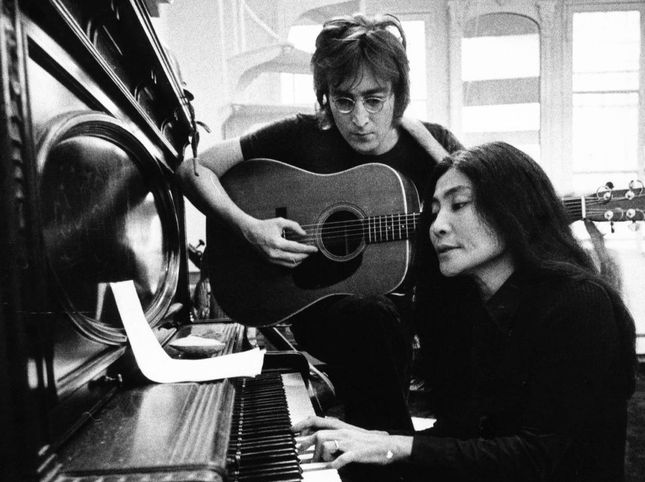
One to One: Lennon, Yoko and America of the 70s
Those who have familiar with the Beatles and the careers of the four post-schools, know well that in the ten years between the end of the band (1970) and his disappearance (1980), John Lennon performed in a single complete concert (without considering, that is, some appearances in which he performed a reduced set), on August 30, 1972, and called One to One. This is to provide the title to the new documentary “One to One: John & Yoko”, lasting 100 minutes and codirect from Sam Rice-Edwards and Kevin MacDonald, winner of an Oscar for the documentary “One day in September”. It will be in cinemas from 15 to 21 May.
The result is remarkable: not a documentary in the strict sense on Lennon’s performance at the Madison Square Garden (indeed two, one afternoon and one evening, as per the practice of the time), but rather a chronicle of about a year and a half (August 1971-Marzo 1973) that John & Yoko spent in an apartment at the Greenwich Village, immersed in the New York counterculture of the era-in contact with contact with contact with contact Figures such as Jerry Rubin, John Sinclair (it was precisely the participation of the Lennon in a concert in his support, where 15 thousand people noticed, who made the release of the latter possible, sentenced to ten years in prison for possession of cannabis) and Allen Ginsberg – and also immersed in the thousand programs offered by the glittering and very rich television schedules of the time, between invitations to consumer, CHRONY ACTS, in a mixture of dramatic and grotesque.
How to shake the consciences from “apathy” (term used several times by John) and how to help unhinge the system – there are naturally images and words of the then Nixon president, whose administration hired a battle without exclusion of shots against John and Yoko, trying in vain to expel them from the country on several occasions – is the heart of the activism of the spouses Lennon, made in an interesting way through Listening to numerous seizures of phone calls between the two and journalists, activists, colleagues: mind you, they are not reconstructions, but of the original ribbons, which Lennon himself had begun to document when he suspected of being intercepted by the government authorities (true). It is therefore, this “One to One” is a cross -section of American society and politics of those early seventies and its contradictions.
Contradictions of which Lennon himself was prey, and which determined its detachment from the “movement” and the folding towards a more private dimension, made of greater concreteness: it was in fact the emotional wave of a report by Geraldo Rivera about the abuses perpetrated on children with mental retardation guests at the Willowbrook structure to push John & Yoko to organize the famous concert, some songs of which The audio supervised by Sean Lennon, the performances are remixed and boast a very clean sound, and come from the excellent evening concert, therefore different from those included in the album Live in New York City of 1986) are the backdrop to the documentary.
“One to One” also gets appreciated for the few but essential flashbacks (the therapy of primary urlo, which John and Yoko undertook with Dr. Janov in 1970) and for the excellent focus on the figure of the honor, perhaps more appreciable here than ever.