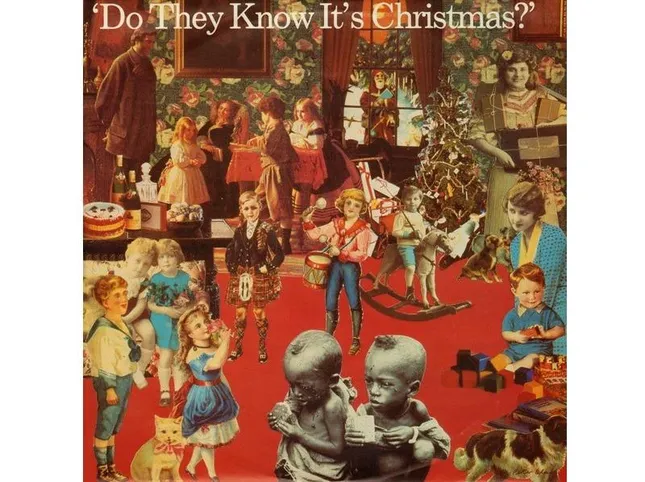
Nine days until Christmas: “Do they know it’s Christmas?” (Band Aid)
Authors: Bob Geldof /Midge Ure
Year of publication: 1984
Beyond the purely artistic merits, a very important song, an event that kicked off a series of charitable initiatives that have taken place all over the world, just think of the Live Aid concert on 13 July 1985 or the USA for Africa project with the song “We are the World”.
This story begins in London in October 1984. On October 23, the BBC broadcast a documentary by Michael Buerk on the serious famine that is afflicting Ethiopia. The BBC News crew is the first to document the incident, which Buerk describes as “a biblical famine in the 20th century” and “the closest thing to hell on Earth.” The documentary shocks England, and among those who witness the dramatic images in astonishment there are also Bob Geldof, singer of the Boomtown Rats, and his girlfriend, the television presenter Paula Yates.
Geldof’s career in 1984 is at a standstill. After the success of the single “I don’t like Mondays”, from 1979, the subsequent Boomtown Rats albums had left no trace, so Bob wrote a draft of a song entitled “It’s my world” and submitted it to the band members in anticipation of recording a new album, but the others didn’t like it and rejected it. Geldof doesn’t give up and changes the title to “Do they know it’s Christmas?” (“Do they know it’s Christmas?”) thinking it might be a good Christmas piece. In early November Bob accompanies his girlfriend Paula to Tyne Tees Studios in Newcastle upon Tyne, where she hosts the live music program “The Tube”. Among the artists performing that week are Ultravox, whose leader, Midge Ure, is an old friend of Geldof’s.
Reaching him in the dressing room after the performance, Geldof tells him that he would like to do something to help the Ethiopian people by recording a record for charity. Ure immediately agrees to get involved in the project, and they both agree that the best thing is to make a new song, rather than a cover which would force them to have to pay royalties, but time is very tight to be able to release the album for Christmas. Geldof remembers the outline of the song he had written and a few days later, on November 5, he shows up at Ure’s house.
Midge Ure himself said: «Bob showed up at my house with a guitar that looked like he had found in a landfill. It had almost no rope. He started singing this thing to me… it was obvious he was making it up as he went along. There was no melody, no structure and every time he sang it, it sounded different. He presented me with the idea for the lyrics, “It’s Christmas, there’s no need to be afraid”. My main contribution to the text was to change the sentence “And there will be no snow in Ethiopia this Christmas”, replacing “Ethiopia” with “Africa”. Then we wrote the central section together.”
While Midge Ure shuts herself in her personal studio to refine the song and prepare the base, Geldof takes action to try to involve as many English artists in the project. His idea is to ask Trevor Horn (author of “Video killed the radio star”) to produce the song. Horn was an in-demand producer at the time, having produced three number one singles in 1984 for Frankie Goes to Hollywood. Horn is enthusiastic about the idea, but tells Geldof that he needs at least six weeks to be able to produce the song, which obviously makes it impossible for the record to be ready for Christmas.
However, it is offering free use of Sarm West Studios in Notting Hill, west London (owned by Horn and his wife Jill Sinclair), for twenty-four hours on Sunday 25 November. Ure then decided to take care of the production, and together with his engineer Rick Walton he created the musical basis of the song, programming the keyboards and drum machines, while Geldof contacted the most prominent artists on the British scene, who all accepted with enthusiasm, except three whose names, however, Geldof never wanted to name (even if it is known that one was Morrissey, singer of the Smiths at the time). Some who were contacted but were unable to appear did send recorded messages which appeared on the single’s B-side, including David Bowie and Paul McCartney.
In the end the artists featured are Paul Young, Boy George, George Michael, Simon Le Bon, Sting, Tony Hadley, Bono, Paul Weller, Glenn Gregory, Marilyn, Adam Clayton, Martin Kemp, Steve Norman, John Keeble, Nick Rhodes, Andy Taylor, Roger Taylor, Chris Cross, Holly Johnson, Martin Ware, Francis Rossi, Rick Parfitt, Jody Whatley, Bananarama, Boomtown Rats and Kool & the Gang.
Regarding the recruitment of the various artists, Bob Geldof said: «I called Sting and he said, “yes, count on me”, and then Simon Le Bon, who said to me “tell me the date and let’s cancel all the programs on the diary!”. The same day I pass by an antique shop and inside I find Gary Kemp, the guitarist of Spandau Ballet, about to leave for a tour in Japan, who said to me if it was possible to wait 10 days for the band to return to England… Suddenly I thought, “Christ, we really have the best guys here, all the big names in pop are ready and willing to do it”…».
Sting and Simon Le Bon recorded their parts before the others in Midge Ure’s studio, but they would still be present at the recording with the rest of the group. A small misunderstanding concerns Simon Le Bon himself who believes that the song is a duet between him and Sting. “Bob called me and said, ‘Simon, have you seen the BBC documentary on the famine in Ethiopia? We have to do something.’ I hadn’t seen the show, and he told me what it was about and said, “I have an idea. We should make a benefit record. What do you think?” He told me that he had already received a yes from Sting and of course I accepted immediately. I thought I was going to have half the song, so I was honestly a little pissed off when I walked into the studios and heard someone else singing one of my verses!”
Geldof and Ure arrive at Sarm West Studios around 8am on Sunday morning, with media present outside. Registration is scheduled to begin at 10.30am and the artists begin to arrive. Geldof arranged for the British newspaper “Daily Mirror” to have exclusive access inside the studio and ensured that a group photo was taken by the newspaper’s photographer, Brian Aris, before starting the recording. Geldof absolutely wants Boy George, from Culture Club, to be present at the recording too, he is one of the top artists of the moment and Geldof already knows what phrase to make him sing. Except there’s one little problem: Boy George is in New York. The day before the recording Geldof calls Boy George and insists that he take the first plane back to London. The singer accepts but is unable to wake up in time. At noon on the day of the recording, Boy George is still nowhere to be seen, so Geldof calls him angrily telling him to get off his ass and get on a Concorde straight away. Boy George arrives at Sarm West at 6pm and immediately goes into the recording booth to sing his line, the last solo artist of the day.
Except Le Bon and Sting, none of the singers had ever heard the song before arriving in the studio. Ure recorded a guide voice and the various artists learn their parts by listening to it, then recording it immediately. In an interview, Midge Ure said that this time limitation certainly helped: «Sometimes, this kind of pressure leads you to create something magical, it leads you to eliminate the tensions that you end up having in the studio. We just had to nail that moment and try to get along… and a lot of the vocal tracks were brilliant.”
The recording takes place in several parts which will then be assembled by Midge Ure. Before the solo parts, the choir is recorded: all the artists as a group sing the phrase “Feed the world / let them know it’s Christmas time” (“Feed the world / Let them know it’s Christmas”) over and over again until the song is completed, after which we move on to the soloists’ voices. Ure decides that Tony Hadley will be the first singer to record his solo part. Hadley would later admit that it was difficult, knowing that all his other colleagues were watching him. One by one the other singers do the same, with Ure recording their efforts and making notes on which segments would be cut in the final recording. Out of modesty, despite both being singers, both Geldof and Ure decide not to sing any solo parts, limiting themselves to taking part in the final chorus. The instrumental base is provided by John Taylor (Duran Duran) on bass, Phil Collins on drums and Midge Ure who plays all the other instruments and takes care of the programming.
Collins arrives at the studio with his entire drum set to record a live track over the already programmed drum machine, and after assembling the drums he waits patiently until the evening, after all the vocals have been recorded. Although most of the artists taking part are the biggest British stars of the moment, there are some “intruders”: the members of the US group Kool & the Gang, for example, appear on the album because they were in the London offices of Phonogram on the day Geldof presented his idea; Marilyn, on the other hand (born Peter Robinson), had had a couple of hits in the charts a year earlier, but her star had already faded, so she saw an opportunity to return to the spotlight and showed up at the recording despite not having been invited, but welcomed by Geldof and Ure, in the “the more stars that can appear on the record, the better” series. When asked who had provided the best evidence, Ure replied: “Without a doubt Bono. His verse – “Tonight thank God it’s them instead of you” – I originally sang on the lead vocal an octave lower, and he decided to raise it, and it was phenomenal, electric, it was just sensational.”
The following morning Bob Geldof appears on Mike Read’s BBC radio show to promote the album, promising that every penny will go to the cause. The single was released in record time on 3 December 1984, just a week after recording, and Radio 1 began playing the song every hour, whereas normally a top single plays a maximum of seven or eight times in a day. Number 1 in the UK charts at the time of the release of “Do they know it’s Christmas” was “I Should Have Known Better” by Jim Diamond, who declared: «I’m happy to be at number one, but next week I don’t want people to buy my record, I want them to buy Band Aid». In the first two days the single sold over 200,000 copies, despite many negative reviews appearing in the press. Ure and Geldof themselves have always stated that they didn’t consider the song to be much, but that what mattered was that it sold and raised as much money as possible for the cause of Africa. And so it was. Released in the United States on December 10, the single sold almost two million copies in the first eleven days, and reached No. 1 in the charts around the world, including Italy, and served as inspiration for the similar operation by USA for Africa.
This sheet is taken from the book “What songs don’t say – Vol. 1” by Davide Pezzi