“Mother Mary” and the sacred monster of the pop star, at the cinema
“Cover your ears, this song is cursed” The words appear on the screen during a performance of Mother Mary and they are enough to immediately declare the territory of film by David Lowerywhich arrives in Italian cinemas from May 14th distributed by I Wonder Pictures. After dance and discipline brought to the limit by Darren Aronofsky’s “Black Swan” in 2010, for some time pop has also become one of cinema’s favorite places to talk about the power, fragility and horror of spectacle. No longer just biopics, musicals or concert films, but also thrillers, psychological dramas, horror and gothic fantasies in which the pop star becomes a mythological creaturesacrificial victim, religious idol and performance machine.
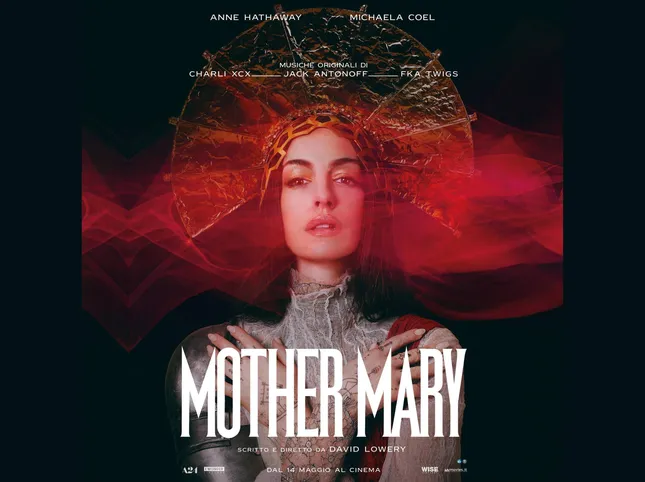
In “Mother Mary” Anne Hathaway she plays a world-famous singer who, on the eve of her big return to the stage after an accident during a concert, flees to the English countryside to look for Sam Anselm, stylist and former collaborator played by Michaela Coel. The pop star’s request is a new dresswhich is not just a simple stage costume, but something that allows her to present herself to the public again, to give shape to a new era, to sing her comeback single “Spooky action“. From this song, presented as potentially “the greatest song ever written”, but of which the public never listens to the complete version, seems to depend precisely the very possibility of being reborn. Sam doesn’t want to listen to the piece, he doesn’t want to listen to Mary’s voice anymore, he doesn’t want to return to a creative and personal story that ended badly. Yet he accepts, transforming the laboratory housed in a barn into an emotional torture chamber where the dress becomes confession, weapon, new skin and ghost.
On the screen, pop stardom becomes frightening
Lowery constructs “Mother Mary” as a ghost film disguised as a musical dramaor maybe like a movie about pop he uses the tension of horror to say what realistic language would not be able to contain. Its protagonist collects and mixes recognizable signs of contemporary stardom. Walk with the stage confidence of Taylor Swiftassumes poses like pop deities that refer to Beyoncécarries ornamental details that make you think of Ariana Grandewhile the aura of a distant icon, extreme fashion and the tension between art, image and control evoke Lady Gaga. Lowery cited Taylor Swift’s “Reputation Stadium Tour” and “Bram Stoker’s Dracula” by Francis Ford Coppola, while Hathaway said she also looked at Beyoncé, in particular at “American Requiem” and “Homecoming”, to understand how to give Mother Mary a vocal and physical presence that is at once immobile, charismatic and threatening.
In its goal, the film definitely does not seek sobriety. The protagonist is called Mother Mary, wears a halo, is observed by fans as an almost sacred figure and crosses the stage as if every concert were a liturgy. The symbolism is evident, at times even brazen, but it is precisely there that “Mother Mary” finds one of its most interesting ideas. Pop, in the film, is not just entertainment. It is a form of worship in which the public deposits desires, fragility, need to belong and hunger for ecstasy. The diva doesn’t sing just to be heard, but to take charge of a collective energy that surpasses her and risks devouring her.
The problem, and at the same time the charm of the film, lies in the fact that Lowery tries to make visible something that cinema has always struggled to invent from scratch. A fictional pop star doesn’t just have to have believable songs, spectacular costumes and an impressive stage. She must convince the viewer that, in the world of the film, millions of people really love her, follow her, imitate her, await her return, attribute meaning to her. It is an almost impossible goal, because the stuff of pop is not only made of music, but of repetition, exposure, shared memory, campaigns, interviews, scandals, choreographies, memes, fanbases and years of presence in the collective imagination.
“Mother Mary” partly circumvents this obstacle choosing the path of myth instead of realism. It doesn’t really explain how Mary became a star, it doesn’t fully show the industrial workings of her fame and it doesn’t get into the precise, ferocious and unromantic machine that regulates a global pop career today. Real pop stars don’t disappear a few days after a decisive performance because they don’t know what to wear, but they plan details and strategies with almost military precision. Lowery doesn’t want to tell that part though he seems more interested in the dreamnot to management or the marketing department. For the purpose of the film It’s interesting what happens when a figure born to give shape to the desires of others no longer knows what shape it has itself.
The cinema in front of the pop factory
In recent years, cinema has continued to revolve around the topic without finding a definitive definition. Talking about contemporary pop is difficult because it means staging something that lives on the surface but it is never just the surface. “A Star is born” worked because it could count on Lady Gaga, a real pop star who brought her own public story, her own voice and her own experience of metamorphosis into the film. Musical biopicsfrom “Rocketman” to “Bohemian Rhapsody” and the recent “Michael”, up to films about Elvis Presley, Bob Dylan or Bruce Springsteen, they start from a huge advantage and play precisely on that “such and such show” effect to work. The spectator already knows the myth and goes to the cinema to see if the actor can evoke it.
However, when cinema has to invent a pop star from nothing, the risk of disaster is always around the corner. Sometimes it works better when pop stardom remains in the background. In “Trap” and “Smile 2,” both from 2024, concerts become spaces of tension and fear, while the fictional stars Lady Raven and Skye Riley do not have to carry all the weight of the film alone. They may seem generic, because that genericness is part of the game. Even “The Idol”, despite everything that didn’t work in the series, had found in “World Class Sinner / I’m A Freak” a fictional song stupid enough, catchy enough to seem plausible in its own cynicism. “Vox Lux” from 2018 starring Natalie Portman, however, remains one of the most extreme and disturbing examplesbecause he imagined pop as a machine capable of transforming trauma into a refrainwithout consolation and without innocence.
“Mother Mary” belongs to this family of gothic and tormented pop stars, but tries to be more elegant, more pictorial, more spiritual. Not always succeeding, at times the film appears pleased with its own metaphorsclosed in dialogues full of solemnity and little interested in the concrete reality of contemporary pop. Yet it contains moments in which the idea takes shape forcefully. The scene in which Sam asks Mary to try the choreography without music is one of the most successful, because it takes away from pop everything that usually supports it, from the production to the beat and from the crowd to the volume, leaving only the performer’s body. Hathaway moves barefoot, breathes, falls, writhes, seems to lose control. That’s when the film really finds the point where performance resembles possession.
And that’s where “Mother Mary” says something specific about pop music in cinema. It’s not enough to write a fictitious hit, it’s not enough to build an arena, it’s not enough to dress an actress like a diva. Pop works when it produces momentary faithwhen he convinces the viewer that that song, that body and that image can mean something to someone. Lowery doesn’t always succeed in building that faith, but his partial failure is interesting because it shows how complicated it is to transform a fictional pop star into a credible presence.
The “Mother Mary” Soundtrack
The musical part is the terrain on which the film places its riskiest bet. The original songs are largely written by Charli XCX and Jack Antonoffwith the contribution of FKA twigswho in addition to appearing in the film in the role of the medium Imogene also brings “My mouth is lonely for you”, a song born during the sessions of “Eusexua” and then entered the world of “Mother Mary”. The result is a soundtrack designed for define a fictional diva of the 21st centurybig enough to fill arenas and weird enough to have an avant-garde aesthetic, suspended between gothic pop, mainstream ambition and personal cult.
“Pop music slowly disappeared and other types of music started to enter that space,” Lowery told the Guardian, recalling that the film’s emotional center of gravity shifted during the writing process. He added: “James Blake and Aldous Harding really captured the emotion I was trying to write between Sam and Mother Mary. They helped me get into the very feeling of the film.”
Hathaway, who already had a theatrical background and an Oscar won with “Les Misérables”, approached the recording as new territory. For the album “Mother Mary: Greatest Hits”, which includes seven original songs played by Anne Hathawayincluding the trailblazing single “Burial“, the actress – now also at the cinema with “The Devil Wears Prada 2” – worked with Antonoff not only on the voice, but also on the idea of production, on the stratification of sound, on the relationship between word and sensation. She said that she understood that the lyrics are important, but that even more important is the feeling that those lyrics manage to conveybecause the way you sing the sound of a word can matter as much as its meaning. In a very pop intuition, great songs are not always understood before they are heard. Sometimes they work because a syllable, a phrase, a melodic line or a timbre manage to become an experience even before a speech.
The film purposely leaves the fandom in the background. In the original script, Hathaway explained, there were more details about who Mother Mary was as an artist, what her songs meant and how deep her relationship with fans was. In the final version, there remain clues, glances, titles, cell phone lights, indistinct crowds and the physical tiredness of a woman who has pushed her body beyond the limit to withstand what the public projects onto her. Even when the film gets lost among symbols, ghosts, red dresses and ambitions that are not always resolved, “Mother Mary” is interesting in tell how pop from a promise of salvation can become a condemnation. The pop star is the one who offers the public a form in which to recognize themselves, but by dint of being a mirror, mother, icon and desirable surface, they risk no longer knowing where the character ends and where the person begins. Cinema, in the face of all this, continues to stumble because pop is both too artificial and too real, too industrial and too emotional, too light to be treated with solemnity and too powerful to be dismissed as simple spectacle. And “Mother Mary” does not solve the problem, but partly confirms it.