Max Richter, electronics in the cathedral to tell Shakespeare
There are few contemporary musicians capable of moving between traditionally separate fields such as contemporary “cultured” composition, cinema and seriality, without one becoming subordinate to the other. Max Richter is one of them. In recent years the English composer’s work has reached a wider audience thanks to projects for the big and small screen (with the soundtracks of “The Leftovers – Vanished into thin air” and “My Brilliant Friend”) without however giving up rigorous formal research. His music continues to move along a line of experimentation that intertwines orchestral writing, electronics and the use of silence, often with explicit political and social awareness. Cinema, in this sense, is not for Richter a simplification nor a “pop” terrain, but a space in which contemporary composition can expand and test its own forms.
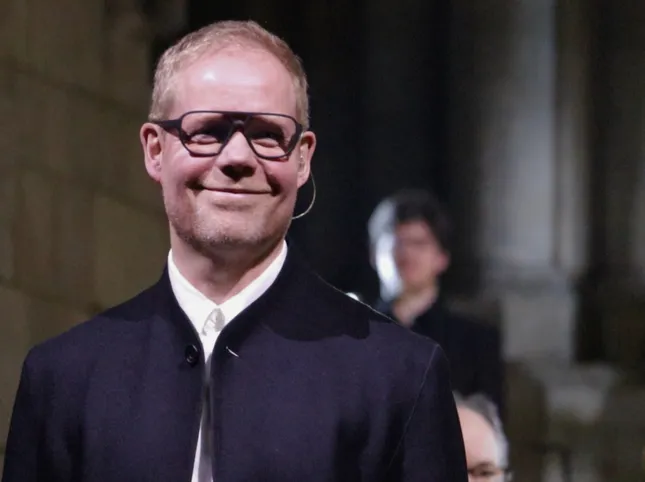
It is in this context that “Hamnet” is also placed, the new film by Chloé Zhao, for which Richter scored the soundtrack for Decca Records. It was organized to present it a live performance in Southwark Cathedral, London, recorded direct to vinyl. Not a neutral frame, but a place full of historical and symbolic stratifications that are linked to the film itself. Here, in fact, Edmund Shakespeare, William’s younger brother, is buried theater actor who died in 1607 at just twenty-seven years old.
During the concert, a funerary statue adorned with a wreath of flowers and surrounded by the original props from the film silently accompanied the performance of the entire score, with an audience of three hundred guests suspended in an almost nervous stasis, so as not to ruin the recording, which was then followed in live streaming from the Abbey Road studios.
Hamnet, a soundtrack made of music, nature and silence
Richter said work on “Hamnet” began unusually early. Zhao’s film, based on the novel of the same name by Maggie O’Farrell, iimagine the death of Shakespeare’s eleven-year-old son from the family’s point of view, moving the center of the story to Agnes, the playwright’s wife. A book that works by subtraction and resonances, more interested in mourning, memory and the domestic dimension than in the public figure of the Bard, whose screenplay struck him to the point of pushing him to write music before the film even entered production: “Chloé and I met and talked about the big questions of the film: relationships, family, motherhood, mourning” explained the composer “but also about broader connections, with the earth, with the cosmos, with the afterlife. I started making musical sketches and she used them throughout the filming.” A music that does not arrive after the fact, therefore, but which ends up imbuing the images already on set.
A central aspect of the soundtrack is the relationship with natural sound and silence. Richter’s work constantly dialogues with environmental textures (the forest, the wind, the earth) in a very delicate balance between presence and subtraction: “it is a fundamental part of the psychological narrative of the film”. In this sense, the intervention on the sound by Johnnie Burn, sound designer and editor for the film, was also decisive, contributing to making the music “float” at the margins of listening, rather than imposing it.
“Hamnet”, Renaissance music in an electronic key
From a timbral point of view, “Hamnet” is built starting from vintage vocal and instrumental materials, then electronically transformed to become a sort of echo of themselves. Richter worked with a choir specializing in Elizabethan music, characterized by very pure male voices, and with ancient stringed instruments subsequently manipulated by computer. The result is music that, despite being technically electronic, it retains a strong organic component. In the sequences set in London, this sound material takes on darker and pulsating colours, which accompany the anguish and isolation of the character.
Richter’s Music Changed the Ending of ‘Hamnet’
There is only one moment in which the soundtrack takes on an overtly Renaissance character. A deliberate choice: “It is the only scene in which the music really recalls that period” said Richter “Agnes’s entry into the world of theater has something universal and there I wanted to use a familiar musical grammar, which refers to composers such as William Byrd or Thomas Tallis”.
The emotional heart of the film, however, remains “On the Nature of Daylight”, song originally composed for “The Blue Notebooks”, a 2004 album born as a response to the war in Iraq. In “Hamnet”, the piece takes on a structural role in the finale. Richter said that initially the song had been used as a “placeholder” and he had thought about replacing it with an unreleased song, which later became “The Undiscovered Country”: “But Chloé had a sort of epiphany and understood that ‘On the Nature of Daylight’ had to stay, going so far as to change the ending of the film. It became foundational for the architecture of its conclusion.”
From Southwark to Abbey Road, via vinyl
What made the Southwark operation possible was also a technical machine that was as complex as it was well-tested. She was the one who told it Laura Monks, president of Decca, who followed the event closely: “We work with Abbey Road Studios every day: for them recording in these conditions is normal” he explained “We miked the space as for a standard recording. What makes everything special is the direct cut on vinyl: seeing the lacquer engraved live is always something extraordinary”.
One rLive recording inevitably involves a certain amount of unpredictability, from ambient noises to coughs from the audience. An element which, for Monks, is not a problem but a value. “It’s part of the game. This is the future: you don’t want a live recording to sound like it was made in the studio, it’s better for it to retain its imperfections.” The choice of the cathedral was also central for this: “Max’s music already has a natural resonance. Here everything works, especially with the choral singing and the strings. It’s almost a perfect environment.”
What was most striking in the end was the silence. “I thought the audience would move between one song and another” Monks said again “Instead they were all still. You could have heard a pin drop. I had never seen so many people hold their breath, aware that they were taking part in something unrepeatable”.
“Hamnet”, winner of the Golden Globe as best drama film and among the most anticipated films in the Oscar race, will be in theaters starting February 5, 2026.