Mace: “My Forum is a collective work”
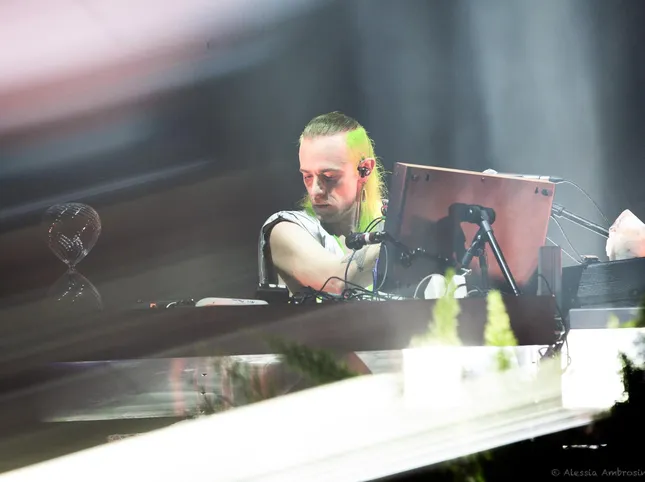
There is no shaman without a tribe, without a collective act. Mace had already demonstrated this in 2024, in the wake of the release of “Maya” (here is the story). Now he has returned to the Assago Forum for a second date, accompanied by a sea of guests and with the presentation of some unreleased songs destined to be part of his next project. By the way: write down “Bad habits” with Salmo and Colapesce, it comes out on May 15th and already smells like a piece. A Forum which, as he says in this interview, is also, and perhaps above all, a challenge. A production challenge, with wonderful visuals, musical and compositional. A challenge also towards the public. Mace remains one of the few producers capable of supporting a live show built entirely around his own artistic vision, putting his music at the center and transforming it into a shared experience with a high-level stage setup. Most album producers don’t find a real live dimension. They remain products to be consumed alone, more useful for an idea of market positioning than driven by artistic intentions. For Mace, bringing music to the stage is a necessity, consistent with his idea of sound as a collective ritual. We talked with him about exactly this: music as an experience, sharing, loss of control and surprise. At the bottom of the interview there is also the lineup for this second live at the Forum.
A Forum in Assago sold out for a concert in which it was largely unknown what would happen. The lineup and guests were unknown. Is it the pure idea of living an experience without knowing its boundaries?
It’s not a question of creating mystery around what I do, it’s that I prefer to be surprised by what I listen to. I don’t like knowing the lineup, much less the guests: I want to go without expectations and see where the artist will take me. If I don’t do my concerts in the same way I would like to experience them, what’s the point of doing them? Of course, it was a gamble. It’s much easier if you announce the guests, if you let them know the lineup. There are many people who perhaps saw me playing alone at the inauguration ceremony of the Olympics and didn’t think that I would show up at the Forum in a nine-piece band with twenty guests. I liked this uncertain perception of what would happen.
What does it taste like?
The one about the challenge. But in my head I already knew everything: I had a clear idea of how to deal with it. In the end this is the second great show I’ve done, an improvement on the first. I inserted new musical elements inside, but it remains linked to the music I published. And I’m honestly surprised that so many people trusted me.
We live in a world where we often already know everything before entering a concert: setlists, videos, skits between one song and another. Has music lost the element of surprise?
In my opinion, one of the great powers of music is to make you give up control. The more you put yourself in a position where you can’t predict what’s going to happen and let yourself be carried away, the more you can truly enjoy what you’re experiencing. Then it is clear that different audiences exist. There is no right or wrong way to experience a concert: there is what I like, which is abandoning yourself. And in fact many people I met after the first Forum of 2024 told me exactly this: the atmosphere we could breathe was different from many other live shows.
In your concerts guests play a decisive role.
My live shows are clearly a collective work. I’m not there on stage alone: I’m surrounded by many musicians, many guests. I have never put myself at the centre, I have always put the community at the centre, both on stage and off stage. In my opinion this creates a different way of experiencing that night compared to going to see the rock star of the moment.
Your producer albums are also among the very few to have had an outlet and a live dimension. Putting together concerts like this is very complicated, precisely because of the presence of so many guests.
For me, the live element, for my producer albums, is fundamental, for what I was saying before: putting the collective experience back at the center. If you think about it, music has been like this for millennia. Solitary use, on a support, is a practice of the last fragment of history. Phonographic media, in fact, have existed for about one hundred and fifty years. Before that, music existed when people came together. It could have had a ritual, emotional, even entertainment value, of course, but it really happened when people found each other. What I do cannot fail to have a shared dimension.
If it weren’t so, would something be missing?
If you publish music, put it on record and spread it on platforms… you’re only doing part of the journey.
“OBE” was a watershed: many in the industry, artists and professionals, consider it a new beginning for album producers. Why do you think?
When I came out with “OBE”there weren’t many album producers. Someone had been there, let’s be clear, and helped pave the way, but there weren’t many. And above all there were almost no albums of that type translated really live. When you don’t have a reference model it is much more difficult to do certain things. That record definitely changed some dynamics. I did it completely without expectations. Zero. It was what I felt I wanted to do. And I feel lucky for that, because if I had approached it with expectations it probably wouldn’t have given me the mental freedom I had while doing it. Expectations are often betrayed.
Then there was an evolution?
Already with “Maya” and with the album I have in the works now, the songs are also designed to be performed live compared to perhaps the first things I did, which were born more in the studio, without even imagining that they could have a live dimension.
What direction is the new album taking? Is it a continuation of what you’ve done with the others?
It’s still in the works. I actually wanted to get it out before the Forum, but I realized I would have to do it in a hurry. And I think records should last over time, so I preferred to take a step back and take more time to work on them. In some ways it is almost a meeting point between “OBE” And “Maya”, as if to close a virtual trilogy. It is therefore a continuation of the discussion started with the first two albums, not a change of direction. But it certainly goes a step further than what I had already started. This is also a widely played record, but I was also influenced by musical genres that I had never touched before. Always in my own way, however: I don’t make a “genre” piece, I always try to bring everything back into my sound and my vision.
The first extract “Levitating High” with Papa V, Pitta and Jojo Abot suggests two elements: sudden changes in sound and, once again, new voices, the search for emerging artists.
Yes, even on the album there will be many sudden changes, passages from one world to another, so there is a lot of the element of contrast and contrast. On new voices: the energy you breathe when you work with very young, or at least still hungry, artists is something contagious. It gives you a beautiful strength. It’s something I never want to give up.
You were also the protagonist of the opening ceremony of the Olympics. You built a soundtrack for that moment, without market or promotional logic. You then posted the set on YouTube. What value did that experience have?
They asked me to provide sound for the athletes’ parade. I immediately said that I would do it, but I wanted to compose music specifically, because it seemed to me to be such an important occasion that it deserved something specially designed. They had asked me for a moment of celebration, something festive. Clearly I interpret the concept of party in a completely personal way, but the idea was to create a danceable flow from start to finish, with an almost constant rhythm. Compared to my usual DJ sets, which are much freer, with long pauses, bpm changes and different moments, there I had more precise tracks to follow. But I still decided to do it my way. I composed various pieces specifically to represent different cultures, different languages. I wanted the music to emotionally follow that complexity.
How do you escape the temptation to make a “paraculo” set?
When they looked for me, they looked for me for who I am. If they wanted easier music or paracula they would have gone to someone else. I thought: it’s probably the first and last time I find myself in a context like this, worldwide. So what do you want to be remembered for? For something easy or for something that maybe fewer people like, but is more identifying and where you really feel like yourself? For me it was never a dilemma, I didn’t even need to ask myself the question.
Ladder:
Intro
God is not deaf – Izi, Jack The Smoker
Fog boys
Praise the Lord
Journey against fear – Joan Thiele, Gemitaiz
Everything else – Promise, One Hundred Thousand Caries
Rust – One hundred thousand caries
Levitating High – Pope V, Pitta
Your fault – Venus
Breathless – Venerus, Joan Thiele
Oxygen – Venus
Love Anthem – Venus
From dusk to dawn – Venerus, Gemitaiz
Candyman – Gemitaiz
Fire in the pan – Frah Quintale, Gemitaiz, Marco Mengoni
The war – Frah Quintale, Venerus
I don’t recognize myself – One Hundred Thousand, Psalm
Splendid madness – One hundred thousand caries
As the world explodes – Marco Castello, Ele A
Good night
Everything out of control – Izi
Lumiere – Izi, Hernia, Astro
Siren – Ernia, Darrn, Samurai J
Bad habits – Psalm, Colapesce
The Dome (Sitar Intro)
Ayahuasca – Colapesce
Intro Suite + Hallucination
Feeling Machines
Only one man – Altea
Meteors – Gemitaiz, Izi, Centomilacarie
Chic – Izi
I no longer live on earth – Venus
Expansion
Our song – Psalm