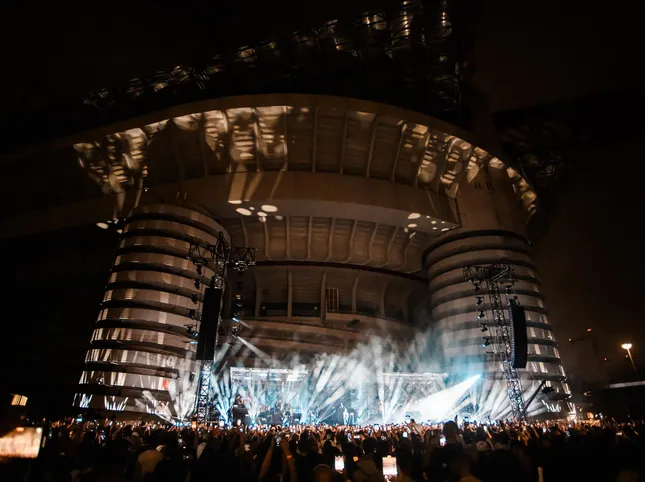
How to reach San Siro and the Milan Hippodrome during the live shows
Milan in 2026 will continue to be one of the European capitals of live music: international tours, summer festivals, event dates and “sold outs” that transform entire neighborhoods into one large fan zone.
If you are planning a concert at the San Siro Stadium or at the racecourses in the San Siro area (SNAI San Siro Hippodrome and, for some major events, SNAI La Maura Hippodrome), the difference between a perfect evening and a race against time often lies in logistics.
In this guide on how to reach San Siro and the Milan Hippodromeyou will find practical and “music-friendly” advice for getting to the venues during concerts: public transport, walking routes, exit tips at the end of the show and, above all, how to get to Milan by plane with direct and digital solutions (very useful when you travel light, with tickets on your phone and playlists ready).
1) First rule for concerts in Milan: plan as if it were a mini-trip
For the big live shows of 2026, Milan is not “just” the concert city: it is a transport system that, on certain evenings, works at full capacity. Here’s what to do the day before:
- Save to your phone: ticket, document, QR code, reservations, and an offline copy (screenshot or PDF).
- Check the start time and consider opening the gates: for San Siro and racecourses the influx is massive and checks take time.
- Arrive in the area early: the ideal is 60–90 minutes before, more if you want merchandising or if you have a distant sector.
- Battery and mains: power bank and energy saving mode. After the concert the cell phones can be congested: having offline maps helps.
2) San Siro (Meazza Stadium): how to get there during the concerts
Metro: the most reliable choice
On concert days, the metro remains the most “anti-unexpected” way to reach the stadium.
- M5 (Lille) – “San Siro Stadio” stop It is the most convenient solution when available for your route: it takes you a few minutes walk from the entrances.
- M1 (Red) – “Lotto” stop From Lotto you can continue on foot (walk varies depending on the entrance) or intercept the surface connections. AND useful if you arrive from areas well served by the M1 or if at the exit you want to distribute the crowd along several directions.
Concert tip: on the outward journey go “straight” and simple (metro), on the return journey you should consider walk 10–15 minutes before entering the subway: it often reduces the funnel effect and saves you time.
Trams and buses: ok if you know the area (or if you rely on apps)
Surface transport can be convenient, but with traffic, detours and roads closed for events they can become slower. If you use them:
- check in real time any deviation of the line (via the ATM APP where you see all the Milan transport alerts in real time)
- choose stops a little further from the venue (less crowded)
- take into account variable times.
Here are some recommended tram and bus lines:
- Tram 16: arrives in the stadium area with stop/terminus a Axum Square (San Siro). In major events it may undergo changes/limitations
- Bus 49: also indicated by the stadium website; a reference stop is Harar Street (direction San Siro). Please note: in case of events the area is often subject to detours and some stops may be skipped.
- Other lines that often enter mobility plans (but with possible deviations): 64, 78, 80 And Q78 (the latter in service after 10pm).
After the concert: “save-return” night options
If you leave late and the metro is closed, you can consider these options:
- trolleybus 90/91 I am on duty every night (circular tour also useful for attaching strategic points such as Lotto).
- there are also night replacement metro lines (NM1, NM2, NM3, NM4).
Taxis and ride-hailing: useful, but expensive
In “big” concerts it is common for:
- some roads are closed,
- the pick-up points are moved,
- demand increases waiting times.
If you want to use taxi/ride-hailing, the trick is move on foot to a more external pickup point (10–20 minutes) and set a clear location with whoever is traveling with you. However, consider that the costs are much higher than public transport.
Car: yes, but only with a strategy
Going by car may make sense if you are coming from outside and sharing the journey, but:
- the parking lots near the stadium quickly fill up
- the outflow after the show is slow.
Recommended strategy:
- park further away and use the metro for the last stretch,
- or interchange car parks (Park&Ride) along the metro lines and then continue underground.
ATM means i interchange car parks near the metro: in the western area (very convenient for San Siro/Ippodromi) the most useful are:
- Lampugnano (M1)
- Molino Dorino (M1)
From there take the metro to Lot and then continue on foot or with M5 (depending on the venue). It is often the most “anti-traffic” choice because it avoids blocked roads and post-show traffic jams.
3) Milan Hippodrome: San Siro and La Maura (pay attention to the venue indicated on the ticket)
When we talk about the “Ippodromo di Milano” in concert season, there can be two main venues in the western area:
A) SNAI San Siro racecourse
It is very close to the stadium and often the logic is similar:
- M5 – San Siro Hippodrome: Then standing along via Aldobrandini northwards to Piazzale dello Sport (about 600 m, 7 minutes).
- M1 – Lot: Then standing along via Caprilli up to Piazzale dello Sport (approximately 1.2 km, 15 minutes).
These two options are perfect to recommend to those who arrive “in concert mode” (no worries, follow the crowd, walk and you’re inside).
B) SNAI La Maura racecourse (for some large events/festivals)
Here it is essential to check the entrance and the official map of the event: the area is large and the “best” metro stop can change based on the assigned gate. In general, for La Maura:
- some people choose M1 and then a walk,
- others focus on M5 and they walk more but with a different flow.
The closest metro is M1 Uruguayand then continue on foot until you reach via Lampugnano (approximately 800 m).
Alternatively you can take the bus 69which stops in via Ugo Betti, a few hundred meters from the entrance.
Practical tip: if you’re traveling in a group, choose a “meeting point” outside the super crowded area (a side street, a crossroads, a specific stop) and share it in chat before the concert starts.
4) Leaving the concert: how to go home without turning the finale into a marathon
The most critical moment is often after the last song, when tens of thousands of people move together.
Here’s a simple plan:
- Don’t rush to the subway right away: If you can, wait 10 minutes, go to the bathroom, get your jacket, then move.
- Walk “outside the bubble”: Move far enough away to get into a less congested station or in a smoother direction.
- If you have to take a train (Centrale, Garibaldi, Rogoredo): calculates an extra margin. On event evenings, even 20 minutes make a difference.
- If you sleep in Milan: consider stopping for a drink in a more external area and leaving again when the peak drops.
5) How to reach Milan by plane (and then San Siro/Ippodromo): the direct and digital solution
If you attend more concerts in different cities in 2026, you already know: the combo “flight + shuttle + metro” is often the most efficient, especially when you want to avoid complicated changes with luggage and tight schedules.
From this perspective, Flibco has recently expanded its offer and made the organization of events even simpler and more digital travel to Milan airports: Now travelers can book directly on flibco.com or via the app also shuttle services to Malpensa Airport and Linate Airportwhich join the line already active for Orio al Serio Airport (Bergamo).
Among the advantages: cheap prices, flexible tickets, promo for families, luggage included and above all direct buses without changeswhich drop you off directly at the terminal.
Below are the three useful lines for those arriving (or leaving) for the concerts:
Flibco Milan – Malpensa line
- Price: Milan → Malpensa starting from €10
- Concert travel plus: direct solution, no changes, luggage included: excellent if you arrive with a backpack + bag (or if you are doing “live tours” in multiple cities).
Flibco Milan – Linate line
- Price: Milan → Linate starting from €7
- Concert travel plus: simple transfer, ideal if you arrive in the afternoon and want to go straight to the hotel and venue.
Flibco Milan – Orio al Serio (Bergamo) line
- Price: Milan → Orio al Serio starting from €8
- Concert travel plus: flights to Orio al Serio are usually the cheapest: if you have already spent a fortune on the live ticket and want to save, choose this airport. There are also night busesif you want to be crazy about fly home early in the morning after the concertwhich take you to the airport even at 03.00 in the morning. If you need a clear reference, here you can find it bus to Orio al Serio from Milan Centrale.
6) From arrival in Milan to the venue: “fan” scheme (simple and robust)
If you land at one of the airports and want to go to a concert that same evening, the most linear sequence is:
- Direct airport shuttle → Milan (main hub)
- Metro → San Siro / Hippodrome area
- Return: metro + (if you leave the next morning) shuttle booked in advance.
This scheme reduces changes, saves you energy and allows you to focus on what matters: arriving on time, entering calmly and enjoying the live show.
7) Extra “mobile-first” tips for big events in 2026
Given that today the concert experience also involves the smartphone (digital tickets, maps, contactless payments, group chat), here are micro-tips that really make the difference:
- Download the offline map of the San Siro area before leaving the hotel.
- Share location with friends Before let the concert begin.
- Set a default message like: “See you at point X at 00:15” (so if the network is slow you already have a plan).
- Keep tickets in wallet and not just in email: faster at the turnstiles.
- Earphones and playlists: waiting at the gates is more pleasant if you turn the queue into a “pre-show”.
Remember: the perfect evening starts with the journey
San Siro and the Milanese racecourses are iconic places: you go there to sing by heart, experience an ending with the lights of the telephones and go home with a broken voice (in a good way). But precisely because the big shows of 2026 will attract huge crowds, logistics are an integral part of the experience.
Choose the metro for the last stretch, prepare an exit plan, take advantage of direct solutions for airports and focus on “mobile-first” organization (tickets, maps, reservations, times). So the journey to the concert becomes simple… and the only thought remains the right one: the music.
In collaboration with Flibco