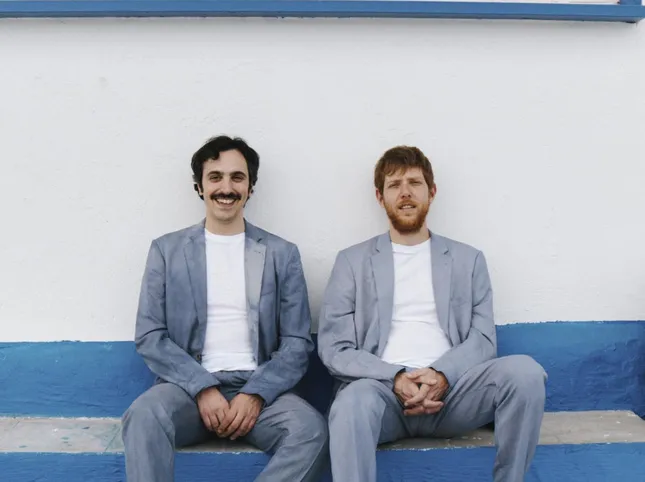
Goodbye Naples: Nu Genea talk about “People of the moon”
A journey “beyond the Pillars of Hercules”, they define it. In fact, “People of the Moon” is truly a journey for Nu Genea that symbolically leaves the confines of the world known to them, namely Naples, to arrive in a completely new world. It is worth quoting “Goodbye, Naples!” (“Goodbye Naples”), a 1955 black and white cult film directed by Roberto Bianchi Montero attributable to the so-called “appendix neorealism”. The album, just released, three years after “Bar Mediterraneo” (which became a small case study: it was the best-selling in the world of that year on Discogs, the site where enthusiasts sell and buy LPs and 45s, while the American music magazine Spin included their “Tienaté” in the ranking of the fifty most beautiful songs of 2022), represents a new chapter that marks a surprising evolution in the path of the Neapolitan duo composed of Massimo Di Lena and Lucio Aquilina, which cross languages and cultures here: Neapolitan, of course, but also Arabic, English, Spanish and Portuguese. There are also international guests, such as the Spanish María José Lergo, the British Tom Misch. The tour will start on May 23rd from Milan.
Let’s start from here: after the almost “cult” success of Bar Mediterraneo, did you feel under pressure to work on People of the Moon? And how much pressure, if any, influenced the new job?
«There was certainly a bit of pressure. Already “Nuova Napoli”, the album preceding “Bar Mediterraneo”, had had a more mainstream success by our standards: from a small niche we found ourselves doing big concerts in Italy and abroad. But after “Bar Mediterraneo” things got even bigger. We suffered through it the first year. We were excited to do something that had a similar power, that made people dance. We set out to make singles that could rock. But we’ve never been good at doing things on the table, think about it. And so we threw everything away: we sabotaged ourselves. We thought we had lost our edge. Precisely in those moments, however, we started jamming and the songs came out which then gradually made up the tracklist of “People of the Moon”».
The title, “People of the moon”, seems like a manifesto, a collective declaration. Is that so?
«Yes and no. The “moon people” are the parts of us that in some moments manage to touch the purity of being. The lyrics talk about these two phases: being subservient to society and learning to find the beauty in things. That’s what happened to us: the moment we felt the pressure of expectation, we were flopping. But the moment we stopped we began to live the moment of composition lightly. It was a moment of liberation.”
Musically, where did this journey take you compared to “Bar Mediterraneo”?
«Linguistically a little further away. We explored new languages: there is Spanish with María José Lergo in “Acelera”, Portuguese with Gabriel Prado, who is not even a professional singer but the percussionist we had chosen for this record. He plays with Mario Venuti. We don’t even remember where we met him, but we remember that we immediately had a connection. And then there is the English with Tom Misch, the Arab with the Lebanese Céline Khoury. All languages that we approached for the first time. On a musical level we have always drawn from all over the world: we have continued to do so here too.”
The cover of “People of the moon”:
Maria José Ergo how did you discover her?
«On the net. For the song we were inspired by Las Grecas, who make a subgenre of flamenco, rumba funk. We put a little soul into it. We mixed everything up.”
And Tom Misch?
«He wrote to us on Instagram. So we reached him in London, bringing him some drafts of the songs. The common ground was a bass line like Pino D’Angiò, which he knew. Maestro D’Angiò had recently died. The song, “Onenon”, is also a small homage to him.”
There is also a particular use of tools. What instrument is the one that opens “Ma tu che bbuò”?
«A Tunisian bagpipe. But only the spout was sounded, without the bag. It’s called mezwed. It is an instrument similar to the Neapolitan ciaramella and the Turkish zurna. We discovered it thanks to Marzouk Mejri, one of the musicians with whom we have been collaborating for some time.”
How is this album linked to the idea of the story of Naples? Is it a way to describe Naples in the center of the Mediterranean, exactly?
«Naples was central in “Nuova Napoli”, less central in “Bar Mediterraneo”. Here Naples is there, but it was not the driving force. We’re not looking for constraints. This is the album we wanted to make, without asking ourselves the problem of what to put or not to put. The Neapolitan is there in the end. But more for a rhythmic-linguistic question, understood as an instrument. We did a particular exercise, using Neapolitan as a rhythmic instrument.”
You seem to be making an anti-fashion choice, at a time when Naples is triumphing in Italy: do you feel represented by Sal Da Vinci and his “Forever yes”, which will compete at Eurovision?
«His album “Footing” (1984, ed.) remains a great album. He comes from a school that has produced a lot. Maybe in terms of taste it doesn’t meet ours. But we have great respect for him and were happy to see him in such an important context.”
And are you interested in that context?
«Let’s see what Stefano De Martino will do: he is a young man less tied to the dynamics of the past. But we are not made for that context. We can say we don’t know the Italian market: we are outside of all the dynamics. We live in a sort of bubble. Let’s look at what we like to do and that’s it.”