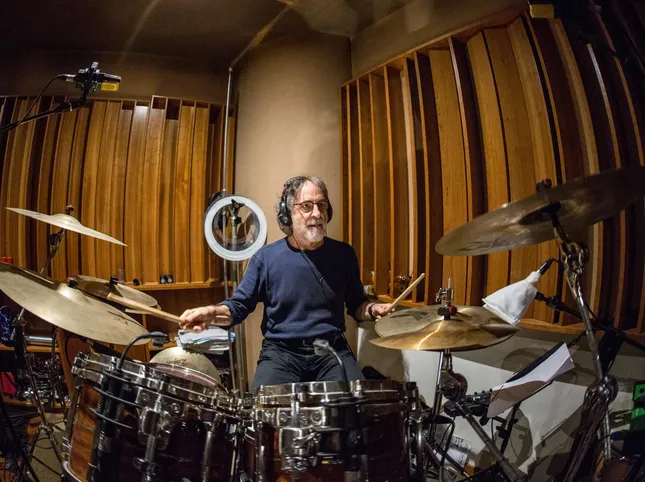
Franz Di Cioccio: “This is what a good drummer should be”
“Good evening, Franz.”
“No, if you leave by saying good evening, you’re already off to a bad start. Give me your first name!”.
When I disturb Franz Di Cioccio for our chat, he just finished the soundcheck, before a concert with PFM. The last of an infinite series, lasting a lifetime. With the Award-winning Forneria Marconi he wrote the history of Italian music and world prog. His sticks have inspired generations of drummers: the energetic and fun, almost funky approach; the aggressiveness that manages to respect the boundaries of millimetric precision.
In PFM’s glorious songs there is no room for error: if the drummer slips a sixteenth, there’s trouble. Odd times, stop-and-go do you continue and change your accent? They are not a problem for those who have “a metronome in their body”. That’s why we interviewed Franz for his 80th birthday from drummer to drummer – and I say this, let it be clear, with all the humility required – it was doubly an honor and a pleasure.
How did you build your drumming vocabulary: more practice or more instinct?
I would say listening. I never went to school, I’m self-taught. A self-taught man who however listened to a lot of music since he was a child: my father was a musician and from him I assimilated classical, popular, jazz, pop music of the time, the beat… I came out of this mix. Unlike others, I like to use the drums as if it were a melodic instrument: I don’t think about the tempos, but about the melody. Music made me discover a world that didn’t exist.
Is it better to have a leading drummer, who guides the group, or one who breathes with the band?
Both. Indeed, it is impossible to do one thing without the other. I love everything: I am the fulcrum in the middle that moves everyone to board, when we have good things in hand that we can do with music, with lyrics. A good drummer knows how to lead his own band. Ringo Starr may have been a simple drummer, but Ringo Starr was perfect for the Beatles. And Di Cioccio is perfect for PFM.
In prog there is the risk of excessive virtuosity as an end in itself. You can perform complex pieces naturally, without sounding mathematical. What’s the secret?
Things like that have come to mind from time to time too, but for me music is when I feel the spark. I take it and tell everyone: oh, guys, we have the spark here, please. Enough. It’s not that I go to everyone and say “look, here you should do a C minor”, it doesn’t exist. That’s not music anymore. Then, regarding the first PFM, one thing mattered a lot: it was a family. A look between us was enough. Everything was fluid and natural, even the interpersonal relationships between us musicians. However, the most important thing that the artist must always remember is that he has people in front of him who want to listen to music, who want to participate and be part of this story; it’s not very easy to sing or play if you look at them and can’t get what’s inside you.
Have you ever written a drum part that changed the identity of a song?
No, I don’t, because I’m sorry to change the identity of a song. I play what comes to mind at that moment. Maybe I’ll go and eat a croissant and I’ll get a piece of Madonna. Is this madness? Maybe, but in fact it works. Because you can’t be stuck on what’s written on the paper, you have to be the one to carry everything forward.
Has your experience as a singer and frontman changed your approach to drums in any way?
No, actually. Probably because I was already singing from behind the drums in the Seventies. For example, “Where… when…” is a song that I have always sung as a drummer. It’s clear that making the leap to the ’80s, passing in front, I had to give up my seat, but even now I continue to divide myself between microphone and drums.
Have you ever had moments of crisis?
There was a time when I didn’t want to hear about drums anymore. Then the love started again. I just needed a break. After that period I also wrote a song for drums: it’s called “Tatum” (from the solo album “Lupus in fabula” from 1992, ed.). It’s an onomatopoeia: “ta” is the hit on the snare drum, “tum” is the return on the drum. But hearing the words, it seems like I’m talking to a woman: “And then suddenly change my life, no longer want you. You felt a little betrayed, I know.” At a certain point I say: “Even when I hit you you were happy.” Anyone who doesn’t know what I’m talking about remains frozen for a moment. Then in the last verse I reveal who it is dedicated to: my great love.
Is it better to have a minimalist kit or a richer one to be able to indulge in?
The right. What you need. I don’t tie my life to one snare drum rather than another. Music is like this: it’s a look that embraces you and makes you immediately understand everything. I’ve never been a big fan of accessories like double pedals. I prefer to find that same sound with a single pedal.
Light wand 7A or heavy 5B?
The heavy one has its own reason. Above all because it makes you discover that lightness exists.
In the prog of the 70s the wall of sound of the keyboards (Hammond, moog, mellotron) was almost impassable. You overcame it.
It’s something that inevitably happens to you and you have to deal with it. When music changes and you have new instruments with which you can express yourself more, playing in a different way, it is very important for everyone to participate. Even when the new instrument isn’t yours. It helped me to be an enthusiast: when I hear a sound I like, I make up films about it. If at the time Premoli (Flavio, the former PFM keyboard player, ed.) started with something, even during a soundcheck, I immediately followed him. The pieces were born like this too. That’s why I say I have a way of playing melodic: because I chased the keyboards, the guitar, the violin.
The trademark that distinguishes you from other drummers?
Being naive. Even though I know music and know exactly everything I have to do, I’m a naïf. A melodica with nerve.
Speaking of other drummers. Who are your references?
Many. One above all? John Bonham. I started watching it, and watching it, for hours. Musicians yes they lookbecause there you have a lot, a lot to learn, a lot to take in from an artistic point of view.
You bring an enthralling energy to the stage. Has it ever happened that the emphasis took you out of time?
No, that never happened. Now I have the metronome directly in my body! Once upon a time, in the United States, in the 1970s, I had a huge gong behind me. Except that this huge gong was on a stand with wheels which, at a certain point, started moving. I grabbed it and held it in place with one hand while I played with the other. Then what happened? He came at me. So I had the gong on my shoulders and you could only see my arms coming out to play.
There are pieces that in PFM’s live performances become almost athletic feats. The medley of “Alta Loma Five Till Nine”, “Celebration”, “Chocolate Kings”… Have you ever prepared yourself physically?
No, it’s just passion. I’m lucky enough to have very gifted ears, also because I started with music just by listening, and my ears have always told me: “Dude, I have some things for you!”. This has always been enough for me, I have never felt the need for anything else. My songs are very lively because they are alive, they were born on the road and they found their success on the road. No gym or anything like that. The only thing I do is run with my dogs in the garden.
A young drummer wants to study PFM: what do you recommend him to work on? The fit with the other instruments, the odd tempos, the resistance, the ability to improvise…
All of these you said, plus one: knowing how to play with yourself. Then when you are alone with the audience, the audience gives you things back that you didn’t imagine. And he also does it the third, fifth, seventh time and so on. It’s what really gives you satisfaction, you don’t need to sit there and be a scribe. What you do must be a pleasure. The drums, percussion in general are the first instrument in the history of humanity; the child’s sense of rhythm can develop immediately. A good drummer must know how to bring out the child inside him.