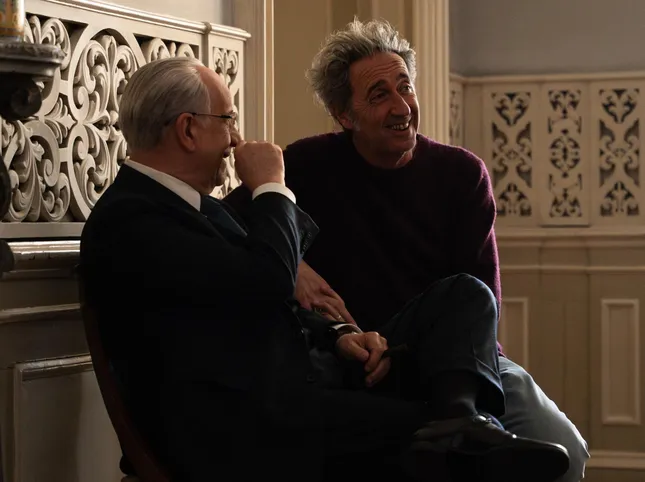
For Sorrentino, music is lightness, between sacred and profane
“Would you like to dream?”
“Very”.
“Grace”, the latest film by Paolo Sorrentinoit’s a daydream. Very briefly, for the record: the President of the Republic Mariano De Santis, played by a masterful Toni Servillo, right at the end of his mandate is tormented by two crucial moral dilemmas: granting pardon to two murderers and deciding whether to sign a bill on euthanasia; in the private sphere, however, he has to deal with loneliness, with the past and with the role of father. In both dimensions, public and intimate, he finds himself exploring the boundary between law, humanity and personal responsibility. And in this delicate, complex intertwining it finds space an irresistible soundtrack.
Between sacred and profane
There are those who still have the shivers from the scratch of “Era Already All Predicted” by Riccardo Cocciante in “Parthenope” and there are those who lie. Many didn’t like the film with Celeste Dalla Porta because it was too pompous and self-referential, while for others it was a very enjoyable exercise in style (and what style). But with “La Grazia” Sorrentino makes an undeniable leap in quality. You want it because it’s there Toni Servilloand when Sorrentino works with Servillo he is as inspired as Martin Scorsese with Robert De Niro; perhaps because the theme necessarily forces us to change register, to become deeper. Consequently, if in “Parthenope” the soundtrack was linked to myth and youth, in “La grazie” it becomes more austere, sacred but also popularin that game of continuous exchanges between serious and facetious that the director has always adored.
President De Santis is a jurist through and through, even in human relationships, with a coldness that earns him the nickname “reinforced concrete”. He is a widower and Catholic, anchored to the neutral and diplomatic approach of the Christian Democrats. Neither law nor religion, however, can guarantee unshakable certainties, and music reflects this perfectly dualism between institutional rigor and human frailty.
The penalty is there electronic musicthe minimalist but insistent sounds that accompany the protagonist’s obsessions, from resentment towards Ugo, his old friend, to chronic indecision (“I need further time for reflection”). Special mention for that extraordinary scene which is the arrival of the Portuguese politician, in slow motion, under the downpour: “5 Mins Of Acid” by the Dutch DJ KI/KI – who will then counterpoint the rest of the film, playing briefly from time to time – best expresses Sorrentino’s genius, capable of making electronics not only credible as the background of dramatic moments, but also seductive, in its eternal dribble between melancholy and irony.
A combination that finds its musical exemplification in “Aurora”, the result of the collaboration between the Japanese composer Ryuichi Sakamoto and the German electronic artist Alva Noto (pseudonym of Carsten Nicolai): a fusion of minimalist piano and electronic sounds, a meeting between different sensibilities in contemporary music. In the film, sound and image function as a single emotional organ that brings the protagonist back to his human dimension, far from the duties of office.
Guè’s rap
And it is precisely when De Santis begins to free himself from the weight of the institutions (“I’m tired of the rituals”) that an artist who has made purists turn up their noses in both cinema and music comes into play: the rapper Guéwho also appears in a hilarious cameo of himself in the company of Shablo. Thus Sorrentino at the Venice International Film Festival:
“My wife made me discover it. We met when I presented Parthenope in Milan, I didn’t know him. He’s very nice. I started listening to his music, and a certain painful streak of his also brought me closer to him. Behind ninety percent of his lyrics, which I don’t understand due to my generational limitations, there are some very beautiful sentimental intuitions.”
A painful streak that goes hand in hand with the torments of the President, who in fact is so enraptured by “The girls are crying” – a piece by Guè from 2015 – to the point of humming the verses, simulating a rapped which subverts every typical expectation of the institutional character. Guè represents the external world, pulsating and raw, which bursts into the solemnity of the halls of power, where little by little the human being, even the most derelict, returns to the center (the scene in the waiting room in prison, before meeting Professor Arpa, is emblematic in this sense). And one cannot fail to quote the line “Sorrentino wouldn’t have done a better take”, which here becomes a self-quotation (self-ironic) that blends pop culture and great cinematic art.
There is nothing to change in this film. Not even the silencesa fundamental part of the music that the director knows how to dose with mastery, also thanks to a Servillo who only needs an American piano to move. In summary, the music in “La Grazia” builds a bridge between the immutability of law and compassion, between the stills of reason and the beatings of the heart. It is no coincidence that the highest office of the State takes refuge in listening to find the courage to sign – or not sign – documents that will change people’s lives. From Guè’s rap to experimental sounds, the soundtrack it is the mirror of what Sorrentino wants to tell: a complex, multifaceted, ironic and profoundly human world. Where what really matters is knowing how to be light.