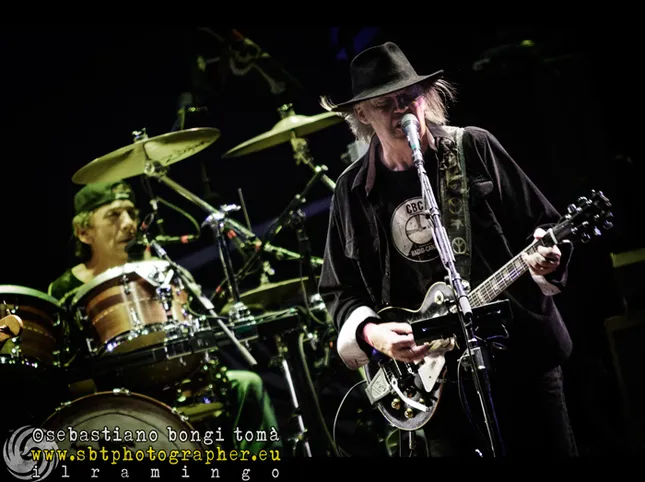
“Cortez the killer”, Neil Young’s infinite masterpiece
It’s impossible to keep track of how many live albums Neil Young has released. We are not in the Grateful Dead area, but almost: about ten official ones, from “Time Fades Away” in 1973, through those released in recent years in the Archives series on platforms and in physical format, and the exclusive ones in the NY Archives subscription application.
“As time explodes” was released in recent days: it was only supposed to be in physical form for Record Store Day, but it will soon arrive on traditional platforms and channels. And it’s interesting for two reasons: it’s one of the first official live recordings with the Chrome Hearts, the latest iteration of the “electric” band that accompanies Young. And it contains a wonderful version of one of the most beloved and iconic pieces (this is not an exaggeration) of his production: “Cortez the killer” – with a wonderful interplay with Micah Nelson, which doesn’t make you miss the days of Crazy Horse.
“Cortez the killer” was included in the list of the greatest rock songs of all time by Rolling Stone, and was also included in the list of the best electric guitar solos by Guitar World. Although this song is much more: it is a song that changes shape, an infinite masterpiece.
The story of a masterpiece
“Cortez the killer” is a song with an epic story, how epic (and in some ways controversial) the story it tells is.
It was recorded 50 years ago for “Zuma”, Young’s seventh album and first after the dark “Tonight’s the night”, dedicated to the death of guitarist Danny Whitten from an overdose. It was recorded with Crazy Horse: the version contained in “Zuma” was cut due to a tape problem in which the final part of the jam and the last verse were lost.
“Cortez” is in fact the title track of the album: it refers to the Spanish conquistador Hernán Cortés and the Aztec ruler Montezuma. The lyrics of “Cortez The Killer” recount the conquest of Mexico by contrasting the violent arrival of Cortés with Montezuma’s society. The Aztec world is idealized, a place where “Hate was just a legend, / And war was never known” and where even human sacrifice becomes the symbol of those who sacrifice themselves for others: “They offered life in sacrifice / So that others could go on”. Cortez arrives with his “Dancing on the water” ships to break this idyll, becoming a sort of symbol of colonialism.
In the penultimate verse Young then switches to the first person telling of a lost love: “And I know she’s living there / And she loves me to this day / I still can’t remember when or how I lost my way” – probably a reference to the end of the story with Carrie Snodgress.
The controversies and the true story of Cortes and Montezuma
Neil Young said he wrote the lyrics to the song when he was very young, mixing imagination and some historical fact. For this reason it was heavily criticized. Several historians have underlined that the Aztec civilization was not the peaceful paradise evoked in the passage: it knew wars, military rule and ritual sacrifices. Even some details are imprecise: Montezuma did not live “on a shore”, and the conquest was a much more complex process, also marked by indigenous alliances against the Aztecs. Precisely for this reason today the song is read more as an anti-imperialist allegory than as a historical reconstruction.
From Live rust to Almost Famous: the most beautiful versions
“Cortez” has become one of Young’s signature songs for long live jams: it was already included in “Live Rust”, a live album from ’79 where it lasts around 7 and a half minutes, like the original. To then grow in length: the version in “As time explodes” is almost double the length: it has been included in several other live albums, played over 550 times live.
“Cortez” was played mostly electric. But also acoustically about ten times: one of the most popular versions is on a 12 string. It’s the one recorded on a late ’90s show and included in one of the central scenes of “Almost Famous.” Director Cameron Crowe had asked Young to star in the film (the part of the boy protagonist), but Young ultimately declined. The version was only released in 2021, in an expanded version of the soundtrack.
The most epic version, however, is the one that goes by the name of “Horse Back” and was included in the blu-ray version of “Psychedelic Pill”, the 2012 album with Crazy Horse: 37 minutes, with a very long initial instrumental jam of almost 20 minutes in the studio.
The covers
The song has been covered by dozens of artists, from all backgrounds: from Slint, a 90s post-rock band, to Jeff Tweedy of Wilco, up to Jason Isbell and bands from the jam circuit. The best cover is probably the one by Dave Matthews with Warren Haynes of Gov’t Mule, included in the 2003 live album “The Central Park Concert”.