Björk, 60 years of an artist who transforms sound into vision
There are artists who follow a straight, orderly and chronological line. And then there is Björk, whose trajectory starts in the Seventies, when a young girl from Reykjavík recorded her first album in 1977, and continues until today, capable of speaking to the most influential artists of contemporary times, of intertwining tradition and future as if they were the same thing. Björk’s revolution it is not an event of the past, but it is a continuous process that spans decades and continues to generate new forms. This is demonstrated, among many things, by the Icelandic artist’s recent collaboration with Rosalia in the song “Berghain“, included in the Catalan singer-songwriter’s album “Lux” (our review here). It happens here a meeting between two generations of visionariesreceived with the enthusiasm that Björk herself wanted to share publicly, writing that it is “truly exciting to watch this woman grow: congratulations to her for this incredible album, which crosses genres with the grace of martial arts; its concept is ferocious!”. This act of admiration tells a lot about Björk Guðmundsdóttir, born on November 21, 1965 in Reykjavík, Iceland, who established herself as an artist who is not afraid to recognize the value of others and that, at the same time, continues to be a cardinal point for anyone trying to reinvent music today.
And if it’s true that the world discovered it in the Ninetieswhen “Debut” and “Post” established her as the icon of hyper-contemporary alt-pop, free from hierarchies and genres, the trajectory of Björk has never known linearity or complacency. From the vocal architectures of “Medúlla” to the microscopic intimacy of “Vespertine”, up to the electric twists of “Volta” and the sonic anatomies of “Biophilia”, the Icelandic musician has built an aesthetic system in which electronics, nature and body become one, a living organism that changes shape with each record”.
His visionary presence crosses not only music, but also cinemain which Björk immersed herself thanks to her participation in the independent film “The Juniper tree” in 1990, until collaborating with Lars von Trier – without going into the revelations that the artist made in 2017 about a “Danish director” – in “Dancer in the dark” in 2000, a role that earned her the award for best actress at the Cannes Film Festival. And more recently in “The Northman” in 2022, where, together with her daughter Ísadóra Bjarkardóttir Barney, she moved among the visions of Robert Eggers, one of the most interesting directors of contemporary cinema, today at the center of the international gothic renaissance. In that film Björk played the seer: an almost mythical figure, wrapped in costumes that seemed to come from another world, or perhaps from the very heart of her Icelandic nature.
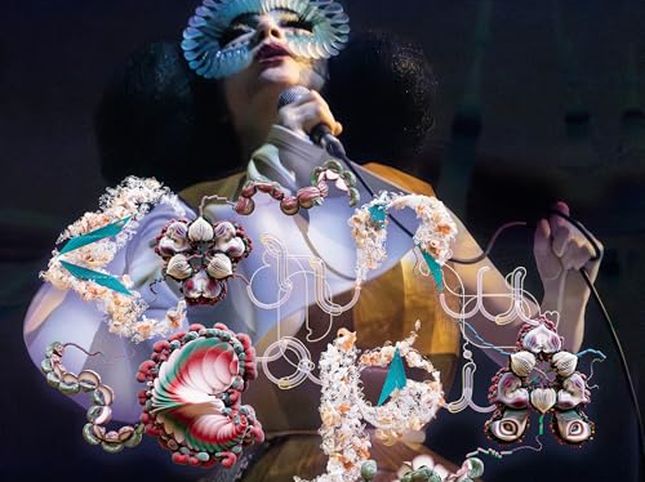
The musical journey has never stopped, continuing in a tension between body and cosmos. After her debut with the Sugarcubes and the explosion of the nineties, Björk has crossed aesthetics and ideas with the naturalness of someone who walks between elements. With “Vulnicura” in 2015 gave pain a wounded and transparent sonic form, one of his most vulnerable albums: “It’s about what could happen to a person at the end of a relationship. We talk about the dialogues that we can have in our heads and in our hearts, and about the healing processes”, the artist said when presenting the album. Precisely from that fragility, “was born in 2017Utopia“, a record in which the flutes become breath, community and promise on an imaginary island built through a new, luminous language. In 2022 “” has therefore arrivedFossora“, to take a journey into the earth and its deep layers, going through loss and processing, made of sounds that vibrate under your feet as if they came from underground chambers full of life. Then, the season of “Cornucopia“, a show, which later became a concert film and live album, taken from a tour that began in 2019 and concluded in 2023, also passing through Italy with dates in Milan and Bologna. An immersive experience that wanted to rethink the concept of live thanks to the union of digital theatre, installation, sound multiverse in which wind instruments, harps, electronics and percussion coexisted under a single imaginative dome.
In Milan, as we reported on RockolBjörk was a live art installation. The show was nourished above all by the songs of “Utopia”, enriched by the songs of “Fossora”, playing on enchantment.
Sixty years after her debut in a country that at the time seemed very distant from the rest of the musical world, Björk continues to embody the idea that art is metamorphosisletting yourself go to a constant movement, a dialogue between roots and futurea laboratory in which every sound gesture can become a story, geography, vision. On her birthday, the certainty is that, even today, while younger generations are looking for new grammars to express themselves, Björk remains, reminding us that music, like life, is never a stable place, but a continuously inventing form.