Birthh: “I don’t want to be one thing: I love chaos”
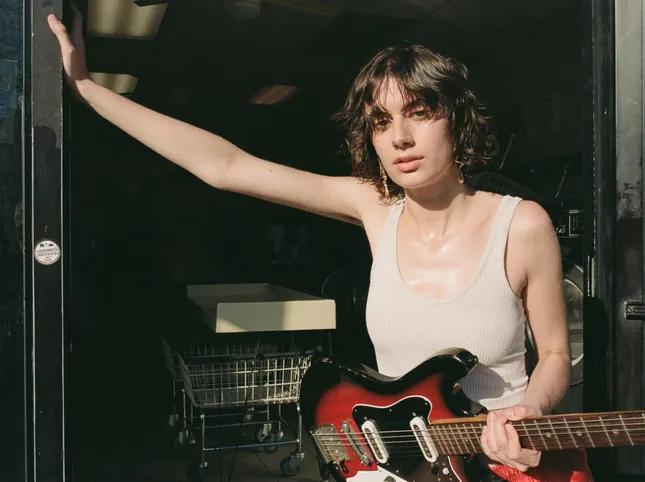
Birthh doesn’t make music to survive, but to live. “Senza breath” is an album that shakes, bites, that never stands still. After three projects in English, the artist born in 1996, suspended between Italy and New York, seeks a new identity in a record co-produced by Chef P: a sonic magma impossible to pigeonhole, where pop, urban and singer-songwriter alternatives coexist. It’s a record that resembles New York, the city that welcomed and transformed her. It’s chaotic, desperate, happy, sad, shiny. It is the reflection of Birthh, but also of an entire generation, which can recognize itself in this emotional disorder. He will present it live on tour.
Alice, Was the transition to Italian also a way to free yourself from certain superstructures?
No, actually English has never been a burden for me. I have never seen it as a way to hide or not really say what I thought or felt, also because it is a language that I know very well, in a profound, almost visceral way. It’s a language I hear. My dreams, for example, are still perfectly divided between English and Italian.
So how did the transition happen?
Something different happens when you speak the language of your parents, your grandparents, the one you have used since you were a child. Something is triggered that is linked to the roots, to the identity. My parents are Italian, not bilingual, and this has a much more complex impact on me than the idea of English as a “mask”. I started writing in Italian naturally, also thanks to listening. After years in which, since I discovered MTV in middle school, I almost only listened to music in English, moving to New York made me rediscover Italian music, also due to a need for proximity to home.
An example?
In America I understood the value of Italian music, a value that I had always taken for granted: it was enough to make my American friends listen to Mina to realize it. From there a search began, which took me into an Italy full of beauty, including musical beauty, which has always belonged to me. In the family we listened to Gino Paoli, Mina, Battisti. Writing in freestyle, I found myself using Italian and certain melodies more linked to that tradition.
Has it transformed you?
It made me grow a lot, because Italian forces you to work more on images and to observe your life in a different way. In the end something truer, more honest comes out, even if you get there through another path: this is the album.
The album has a very hip hop approach.
Hip hop has always been a point of reference for me, first of all as a listener. I remember that in elementary school I discovered Fabri Fibra and had a sort of epiphany. Then came American hip hop and some English stuff, and I understood that that language, direct, rhythmic, belonged to me a lot. I love rhythm and I think it is a very powerful tool for conveying even complex messages.
This album, in its positive sense, is “creative chaos”?
I am a very chaotic person by nature. Over time I understood that it is not necessarily a defect: that chaos I feel inside can also have a value. Maybe that’s also why I had such a good time in New York. It is a city that is not just one thing: it is many things together, yet it always remains itself. I really recognize myself in this idea, even on a musical level.
Do you chase the colors of life with music?
Yes, I’m interested in exploring nuances, mixing different languages. For example, “Inferno” has a very hip hop beat, but there’s more, there are also strings. “Canyon” starts from a garage imprint, but then opens on a very Italian melody. They are encounters between different worlds that arise quite instinctively, and which I rationalize only afterwards.
How instrumental was working with Chef P?
He comes purely from rap. I went to him with demos in which there were rhythmic elements that didn’t follow the beat in a traditional way, creating something very dark and not always easy to listen to. The risk is that, if the message doesn’t arrive, all that complexity becomes a limit. And this is where working with Chef P was fundamental. He had the sensitivity to immediately understand what I wanted to do, but at the same time to put everything in balance. We spent three weeks in the studio in Brooklyn, making everything more essential.
Do the songs have to work even without superstructures?
I tend to “over-produce”, that is, use production to solve structural or writing problems. This time however I wanted the pieces to stand on their own. It’s something I learned from London O’Connor: if a song doesn’t work with bass, drums and vocals, then there’s a structure problem.
Writing instead?
Producing and arranging comes naturally to me, while writing lyrics is much more tiring. This is why it was important to work with Veronica Carotta, who has a great sensitivity for words. In general, for this record I felt lucky: I had people around me who really believed in the project.
What is “Breathless” for you?
It is an expression that encompasses two opposite poles of my recent life. On the one hand there is the rush, the anxiety, the feeling of not being able to keep up with everything. It’s something I see a lot around me too: everyone is running, but it’s not always clear towards what. On the other hand there is amazement. It happened to me recently, in Salerno: I stopped on the seafront, had lunch there and was breathless in front of the landscape. It also happens with a sunset, with the stars, with the moon. In those moments I think about how incredible it is to have the tools, the eyes, the body, the mind, to perceive all this.
It’s a title with multiple reads.
“Breathless” holds both these dimensions together. This is why it seemed like the most right title to me, even if at the beginning it was only the first song written, without a precise idea of a record.
This is a record that takes a bite out of life: is it a way to be grateful for existence?
I think the public is not stupid at all. Perhaps, on the one hand, there is less attention today, this is true. And it’s something I often reflect on: precisely because of the topic of gratitude, in my opinion, people’s attention, at this moment, is not something that can be taken for granted. It must be conquered, it must be captured, especially if you think you have a message that can reach you, that can help. And the moment you manage to capture that attention, that’s when responsibility comes in: you have to do things right. That’s what, in my opinion, really makes the difference. This is why the way to say “thank you” is to do things to the best of my ability. Then maybe this album will come out and nobody will give a damn. Maybe I got it all wrong. But at least I will have done exactly what I wanted to do.