Biffy Clyro was missed, an irreplaceable anomaly
Italy embraces Biffy Clyro again in a sold out Alcatraz, approximately three and a half years after their last appearance. Maybe it’s because before the pandemic we were used to seeing them almost every year in these parts, between festivals, indoor tours and acoustic concerts, but there seems to be a widespread perception that they have been missing for a geological era and this concert comes to quench the thirst of many dehydrated fans, eager to rediscover their usual repertoire, but also to discover how “Futique”, the Scottish band’s tenth studio album, sounds live.
Unfortunately, Biffy’s return is marked by a very serious lack. James Johnston, bassist and one of the three pillars of the band, had to give up the entire Futique Tour due to serious mental health problems. Replacing him more than dignifiedly and with great heart is Naomi MacLeod, who is not only an excellent musician, but was also already part of the Biffy-verse, as bassist of Simon Neil’s metal project: the Empire State Bastards. Neomi was able to enjoy the experience in the studio and on tour not only with Simon himself, but also with Mike Vennart – more than a faithful session player, an honorary member of Biffy since time immemorial. “And I can’t think of a better person for the job,” James himself wrote at the time of the sad announcement. In short, it was the most logical and emotionally right choice to make to prevent the entire tour from falling apart.
Needless to say, James is missed live. After almost thirty years of concerts this is the first time that fans of the Scottish band have to do without him and his incomparable energy, and although Neomi is very good and technically impeccable, the gaze occasionally gets lost in search of the red hair of the more vital of the Johnston twins. Even on the choirs, Biffy’s great trademark, not seeing the good James singing at the top of his lungs with his iconic poses is quite heart-stopping for those who have been following them for a quarter of a century now.
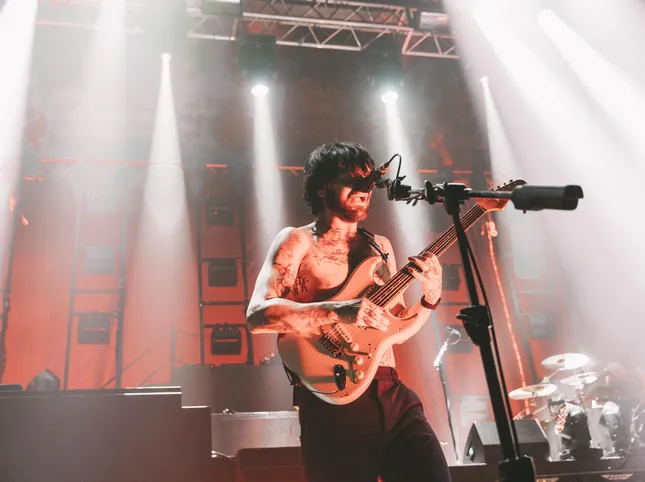
Simon Neil is there to compensate. Not that the Biffy frontman usually holds back, on the contrary: usually already by the second song he’s dripping with sweat and his enviable hair becomes the perfect subject of an expressionist painting, while he hits his worn-out Stratocaster. But on this tour he knows he has to fill a void, to allow his colleague, friend, brother-in-law to think about his health without worries. The trio made up of Simon and the Johnston twins have always shown a great ability to care for each other, to cover each other’s backs and have made this synergy the main strength of such a solid career.
Simon takes the entire band on his shoulders, which in a live setting has for some time now no longer been a power trio, but an increasingly powerful collective of seven elements, thanks also to the now consolidated connection of the two strings. Although vocally he is starting to feel tired due to a very tight tour, Simon’s flame is more alive than ever. And given that his somewhat dirty way of singing – with distorted words, screams and uncontrolled verses – has always been an indispensable part of the show, the inaccuracies are not stains on the performance, but become the golden thread of kintsugi.
Without surprises, the new “Futique” dominates the setlist, perhaps the most lukewarmly received album during the launch of the first singles. It took a few more moments and a trust that Biffy’s rock-solid fanbase never denies, but then the album managed to show itself in all its beauty and solidity upon its official release, complete with yet another number one in the UK charts that had been missing for some releases. “True Believer” remains inexplicably excluded from the tour, perhaps for reasons related to James’ absence. Not bad, because all the other new songs work very well, especially “Two People in Love”, glorious in its final crescendo and supported by an audience that is always participatory.
The rest of the setlist, absolutely generous in its twenty-three songs for an hour and three quarters of concert, unfortunately leaves out the first trilogy entirely. This inevitably displeases many people, especially long-time fans, but it is also a great indicator of the longevity of the project and the quality of Biffy’s discography, which after ten albums and countless additional releases including b-sides and soundtracks makes us lose count of the indispensable pieces. Hit after hit, from “Mountains” to “Many of Horror”, passing through “Machines”, “Space” and “Black Chandelier”, even those who mourn the absence of Justboy or Glitter and Trauma return home with full hearts and tested vocal chords.
Biffy are one of the most versatile live bands: they go from headlining shows in parks of 50 thousand people (in the United Kingdom, of course) to small clubs (especially in the United States, where they still struggle to find the size they deserve) with great ease. They fit well with both dispersed crowds and compact crowds, ranging from ballads with lit torches to outbursts with crowd surfing and mosh pits. They may headline large festivals or play acoustic shows in intimate venues, but the connection with their audience doesn’t change.
Biffy Clyro continue, undeterred, to be an anomaly. The exception that confirms so many rules that it becomes necessary to establish another rule, created especially for them. It doesn’t matter how many times you see them live, in what conditions or with what compromises: it will always be an irreplaceable experience.