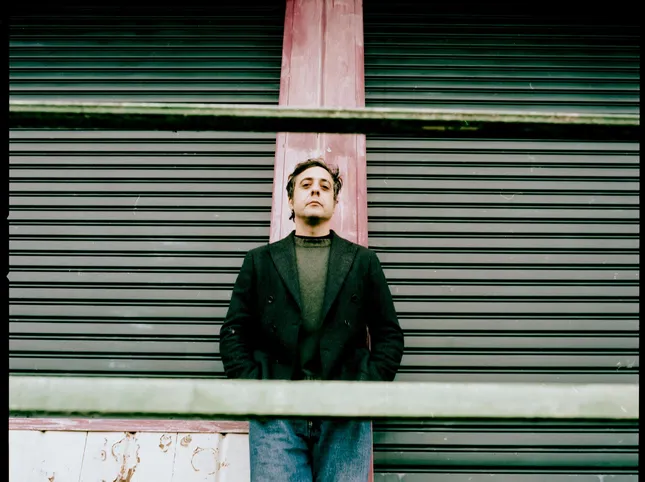
Bianco’s artisanal music
A free, sincere album, rare for these times. A box set of eleven tracks that leads the listener to cross a threshold in which the story is made of frames: moments of life returned with a poetry that moves between nostalgia, lightness and truth. Very personal stories that become universal, touching the truest emotions with simplicity.
“Camaleonte” is the new album by Alberto Bianco released on February 6th for Garrincha 373. A handcrafted record, recorded in an analogue way that returns an authentic and imperfect sound, where the singer-songwriter from Turin talks about change, the need to choose, the struggle to grow up without forgetting who we have been. Like a chameleon, “an animal that sheds its skin but always remains itself.” An album born and recorded in just one week in Torri in Sabina, last summer, together with Roberto “Bob” Angelini (with whom he has also shared the stage on Niccolò Fabi’s tours for years) and Andrea “Fish” Pesce, musicians who will continue this adventure also in the live dimension, on tour since the end of March. A new work for Bianco who, from his debut in 2011 with Nostalgina to today, has carved out his own space in the Italian singer-songwriter panorama thanks to a coherent and distinctive sound poetics.
“Chameleon” is graphically dressed by the illustrations of Cabani Bros, the artwork created within the TheSIGN academy in Florence. Furthermore, Bianco collaborated with the Turin director Mauro Talamonti in the video for the track “Il tempo è un bastardo”, already online. On March 8, the song “Camaleonte” will be the soundtrack to the short film “Non Torna Più”, having its international premiere at the Cinema Massimo in Turin during the Seeyousound Festival.
You chose to give a handcrafted look to your songs: how important was it for you to return to the essence of music?
«I must say that it happened quite randomly, I wasn’t sure I had this need. I discovered it when, together with Bob (Roberto Angelini), we tried to record with a four-track Tascam. It happened one day, by chance. It’s a cassette instrument from the nineties: American singer-songwriters used it to record auditions, and that sound drove me crazy. It made me rediscover the sounds of when I started making music, even when I was a child and played with overdubbing cassettes. It is a sound that recalls some productions by Elliott Smith or John Frusciante. Well, I wanted to go back there, to take refuge in that sound. It excites me, as does the recording method, which is very instinctive and artisanal. It teaches you to accept imperfections and mistakes as part of artistic expression. I wasn’t used to this, I had to make peace with it, but then I found myself at ease precisely in that imperfection. There is a continuous dialogue with this nice instrument: a continuous discovery, but which also requires continuous maintenance.”
Angelini described it as a “magnet versus algorithm” record. Today, how does a free musician like you manage to find a place in a world dominated by numbers?
«It’s a will. Everything that is outside the screens seems very interesting to me, not entering the tank full of fish but staying in my little pond. It calms me, makes me calm. I think people still want to be passionate about things that aren’t in the main. I feel calm and almost a little cool, not out of snobbery but because I’m at peace with myself. I understood that numbers don’t always translate into true passion. I receive very beautiful messages from those who listen to me and this opens my heart more than any meter.”
“Chameleon” is the heart of the album and talks about the fear of choosing and exposing yourself: what does it represent for you today?
«Chameleon is not the song that started the album but it is one of the most important. It recounts those moments in life in which my identity was defined: the period in which I understood that music had a central role in my life and in the perception that others had of me.
It was a moment of wonderful awareness, but also of difficulty in making decisions. That path was then defined, but today I find myself at forty-two years old, about twenty years after that choice, with doubts that ultimately remain the same. This thing makes me smile, because it is an unresolved issue that represents existence itself. Maybe it’s also the reason why we get out of bed every morning: life asks us to solve puzzles and it’s up to us to look for a solution.”
How did these songs come about? When?
«The first to be born were “Un tempo è un bastardo” and “Due parole”, while the others were all born in that week in Torri in Sabina. I was in a hurry to close the spark that had ignited: I wanted everything to be the photography of those days and I didn’t want the recording to be “polluted” by other places or circumstances. I closed the album all there, in that moment. Then I trusted my gut. Usually the lyrics for me are a long process; this time instead I trusted myself to instinct. There are parts of lyrics that are perceived as immature, but I like them that way.”
You say that music seeks you out even when you reject it: today, when is it most difficult for you to respond to this call?
«I’ve never been addicted to anything, but I think I can say that for me music is a bit like an addiction. An addiction that I feel I can afford and indulge in. I have a lot of respect for this being and for this profession. When I feel that the energy I can dedicate to it decreases, it seems like a lack of respect towards everything I have dreamed and imagined, and towards the dedication I have put into it. To preserve it, therefore, I try to hide it under my coat and, whenever there are conditions to take care of it and give it energy, I do it with all the love in the world.”
The album opens with “A casa di Mimì”, why did you choose to leave instrumental tracks on the album?
«I’ve been writing instrumental parts for a long time and at a certain point, I give in and put the words in. This time, however, playing with Bob and Fish, there were instrumental tracks that had a strong meaning, because they already contained a narrative path. I tried, for example, to write a text on “A casa di Mimì” but then we asked ourselves: why underline something that is already written within the music? They are almost filmic instrumentals and inserting lyrics risks disturbing the listener. So instead, the song can be whatever it wants. If I had written a text I would have given too many elements. “The Serpent of the Bushes” was born from the tail of Chameleon, a piece that has almost become one of my favorites on the album.”
In your records, you are surprised by your ability to talk about life’s difficulties with a positive twist, other times by the use of images that take you back to childhood or adolescence. Where does this thing come from?
«The past is always smoothed out a bit: the passing of time rounds the corners compared to the present. In this case, above all, talking about my adolescence in a specific place did me good. It was like looking back at the photos I had in my head, but also like reliving crucial moments in life: the rehearsal room as a kid, the first kiss, the bassist who patted you for his girlfriend. I probably wanted to relive those moments of lightness, and I really felt the need. And then, in general, when you are faced with problems you have to find a way to solve them, even in a concrete way. I often end up fixing things myself: at home, in the rehearsal room. And perhaps, deep down, the songs also tell this thing.”